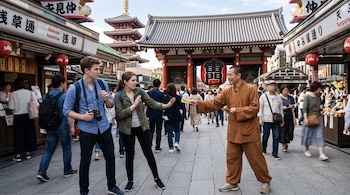
Tokyo’s iconic neighborhoods draw travelers from around the globe seeking Japan’s rich traditional culture and historic streets. However, while strolling through bustling areas like Ueno Park, Asakusa, Akihabara, or Harajuku, you might have spotted suspicious figures draped in ochre or gray monastic robes.
At first glance, they appear to be monks in training or holy practitioners engaging in traditional alms-gathering (takuhatsu). In reality, these individuals are part of organized “Fake Monk” donation scam groups targeting tourists and well-meaning pedestrians.
First emerging around 2010, this street fraud became a major news topic in 2025 following a high-profile police crackdown and arrest drama in Tokyo. Since then, the Tokyo Metropolitan Police Department and local crime-prevention networks have consistently issued warnings about their operations.
In this article, we break down the full scope of this malicious scam—which exploits good intentions and curiosity—and reveal the surprising behind-the-scenes reasons why you can confidently treat every one of these street solicitor monks as a fraud.
The Dangerous Reality of Fake Monk Scams Spreading Across Tokyo’s Top Tourist Spots
With the surge in international tourism, donation scams operated by fake monks have become a persistent issue across Tokyo’s major sightseeing hubs. These scammers frequent specific high-traffic areas where tourists are most vulnerable.
Frequent Sightings and Target Demographics
| Target Area | Primary Target Demographics | Typical Encounter Locations |
| Ueno Park | Overseas tourists, families | Near Ueno Toshogu Shrine, Shinobazu Pond, museum plazas |
| Asakusa | International visitors, domestic travelers | Around Senso-ji Kaminarimon Gate, side alleys off Nakamise Street, Sumida Park |
| Akihabara | International visitors exploring electronics, youth groups | Pedestrian zones near the station, along Chuo-dori |
| Harajuku / Takeshita Street | Young international travelers, trend-seeking tourists | Approaches to Meiji Jingu Shrine, intersections around the station |
The common denominator among these locations is that visitors arrive expecting to experience Japan’s spiritual and historic heritage. Scammers approach when people are relaxed, open-minded, and enjoying their vacation.
Why Authorities Repeatedly Issue Fraud Alerts
This problem is far more than simple street hawking. Authorities take it seriously due to ties with international scam networks. The Tokyo Metropolitan Police Department, municipal governments, and crime prevention email alerts frequently publish notices instructing the public: “Do not accept items or donate money to unfamiliar individuals claiming to be monks.”
In a country known for world-class safety, the presence of street fraud damages Tokyo’s reputation as a welcoming global destination. While police patrols have been stepped up, these scammers quickly melt into side alleys the moment a uniform appears, making on-the-spot apprehensions challenging.
Forced into Your Hands: The Predatory Tactics of Fake Monk Scams
The methods used by fake monks are psychologically calculated and aggressive. Once a pedestrian gets drawn into their pace, the awkward pressure often leads victims to hand over cash just to escape the interaction.
Step 1: Approaching with a Smile and Forcing Gold Cards or Beads into Your Hand
Most fake monks appear to be foreign nationals wearing shaved heads and simplified robes. Rather than starting a conversation, they approach silently or speak broken English/Japanese with a gentle, reassuring smile.
The moment a passerby slows down or walks past, the scammer forcibly presses a “gold talisman card” or a cheap wood-bead bracelet directly into the victim’s palm.
[Approach Pedestrian]
▼
[Force Gold Card or Beads into Their Hand]
▼
[Chant “Peace” or “Peace for You” & Present a Registry Book]
▼
[Aggressively Demand 1,000 to 10,000 Yen in “Donations”]
Step 2: Presenting a Guest Book to Create False Credibility
Immediately after shoving the item into your hand, the scammer opens a ledger or guest book. Inside, you will see a list of signatures alongside high donation amounts like “¥5,000” or “¥10,000,” presumably written by previous victims.
Seeing this leads victims to assume: “Everyone else is donating,” or “This must be a legitimate fund for temple repairs or world peace.” The scammer then explicitly demands cash, usually anywhere from ¥1,000 up to ¥10,000.
Step 3: Sudden Aggression When You Try to Decline
If you try to return the card or beads and say, “I can’t give money,” the scammer will flatly refuse to take the item back. They pulled their hands behind their back, scowl, or raise their voice to intimidate you into paying.
For international visitors facing a language barrier, this sudden shift in demeanor creates fear and panic. To resolve the confrontation quickly, many pull out several thousand yen from their wallet—completing the scam’s extortionate cycle.
How to Spot a Fake: The Surprising Reality of Real Monks in Tokyo
Kind-hearted travelers might hesitate when confronted, wondering, “What if this is a genuine Buddhist monk collecting alms?” To put it plainly: Every single rogue monk soliciting cash on the streets of downtown Tokyo is a fake. This certainty comes down to traditional Japanese Buddhist rules surrounding alms-gathering (takuhatsu) and the economic reality of modern Japanese temples.
Crucial Differences: The Strict Rules of Genuine Alms-Gathering
Real takuhatsu practiced by traditional Japanese sects (such as Zen, Tendai, or Shingon) follows strict, centuries-old etiquette. It looks completely different from street scams:
| Comparison Point | Genuine Alms Monk (Takuhatsu) | Fake Street Monk |
| Distribution of Items | Receives offerings in a bowl. Never sells or gives out cards or beads. | Forcibly shoves gold cards or bead bracelets into your hands. |
| Demeanor & Conduct | Stands completely still or walks slowly while chanting sutras softly. | Walks up to people, presents a registry book, and actively talks/solicits. |
| Money Demands | Never specifies an amount or asks for specific currency notes. | Explicitly demands large amounts (e.g., ¥5,000 or ¥10,000). |
| Attire & Appearance | Wears a traditional woven straw hat (ajirogasa) covering the upper face, formal robes, and tabi socks. | No woven hat (face fully exposed), sneakers, and cheap, unnatural robes. |
A genuine monk engaged in takuhatsu will never walk up to a pedestrian, shove a trinket into their hand, or demand a specific cash donation. Knowing these rules makes it instantly clear when someone is an imposter.
The Financial Reality: Real Downtown Monks Do Not Need Street Cash
There is an even simpler economic reality at play: chief priests and ordained monks at established, historic temples in prime Tokyo locations manage valuable temple grounds and properties. Financially, these institutions are well-established.
In modern Japan, there is virtually no legitimate Buddhist monk who relies on standing on street corners to collect ¥1,000 bills from tourists to survive. When authentic monks perform takuhatsu, it is done 100% as a spiritual training exercise, not as a fundraising drive.
Because it is spiritual training, a real monk would never harass passersby for money. Therefore, anyone dressed as a monk approaching you for cash on the street is simply a scammer exploiting religious imagery.
How to Handle and Deflect Fake Monks on the Street
If you are approached by a fake monk in Ueno, Asakusa, or elsewhere in Tokyo, follow these practical steps to stay safe and resolve the situation immediately:
1. Avoid Eye Contact and Keep Walking
Scammers target people who make eye contact or appear distracted by sightseeing. The moment you sense someone in robes approaching:
- Keep walking at your normal speed without looking at them.
- Do not react or engage, even if they speak to you.
- Avoid stopping in the middle of the sidewalk to check your phone.
Stopping to listen gives them the exact opening they are waiting for.
2. What to Do If an Item Is Forced into Your Hand
If a scammer managed to drop a bracelet or card into your hand before you could react, remain calm and follow this sequence:
[Place the card or beads on a nearby ledge, bench, or the ground]
▼
[Say a firm “NO!” while making a clear stopping gesture]
▼
[Walk away immediately without negotiating or opening your wallet]
▼
[If followed, gesture toward a police box (Koban) or uniformed officer]
▼
[Safe Resolution]
If the scammer refuses to take the item back from your hand, do not hold onto it. Place it down gently on a nearby wall, bench, or even the ground, say a clear “NO,” and walk away. Scammers fear police intervention above all else and will almost never pursue you once you walk away firmly.
Conclusion: Enjoy Tokyo with Confidence and Clarity
The fake monk donation scam target iconic cultural destinations like Ueno Park and Asakusa, taking advantage of travelers’ goodwill and respect for Japanese culture.
However, once you know their tactics and how real monks actually conduct themselves, there is nothing to fear. Remember the golden rule: Every street-soliciting monk in central Tokyo is a scammer. Refuse any items pushed toward you, ignore their demands, and walk away.
Armed with these practical safety tips, you can explore Tokyo’s vibrant streets, historic temples, and beautiful parks safely and with total peace of mind!