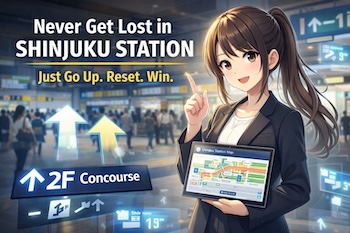
People who get lost in JR Shinjuku Station usually start with the same assumption:
“If I memorize the shortcut, I’ll win. There must be a fastest route.”
That thinking feels logical. It feels efficient.
But Shinjuku Station is built to crush that mindset.
It looks like a maze where the smartest player memorizes the optimal path. In reality, it’s not a route-memory game at all. It’s a vertical strategy game.
As someone who walks Tokyo constantly, I stopped trying to remember specific routes years ago. I simplified everything into one operational rule.
Go up.
Aim for the upper level. There is almost always a “Perfect Floor” — a layer where corridors open up, signage becomes clearer, and direction finally makes structural sense.
Lower levels are compressed, intersecting, and deceptive. The upper layers restore orientation. Once you understand that, you stop fighting the maze and start navigating the building.
That’s it. One rule.
If this idea shifts your perspective even slightly, Shinjuku Station will never feel the same again.
- You Don’t Get Lost Because of Routes — You Get Lost Because of Levels
- Definition: What Is the “Perfect Floor”?
- The Critical Switch: Think in Gates, Not Lines
- All Platforms Directly Connected from the Perfect Floor (2F Concourse)
- Real-World Flow: What to Do the Moment You Get Lost in JR Shinjuku Station
- Why This Method Wins
- Conclusion: Forget Shortcuts. Go Up.
You Don’t Get Lost Because of Routes — You Get Lost Because of Levels
Most people assume JR Shinjuku Station is confusing because there are “too many corridors.”
That’s not the real problem.
The real problem is choosing the wrong vertical layer.
Shinjuku’s chaos isn’t horizontal. It’s vertical. When you descend too early, you enter a compressed underground network where sightlines shrink, signage overlaps, and spatial logic collapses. You try to recover your sense of direction — but you’re already inside the wrong layer. So you move laterally. Then you descend again. And suddenly you’re in a completely different underground branch.
That spiral is the hardest trap to escape.
It feels like you’re making progress.
But you’re just moving sideways inside the wrong dimension.
So reverse the thinking.
When lost, go up.
Higher levels in JR Shinjuku Station are architecturally calmer. Corridors widen. Natural light increases. Signage simplifies. The traffic flow becomes readable. From there, you can reset your orientation and then descend intentionally toward your destination.
Underground layers fragment you.
Upper layers realign you.
If you remember only one rule, remember this:
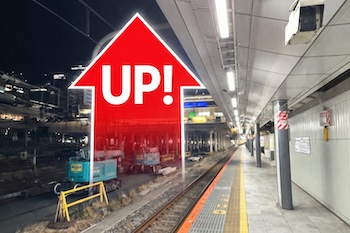
Lost? Go up.
Once you’re up, everything starts making sense again.
Definition: What Is the “Perfect Floor”?
In this article, the Perfect Floor refers to a specific spatial advantage inside JR Shinjuku Station.
It is the upper concourse level — generally around the 2nd floor — that most passengers can reach from inside the ticket gates without difficulty.
When you stand there, something changes.
Instead of endless corridors, you see vertical clarity.
Escalators and stairways leading down to JR platforms are lined up in visible clusters. From this position, navigation becomes simple:
You don’t need to remember routes.
You only need your platform number.
That is the key distinction.
The Perfect Floor is not a shortcut zone.
It is a recovery point.
A place where the chaos of Shinjuku collapses into something manageable because you can process everything through one variable: platform number.
Now compare that with the underground.
Once you descend, the environment shifts into a hybrid space of subway networks and pedestrian tunnels. External reference points weaken. Sightlines shorten. The signage becomes denser and more fragmented.
Instead of correcting direction, you end up searching for “the right underground” while still inside the underground.
That’s the trap.
Above ground levels give you structural information.
Underground layers multiply ambiguity.
The Perfect Floor exists because it restores vertical order.
And once vertical order returns, horizontal navigation becomes trivial.
The toilet is arranged here in an easy-to-understand way!
Important :
If you are aiming for a toilet, aim for the corner of the “perfect floor”!!
By the way,there are also convenience stores and Japanese pop-up stores and JR windows (station staff resident), so it is safe and perfect.
The Critical Switch: Think in Gates, Not Lines
Let’s correct something clearly and completely.
The Perfect Floor exists inside JR ticket gates.
That means it directly connects only to JR platforms.
Not Odakyu.
Not Keio.
Not Tokyo Metro.
If you are heading to any of those, you must — at some point — exit the JR gate and move into the outside-gate world.
This is the structural truth most people miss.
Travelers usually think in line names:
“I need Odakyu.”
“I need the subway.”
“I need the Keio Line.”
But JR Shinjuku Station does not punish you for choosing the wrong line name first.
It punishes you for choosing the wrong gate layer.
That is the real mistake.
Inside JR gates = JR world.
Outside JR gates = transfer world.
Once you shift to this model, confusion drops dramatically.
Instead of memorizing dozens of exits, you ask a simpler question:
Am I inside JR gates, or outside?
If you are inside and your destination is not JR, stop navigating laterally.
Find the nearest JR exit. Leave the gate. Reset.
That single mental switch eliminates most wandering loops inside the station.
Shinjuku is not a route maze.
It is a gate-layer system.
Understand the layer you are in, and the rest becomes mechanical.
All Platforms Directly Connected from the Perfect Floor (2F Concourse)
From the Perfect Floor, you descend directly to the JR Shinjuku Station platform group.
According to JR East’s official platform layout, the connections are structured as follows:
Platforms 1–4
Saikyo Line / Shonan-Shinjuku Line
Services toward the Tokaido Line, Yokosuka Line, Utsunomiya Line (Tohoku Line), and Takasaki Line.
Platforms 5–6
Narita Express
Limited Express services through to Tobu Railway lines.
Platforms 7–8
Chuo Line (Rapid) / Chuo Main Line
Tokyo-bound direction.
Platforms 9–10
Chuo Limited Express services.
Platforms 11–12
Chuo Line (Rapid) / Chuo Main Line
Takao-bound direction.
Platform 13
Chuo-Sobu Line (Local)
Ochanomizu and Chiba direction.
Platform 14
Yamanote Line (Inner Loop)
Shibuya / Shinagawa direction.
Platform 15
Yamanote Line (Outer Loop)
Ikebukuro / Ueno direction.
Platform 16
Chuo-Sobu Line (Local)
Mitaka direction.
This list is the only answer most visitors actually need.
Once you return to the Perfect Floor, your decision becomes extremely simple.
You now have only two choices:
- Look up your destination and match it to a platform number.
- Walk straight to the stairs or escalator marked with that number.
No route memorization.
No underground wandering.
No mental map reconstruction.
Real-World Flow: What to Do the Moment You Get Lost in JR Shinjuku Station
Forget pride. Forget shortcuts.
The second you feel disoriented, switch to system mode.
If You Are Taking JR
- Go up. Always go up. Return to the Perfect Floor (2F concourse).
- Confirm your destination by platform number, not by route name.
- Walk to the staircase or escalator marked with that number.
- Go down. Board.
That’s it.
No maze solving.
No remembering which corridor curves left.
No “I think it was this way.”
Platform number → descend → done.
If You Are Heading to Odakyu, Keio, or the Subway
- Go up. Return to the Perfect Floor.
- Recognize that you are still inside JR ticket gates.
- Exit the JR gate first.
- Only after exiting, follow the signs for Odakyu, Keio, or Tokyo Metro.
This is where most people fail.
They try to reach Odakyu while still inside JR space.
They look for subway arrows in the JR layer.
They wander underground trying to fix an upstairs mistake.
The rule is simple:
Inside JR gates = JR only.
Outside JR gates = transfer world.
Switch layers first. Navigate second.
If you remember nothing else from this article, remember this:
Lost? Go up.
Need non-JR? Exit first.
JR Shinjuku Station is not beaten by memory.
It is stabilized by structure.
And once you accept that, the station stops fighting you.

Why This Method Wins
JR Shinjuku Station defeats people who try to memorize shortcuts.
It looks like a route puzzle.
It feels like there must be a “fastest path.”
But the station is not a path problem.
It’s a layer problem.
If you try to optimize narrow corridors, you lose.
If you reset by hierarchy, you win.
Why?
Because corridors change your orientation.
Floors restore it.
When you move laterally underground, you accumulate uncertainty.
When you move vertically upward, you regain structure.
The 2F concourse works because it centralizes information.
From there, JR platforms are organized by number, not by maze logic.
You are no longer guessing directions. You are executing a number.
Upstairs = clarity.
Platform number = certainty.
That combination removes randomness.
And remember this final rule to make the system complete:
The Perfect Floor is JR territory only.
If your destination is not JR, exit the JR gates first. Then navigate.
This single distinction prevents 80% of transfer mistakes.
Shinjuku Station is not conquered by speed.
It is stabilized by reset.
Go up.
Recenter.
Execute by number.

Conclusion: Forget Shortcuts. Go Up.
The secret to not getting lost in JR Shinjuku Station is not how much you know.
It is not about memorizing corridors.
It is about committing to a single reset rule.
Stop thinking in routes.
Start thinking in recovery.
Go up.
Then ask one question: Am I inside the JR gates or outside?
Do not exit randomly.
Level 1 is ground-level platforms.
Level 2 is the Perfect Floor.
Once you reach the 2F level, everything simplifies.
Stairs and escalators line up toward platform numbers.
Route names become readable.
Your brain stops guessing and starts confirming.
Even if you get trapped underground, you are never truly stuck.
Vertical movement resets the maze.
Shinjuku Station is beatable.
If you want to win intelligently, build the habit of going up.
That habit is stronger than any shortcut you could ever memorize.
Written by Kumao
Tokyo-based field writer
JR Shinjuku Station – Gate Information & Staff Availability
If you are navigating JR Shinjuku Station, knowing which gates have staff — and when — can reduce anxiety immediately.
Here is a structured overview based on official JR information.
Gates with Staff from First Train to Last Train
These gates have ticket counters open from the first train of the day until the last train, with station staff present:
- South Gate
- West Gate
- Central East Gate
- East Gate
These are your safest fallback points if you need in-person assistance at almost any hour.
Gates with Limited Ticket Counter Hours (Staff Present)
These gates have staffed counters, but opening hours are slightly restricted:
- Central West Gate
Ticket counter: 6:00 AM – Last train - Southeast Gate
Ticket counter: 7:00 AM – 12:00 AM - Shin-Minami Gate
Ticket counter: 5:45 AM – 12:00 AM - Koshu Kaido Gate
Ticket counter: 5:45 AM – 12:00 AM
Staff are physically present during operating hours.

Gates Without On-Site Staff (Remote Support Available)
These gates do not have station staff physically stationed there, but support systems are available:
- Miraina Tower Gate
No on-site staff
Customer Support Call System available
An operator responds at all hours - Odakyu Transfer Gate
No on-site staff
Intercom available
Operator response times:- First train – 7:30 AM
- 10:30 AM – 4:00 PM
- 7:00 PM – Last train

Reference
I quoted and referred to the information from this article.
We deeply consider and experience Japanese otaku culture!
Information sourced from the official JR East website (JR Shinjuku Station)