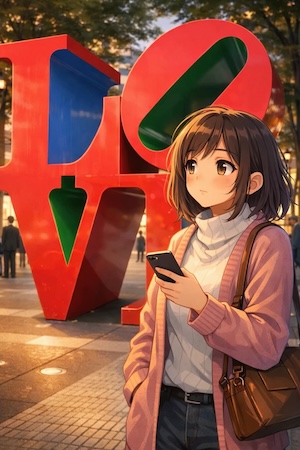
In the heart of Nishi-Shinjuku’s office towers stands a bright red symbol that feels oddly emotional for a business district: the LOVE sculpture.
For some, it’s a popular meeting spot.
For others, it’s a place where relationships begin—or mysteriously end.
Over decades, the sculpture has accumulated contradictory stories: romance, heartbreak, obsession, and even whispered curses.
But behind the myths lies a very deliberate urban design decision.
- The “LOVE” Sculpture: What It Really Is
- The Intended Function (Urban Design, Not Romance)
- The “Good Love” Stories (Positive Urban Legends)
- The “Cursed Love” Stories (Dark Urban Legends)
- Why the “Curse” Narrative Emerged
- The Brutal Irony of “LOVE” in Nishi-Shinjuku
- The “Expose”: There Was No Romance Agenda
- Visiting the LOVE Sculpture Today
- Final Note for Overseas Readers
The “LOVE” Sculpture: What It Really Is
The sculpture is a Japanese-cast version of Robert Indiana’s famous LOVE design, originally created in the 1960s and later reproduced worldwide.
Why it was installed in Nishi-Shinjuku
- The area was undergoing large-scale redevelopment into a modern business district.
- Developers wanted a human, emotional landmark to soften the image of steel, glass, and corporate power.
- “LOVE” was chosen specifically because it was:
- Instantly readable in English
- Politically neutral
- Emotionally universal
In short, it was not romantic art for lovers, but a branding device for a new kind of Tokyo.
The Intended Function (Urban Design, Not Romance)
From an urban-planning perspective, the sculpture served three clear purposes:
- A visual anchor in a space dominated by tall buildings
- A meeting point in a district lacking street-level identity
- A psychological counterweight to corporate stress and anonymity
The irony is that none of this involved romance at all.
And yet—romance is exactly what people projected onto it.
The “Good Love” Stories (Positive Urban Legends)
Over time, Nishi-Shinjuku’s LOVE sculpture became associated with favorable relationship stories.
Commonly told anecdotes include:
- Couples who met accidentally under the sculpture and later married
- Office workers confessing feelings there because it felt “neutral” and safe
- Foreign visitors choosing it because it felt globally understandable
In these stories, LOVE functions as a permission structure—a place where emotions feel allowed in an otherwise rigid environment.
The “Cursed Love” Stories (Dark Urban Legends)
Alongside the positive myths, darker stories circulate.
Recurring negative themes:
- Couples who broke up shortly after meeting there
- One-sided confessions ending friendships
- Office affairs exposed after rendezvous near the sculpture
In urban folklore, this gave rise to the idea that the sculpture amplifies emotions—not harmony.
Why the “Curse” Narrative Emerged
The darker legends are not supernatural—they’re structural.
Key factors:
- The location is surrounded by corporate offices, not leisure spaces
- Many encounters happen during stressful life phases (job changes, transfers, overtime culture)
- The sculpture is used by people already experiencing emotional pressure
In other words, LOVE didn’t cause the heartbreak.
It simply became the place where it happened.
The Brutal Irony of “LOVE” in Nishi-Shinjuku
Nishi-Shinjuku is a district defined by:
- Productivity
- Hierarchy
- Performance
Placing a giant word like “LOVE” here creates tension.
That tension is exactly why the sculpture works—and why it attracts myths.
It represents something desired but constrained.

The “Expose”: There Was No Romance Agenda
Despite decades of rumors:
- There is no record of spiritual intent
- No romantic ritual was planned
- No curse or blessing was designed into the work
The sculpture was a branding artifact, later overwritten by human stories.
Urban legends grew because people needed meaning—not because meaning was planted.

Visiting the LOVE Sculpture Today
If you visit:
- Treat it as cultural infrastructure, not a shrine
- Understand that stories come from people, not objects
- See it as a mirror of Tokyo’s emotional contradictions
LOVE stands there silently, absorbing everything projected onto it.

Final Note for Overseas Readers
This article explores:
- Real urban planning decisions
- Verified art history
- Living urban folklore
The legends are not facts—but they reveal how modern cities generate myths without intending to.
Tokyo doesn’t just build structures.
It builds stages for emotion.
By the way, in Japan, most of them no longer appear in the media and dramas (lol)

All Write: Kumao