Roblox is no longer just a game.
For children, it is a daily destination.
For parents, it has quietly become something much larger: a massive digital society where play, communication, and even economic activity coexist.
With more than 100 million daily active users worldwide, Roblox functions less like a single game and more like a network of interconnected virtual spaces. And just like any real society, it contains both positive interactions and real risks.
The question parents face in 2026 is no longer whether Roblox is “good” or “bad.”
The real question is what the platform can realistically protect against, and where parental involvement becomes essential.
This article does not aim to spread fear.
It exists to clarify how Roblox’s latest safety systems actually work, where their limits are, and how parents can draw a practical boundary between platform responsibility andManagement at home.
- How Roblox Uses AI and Facial Recognition for Age Zoning
- Chat Monitoring and Automatic Blocking in Practice
- Platform Test: Console Login Is Not a Shortcut
- The Real Weak Point: External Platforms
- How to Think About Parental Controls by Age
- Financial Risks: The Invisible Cost Problem
- The author’s point of view
How Roblox Uses AI and Facial Recognition for Age Zoning
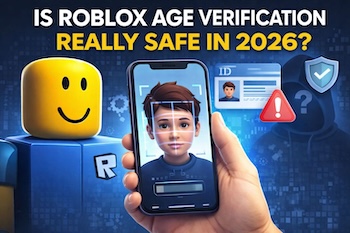
As of early 2026, Roblox has officially implemented AI-based facial age estimation as part of its age verification system.
When a user attempts to access age-restricted features, they are prompted to complete an age check using a smartphone camera. The system analyzes a short facial image or video to estimate the user’s age range.
According to Roblox’s official policy, the image data is deleted immediately after analysis and is not stored. The system does not keep facial data as a persistent biometric record.
Once age verification is completed, accounts are categorized into broad age groups such as:
- Under 13
- Ages 13–16
- 17 and older
These categories automatically control:
- Which experiences are accessible
- Whether text or voice chat is enabled
- What type of content can be displayed
The result is a form of intentional zoning. Roblox actively designs its ecosystem so that younger users and adults are far less likely to interact deeply in the same spaces.
This is one of the platform’s strongest safety measures, and it represents a clear shift from earlier years when age separation relied almost entirely on self-reporting.
Chat Monitoring and Automatic Blocking in Practice
Facial recognition is only one layer.
Roblox also operates an evolving AI-based chat moderation system. Messages are scanned in real time, and certain categories of content are blocked before they are sent.
This includes:
- Phone numbers and email addresses
- Direct invitations to move conversations off-platform
- Explicit sexual language or grooming-related phrasing
- Slang patterns associated with external contact requests
From a systems perspective, Roblox is attempting to make it structurally difficult for adults and children to establish private, unmonitored communication.
For parents, this means the platform itself does provide meaningful friction against the most obvious forms of predatory behavior.
Platform Test: Console Login Is Not a Shortcut
One common concern among parents is whether children can bypass age checks by using a console.
In practice, this turns out to be a non-issue.
When logging in on PlayStation, Roblox forces mobile verification for age-restricted features. Even on PS5, the system routes users back to smartphone-based facial recognition.
The barrier is high enough that casual bypass attempts fail. From a safety standpoint, this is a deliberate design choice, and one that significantly reduces accidental exposure.
The Real Weak Point: External Platforms
Where Roblox’s protection weakens is not inside the game.
It is outside.
The most significant risk remains Guidance to external services such as Discord or X. These platforms exist entirely beyond Roblox’s moderation systems.
Common tactics include:
- Offering rare items or pets
- Suggesting “it’s easier to talk somewhere else”
- Framing off-platform chat as teamwork or friendship
Once a child leaves Roblox’s ecosystem, all AI filtering disappears instantly. This is the point at which grooming, fraud, or manipulation risks rise sharply.
No amount of facial recognition can prevent this.
This is why one of the most effective household rules is also the simplest:
game conversations stay inside the game.
Compared to complex settings menus, this rule functions as an extremely strong protective barrier.

How to Think About Parental Controls by Age
Roblox’s parental controls are detailed, but effectiveness depends on how they are applied.
The goal is not maximum restriction at all ages.
The goal is graduated access that matches a child’s understanding.
Below is a practical way to think about permissions rather than a rigid rulebook.
Younger Children (Under 9)
At this stage, Roblox should function more like a shared activity.
Text chat is best disabled entirely.
Purchases should be blocked or limited to prepaid cards only.
Parents should play alongside children whenever possible.
Upper Elementary (Ages 9–12)
This is where limited social interaction becomes reasonable.
Chat can be restricted to friends only.
Public servers should be approached carefully.
Account activity should be reviewed regularly, not constantly.
Teens (13 and Up)
Age 13 is a real structural threshold inside Roblox.
At this point:
- Voice chat becomes available
- Higher age-rated experiences unlock
- Identity verification becomes more relevant
This is where trust replaces control, but only gradually. Settings should still exist, but intervention becomes situational rather than constant.

Financial Risks: The Invisible Cost Problem
Monetary issues remain one of the most common real-world problems.
Leaving a credit card attached to an account invites accidental overspending, especially with auto-renewing subscriptions. Roblox does not reimburse peer-to-peer trade scams, and item trading carries real loss risk.
Using prepaid gift cards within a fixed allowance is not only safer but also teaches basic spending awareness.
From both a safety and Education perspective, this remains the most balanced option.
The author’s point of view
When you look at Roblox’s systems objectively, one thing becomes clear.
The platform itself is not reckless. In fact, it has invested heavily in structural safety, especially compared to earlier years. Facial recognition, age zoning, and AI moderation are real, functional measures.
But no system can replace judgment.
The most important transition happens around age 13, when children move from a sandboxed environment into something closer to an adult digital society.
At that point, safety is no longer about locks.
It becomes about timing, trust, and communication.
Roblox can close many doors.
Parents still decide when to hand over the keys.
All Write: Kumao