- The Glaring Reception Gap Across the Pacific
- The Power Trip Paradox: Why the West Fell in Love With Cold Domination
- High-End Junk Food: The Audiovisual Wizardry of A-1 Pictures and Hiroyuki Sawano
- The Manhwa Infiltration: A Digital Army Built Before Episode One
- Two Cultures, One Medium: What This Divergence Teaches Us
- The Next Stage: The Movie “Beyond the System” Announced
- The author’s Perspective
The Glaring Reception Gap Across the Pacific
When the animated adaptation of Solo Leveling premiered worldwide, the reaction inside Japan and the explosive reception across the Western internet felt like two completely different dimensions. On Western social media, TikTok algorithms flooded user feeds with edits of Sung Jinwoo glowing eyes, MyAnimeList episode discussion threads broke engagement records, and reaction channels on YouTube reached fever pitch excitement. It was hailed as the definitive modern action epic, an adrenaline surge that redefined the seasonal anime landscape.
Inside Japan, however, the temperature was markedly cooler. Domestic anime fans on major community boards greeted the series with a collective shrug. To many veteran Japanese viewers, the narrative beats felt all too familiar, almost like a standardized Webtoon template or an unseasoned variation of the Narou web novel formulas that have saturated late-night broadcasts for more than a decade. The domestic commentary was peppered with polite indifference. Many asked why overseas fans were treating standard progression fantasy tropes as though a brand new wheel had just been invented.
This massive cultural disparity is neither an accident nor a simple matter of taste. It highlights a profound psychological shift in what different audiences demand from their escapism. While Japanese audiences have grown weary of effortless power fantasies and increasingly demand subversion, grounded emotional resonance, or intricate industry realism as seen in works like 【OSHI NO KO】, Western fans were actively starving for something unapologetically visceral. Solo Leveling did not succeed in North America despite being an overpowered power trip; it succeeded precisely because it was an unapologetic, exquisitely packaged masterclass in power fantasy delivery.
The Power Trip Paradox: Why the West Fell in Love With Cold Domination
To understand why North American viewers embraced Sung Jinwoo with such ferocity, one must examine the specific emotional release that Western audiences seek in contemporary pop culture. For years, mainstream Western heroic media has leaned heavily into psychological deconstruction. Western comic book movies, prestige television, and coming-of-age fiction have spent the last decade agonizing over moral ambiguity, internal guilt, systemic flaws, and the reluctant hero who hates their own strength.
In sharp contrast, Solo Leveling presents an unadulterated underdog triumph. Sung Jinwoo begins as the weakest hunter of all mankind, an E-rank nobody humiliated by society, broken physically, and forced into fatal dungeon traps just to pay his mother medical bills. This classic underdog premise taps straight into universal human empathy. When he awakens with the unique ability to level up through a harsh digital interface, the story makes a deliberate narrative choice that Western audiences found deeply refreshing. He does not hesitate. He does not stop to preach about the sanctity of life, nor does he agonize in tearful internal monologues about the burden of his newfound dominance.
Instead, he hardens his resolve, steps into the darkness, and systematically dismantles every arrogant oppressor, every predatory guild executive, and every terrifying monster that once looked down on him. For a generation of Western viewers fatigued by endless moral agonizing and indecisive protagonists, Jinwoo progression felt like pure narrative adrenaline. The sheer dopamine hit of watching someone transform from a beaten-down loser into a cold, stylish force of nature struck a critical nerve in North American youth culture.
Japanese audiences, on the other hand, have already lived through decades of identical progression loops. The domestic market has been drowning in isekai and cheat-skill light novels where an alienated high schooler or overworked salaryman wakes up with godlike stats. Because the Japanese domestic market has experienced severe genre fatigue with this exact premise, Japanese viewers instinctively look for clever narrative subversions, eccentric character flaws, or comedic deconstructions. Solo Leveling offered no such subversion. It played the progression fantasy completely straight, and while that made it appear pedestrian to seasoned Tokyo otaku, it made the show feel groundbreaking, clean, and devastatingly cool to millions of overseas viewers.
High-End Junk Food: The Audiovisual Wizardry of A-1 Pictures and Hiroyuki Sawano
If the core story of Solo Leveling is essentially standard fast food, A-1 Pictures treated that material as if they were three-star chefs preparing a culinary feast. The visual and acoustic execution of the series is where the gap between simple narrative tropes and global phenomenon was forged.
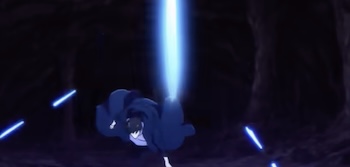
Western gamers and action enthusiasts have grown up on cinematic epics like God of War, Elden Ring, and high-budget superhero blockbusters. They expect visceral impact, earth-shaking bass, and dynamic visual choreography. A-1 Pictures delivered on this expectation with surgical precision. The combat sequences do not rely on static speed lines or repetitive still frames. The camera dives through chaotic dungeon halls, shadows fluidly wrap around Jinwoo daggers, and the impact frames convey genuine physical weight. The animation team understood that in a pure power fantasy, the action must never look effortless to the point of boredom; it must look violent, decisive, and rhythmically satisfying.
Elevating every visual frame is the legendary composer Hiroyuki Sawano. Western anime fandom has possessed an almost sacred reverence for Sawano soundscapes since the heyday of Attack on Titan and Kill la Kill. His signature dramatic drops, blending thundering orchestral percussion with soaring vocal chants and electronic distortions, trigger an immediate physiological response. When Jinwoo turns the tide in a pitch-black chamber and the Sawano Drop hits the soundtrack, the scene transcends standard television animation and mirrors the emotional crescendo of a multimillion-dollar Hollywood climax.
In Japanese domestic analysis, critics often observe that extraordinary production values cannot entirely disguise a paper-thin plot. But in the global streaming economy, spectacle is not merely decoration; spectacle is the product. Western viewers did not watch Solo Leveling looking for nuanced philosophical dialogue; they watched it to experience thirty minutes of sensory exhilaration after a grinding workweek. By pairing an unapologetic power fantasy with world-class animation and Hollywood-grade sound design, the production team created an audiovisual steamroller that crushed any intellectual skepticism under the weight of pure style.
The Manhwa Infiltration: A Digital Army Built Before Episode One
The triumph of Solo Leveling was not built overnight in a broadcast studio; it was the coronation of a multi-year underground movement. Long before mainstream anime licensing companies took notice, the original South Korean webtoon by Chugong and the late illustrator DUBU (REDICE Studio) had already become an undisputed juggernaut across the global internet.
For nearly half a decade, Solo Leveling served as the gateway drug to South Korean manhwa for millions of Western readers. Through a labyrinth of fan scanlation groups, digital webtoon platforms, and international social media communities, the vertical-scroll panels of DUBU breathtaking artwork were consumed hundreds of millions of times. Western fans were captivated by the full-color, vertically paced format, which was perfectly engineered for smartphone screens and midnight binge-reading sessions.
By the time the anime adaptation was officially announced, there was already a massive, deeply invested fanbase spanning North America, Europe, Latin America, and Southeast Asia. These fans did not need a marketing campaign to explain the premise. They were already emotionally primed, eagerly awaiting the day their favorite webcomic would receive the high-budget Japanese animation treatment it deserved.
When episode one finally aired, this pre-existing audience unleashed an unprecedented social media wave. The modern streaming ecosystem thrives on reaction culture and short-form algorithms. Solo Leveling was tailor-made for this environment. A five-second clip of Jinwoo summoning shadow soldiers or flashing a predatory smirk was instantly converted into millions of TikTok edits and YouTube Shorts, setting off a self-sustaining viral cycle. Japanese late-night anime typically builds momentum through domestic television ratings, merchandise pop-ups, and specialized domestic events, but Solo Leveling bypassed that traditional pipeline entirely, operating on the borderless velocity of modern digital fandom.
Two Cultures, One Medium: What This Divergence Teaches Us
The divergent paths of Solo Leveling in Japan and North America reveal an essential truth about the contemporary global anime market. We are no longer living in an era where Japanese domestic tastes dictate the global canon.
As explored in comparative studies of foreign fan behavior, such as MyAnimeList Top 50 Anime: A 2026 perspective from a Japanese geek, international platforms prioritize immediate thematic clarity, visceral action, and charismatic, unapologetic leads. Japanese domestic fandom, enriched by decades of niche subcultural evolution, often favors nuanced worldbuilding, intricate character psychology, and community-driven meta-commentary.

Neither perspective is superior to the other. To the Japanese viewer, Solo Leveling may always resemble a classic junk food burger served on a silver platter with an oversized soda. But to the American fan starved of pure, unpretentious heroic dominance, that burger was the most satisfying meal of the decade. As Korean webtoons continue to cross borders and merge with premier Japanese animation studios, this cultural friction will not fade. Instead, it will define the next generation of global entertainment, proving that sometimes, the simplest stories, when delivered with sheer technical perfection, can conquer the world.
The Next Stage: The Movie “Beyond the System” Announced
While debates over its narrative continue, the franchise shows zero signs of slowing down. A-1 Pictures has officially announced the upcoming theatrical sequel, Solo Leveling -Beyond the System-. For a full breakdown of the teaser trailer, the mysterious Cartenon Temple Key, and what this cinematic expansion means for global audiences, check out our in-depth report here:

The author’s Perspective
But wait, we aren’t finished! Akihabara.site will continue to dissect this cultural divide, exploring the upcoming webtoon adaptations hitting Tokyo studios, a deep dive into Hiroyuki Sawano’s most iconic battle soundtracks, and the real-world spots in Seoul and Tokyo featured in Jinwoo’s universe. We are also preparing a complete Otaku Guide to Power Fantasy Anime that every Western fan needs to bookmark. Stay tuned, drop your favorite dungeon raid scene in the comments, and catch you next time—👍️
by: Kumao
Citation and reference
↓Click here for anime-related articles↓
・Detective Conan OVA Complete List (2026): All Episodes Explained, Timeline & Canon Status
・Detective Conan Movies: What TV Episodes to Watch Before Each Film
・MyAnimeList Top 50 Anime: A 2026 , I tried to consider it from the perspective of a Japanese geek
・Every Anime Set in Akihabara: The Complete Guide to Japan’s Otaku District in Anime
・The Haruhi Suzumiya TV Anime 20th Anniversary Project ExplainedHaruhi’s SOS Brigade
・Joins Sanrio Virtual Festival 2026: What’s Official, What’s Likely, and How to Watch
・Akiba Maid War Review With No Spoilers|Japanese anime
・Pokémon Lovers, Don’t Miss This! The Ultimate Guide to Japan’s Local Pokémon Across 47 Prefectures
・The 7 Biggest Mysteries About Satoru Gojo That Have Jujutsu Kaisen Fans Buzzing
・Jujutsu Kaisen Hidden References Explained Episodes 1–9, With a Japanese Fan Lens
・Jujutsu Kaisen Hidden References Explained Episodes 10–19, With a Japanese Fan Lens
・Sushiro x JoJo Collaboration Starts in Japan(akihahabara,sendai,koube,OSAKA,TOKYO)
・Demon Slayer Finale Begins! Infinity Castle Arc Hits Japan Amid TV Hype—When Will America and Europe See It?
・【OSHI NO KO】『My Star』: A Structural Critique of the Idol Industry & Showbiz Realism
・Solo Leveling The Movie Beyond the System Officially Announced|Teaser Breakdown, Cartenon Temple Key, and Why the Big Screen Changes Everything