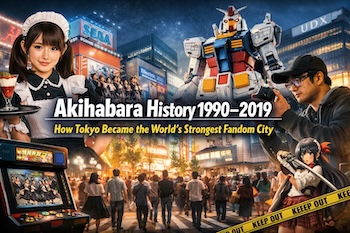
- Akihabara Year-by-Year History (1990–2019) Thirty Years of Electric Town Becoming an Otaku Holy Land
- 1990s The Golden Era of Chaos and Awakening A Subculture Experiment City That Broke Through the Skin of Electric Town
- 1990 Two Souls Coexisting Hobbyists and Home Electronics in the Same Street
- 1991 Toward a Crossroads of PCs and Hobby Culture
- 1992 From Appliance Town to PC Town A Shift in Akihabara’s DNA
- 1993 The Night Before Anime and Game Otaku Fully Arrive
- 1994 PC Shop Warlords Doujin Stores Rise
- 1995 Windows 95 and National Visibility Akihabara Becomes “News”
- 1996 The Golden Age of Anime Shops and PC Parts
- 1997 The Peak of Bishoujo Games The Eve of Maid Cafés
- 1998 Otaku Culture Explodes Akihabara Becomes a Holy Land
- 1999 “Akihabara = Otaku” Becomes the Default Connecting to the Next Era
- 2000s Matured Futurism, and the Pain That Came With It The IT Bubble, Maid Cafés, and a Turning Point
- 2000 IT Bubble Aftermath The First Steps Toward Normalization
- 2001 Development Around the Station The Birth of Permanent Maid Cafes
- 2002 Established as an Otaku Holy Land Doujin and Storefront Culture Thickens
- 2003 Akiba Media Grows Maid Cafes Become a Boom
- 2004 Densha Otoko and Figure Culture Akihabara as a Story
- 2005 Tsukuba Express Opens Yodobashi Changes the City
- 2006 UDX Opens Haruhi Heats Up the City
- 2007 Maid Culture Peaks and Expands AKB’s Presence Grows
- 2008 The Akihabara Stabbing Incident The Day the Air Changed
- 2009 Clubs and Events Toward the Prototype of an “Oshi Activities” City
- 2010s Tourism and Redevelopment Akihabara as a Place to Experience
- 2010 Turning Point Steering Toward a City of Tourism and Commerce
- 2011 Disaster and Recovery The Pedestrian Zone Becomes a Symbol
- 2012 Online Culture Swallows the Real World The Era Mood of Nico Nico Chokaigi
- 2013 The End of Symbols and the Second Maid Wave From a Buying City to an Experience City
- 2014 Radio Kaikan Returns Love Live Repaints the City
- 2015 Shopping Sprees and Mobile Games A Higher Level of Completion as a Tourist City
- 2016 A Year of Reshuffling Game Centers and the Face of an Event City
- 2017 The VTuber Boom Arrives Oshi Activities Become the Purpose of the City
- 2018 Esports and Experience-Driven Spending Akihabara’s Many Sides Expand
- 2019 Reiwa and Redevelopment Toward a Comprehensive Entertainment Town Where Real and Virtual Cross
- Author’s Perspective
Akihabara Year-by-Year History (1990–2019) Thirty Years of Electric Town Becoming an Otaku Holy Land
In the 1990s, Akihabara was still a true “Electric Town,” thick with the smell of appliances and electronic components. But in the backstreets, new heat quietly multiplied—custom-built PCs, doujin, bishoujo games, anime shops, trading cards, cosplay—and little by little, it rewrote the city’s outline. The 2000s accelerated that fusion of IT and subculture: maid cafés and events became a tourism core, and after the tragic 2008 incident, the atmosphere of the district changed. In the 2010s, tourism and redevelopment surged forward, and “Akihabara, the experience-based city” took shape into the globally recognized Akihabara people know today.
1990s The Golden Era of Chaos and Awakening A Subculture Experiment City That Broke Through the Skin of Electric Town
In the early 1990s, Radio Kaikan, Radio Depart, parts dealers, and component shops were still the main characters. But from the middle to late years of the decade, anime, games, doujin, bishoujo games, hobbies, and cards pushed into the center of the district—and the boundary between “electronics nerds” and “otaku” blurred more and more. This ten-year stretch is the prologue to the world-famous otaku city: Akihabara.
1990 Two Souls Coexisting Hobbyists and Home Electronics in the Same Street
Radio Kaikan still carried a strong, Showa-era Electric Town vibe. Amateur radio, electronic parts, and retro appliances formed the core of what people came here to buy. At the same time, the district was beginning to “event-ify,” and big-box PC retail—destined to become a seismic source for Japan’s computer culture—started moving into position.
1990-02-01 Radio Kaikan was still centered on retro appliances, amateur radio, and electronic parts. In your source, subculture presence is described as still minimal at this point.
1990-05 The Electric Town Promotion Association began “Akihabara Day” events as a local revitalization effort.
1990-11-03 Laox “The Computer-kan” opened, later remembered as a key shockwave point for the coming PC boom.
1991 Toward a Crossroads of PCs and Hobby Culture
Tsukumo, Sofmap, Satomusen, and Laox grew in presence, and DIY PC builders began arriving from all over Japan. Weekend crowds spilled beyond Chuo-dori into the backstreets, and Akihabara sharpened its identity as a district for engineers and hardcore enthusiasts. At the same time, early seeds of what would later connect to the doujin game scene started to appear.
1991-03-10 Sofmap Akihabara Store No.1 opened, described as a pioneer for used PC trading.
1991-04 Messe Sanoh (Messe San-O) was founded, later becoming a major symbol in bishoujo game and doujin game culture.
1991-07-21 Radio Depart’s floors for models, railways, and electronic parts are described as becoming more visibly “otaku-leaning.”
1992 From Appliance Town to PC Town A Shift in Akihabara’s DNA
The center of gravity moved from home electronics to PCs, and the heat around custom parts became visibly stronger. Early signs of big retailers expanding into the area began to show, hinting that Akihabara was about to scale up into a nationwide shopping destination.
1992-03 Tsukumo PC Main Store expanded and renewed, cited as a major driver for the DIY parts boom.
1992-04-12 Bic Camera entered Akihabara, a sign that large-scale retail competition was accelerating.
1992-07 Laox “The Computer-kan” hosted what your draft describes as its first PC museum-style event.
1992-12 Akihabara Depart’s railway model section was renewed.
1993 The Night Before Anime and Game Otaku Fully Arrive
With consoles and arcades booming, game shops and game centers multiplied. The sight of people crowding around fighting-game cabinets became everyday scenery. Major PC parts dealers also grew larger, and Akihabara’s density—both in stores and in people—kept climbing.
1993-02-06 A “Gamest editorial office event” is listed in your draft as a trigger point for fighting-game culture in Akihabara arcades.
1993-05 T-ZONE expanded and renewed, marking the arrival of a major PC-parts big-store era.
1993-08 DOS/V Paradise was founded, described as the start of a legendary DIY PC lane for otaku builders.
1993-11-21 At an Electric Town festival, anime goods are noted in your draft as appearing as official prizes for the first time.
1994 PC Shop Warlords Doujin Stores Rise
Specialty shops for bishoujo games and doujinshi increased, deepening Akihabara’s role as a hub for 2D culture. Model kits, Mini 4WD, board games, and TRPGs broadened the layers of “hobby spending,” and the district settled into a dual structure: Electric Town on the surface, Hobby Town underneath.
1994-02-13 Akihabara Soft Store No.1 opened as a game and PC software specialty shop.
1994-03 The Radio Kaikan basement is described as rapidly filling with hobby and Mini 4WD-related shops.
1994-07-10 Game Center “Sega Akihabara” renewed, presented as the start of the fighting-game and purikura era.
1994-08-28 Yellow Submarine entered Akihabara, becoming a key base for board game and TRPG culture.
1994-11-03 Doujin shop K-BOOKS entered Akihabara in your draft timeline.
1995 Windows 95 and National Visibility Akihabara Becomes “News”
The release of Windows 95 made Akihabara visible to the general public in a way nothing else had. The midnight sales lines were covered by mass media, and Akihabara imprinted itself nationwide as “the place where the cutting edge gathers.” At the same time, anime and game hype surged—release days for goods and software began to feel like local festivals.
1995-02 Sofmap Used PC Hall expanded (as listed in your draft).
1995-03 PC game specialty store “PC House Toei” opened.
1995-05-30 A new Akihabara Station building opened (as written in your draft).
1995-08-24 The Japanese Windows 95 release was announced, causing a wave of reservations and excitement across stores.
1995-11-23 Windows 95 midnight sales created legendary lines and chaos at 00:00, presented as a defining Akihabara scene.
1995-12 Messe Sanoh Doujin Hall opened, further anchoring the doujin lane.
1996 The Golden Age of Anime Shops and PC Parts
Animate expanded in Akihabara in a serious way, and doujinshi shops, early “maid-like” concept trends, and hubs for eroge and doujin culture started taking root. PC-parts intensity and 2D-culture intensity rose together, and Akihabara’s signature chaos thickened.
1996-01-28 Animate Akihabara opened, described as the arrival of a full-scale anime shop in the district.
1996-04 Trader entered Akihabara (as listed).
1996-06 T-ZONE opened a DOS/V parts hall.
1996-08-11 Melonbooks entered Akihabara, described in your draft as a fortress for doujin and adult-oriented print culture.
1996-10-13 The Akihabara Electric Town Promotion Council was established, leading to more town-planning and events.
1996-12 A “Akihabara Comic Festival” doujin event is listed as first held.
1996-07 Satomusen’s image-character commercials are noted as becoming an early internet meme.
1997 The Peak of Bishoujo Games The Eve of Maid Cafés
The momentum of bishoujo games changed the air of the district. Reservations, midnight launches, and special in-store booths became normal. Store shelves started to feel “hot” title by title, and Akihabara began shifting from a place you simply buy things to a place you participate in.
1997-02-16 A Leaf/AQUAPLUS shop is listed as opening in Akihabara in your draft.
1997-03-21 The bishoujo game To Heart became a major hit, with late-night sales and lines at Akihabara shops.
1997-05-04 Volks SR Akihabara opened, expanding garage kit culture.
1997-07-25 Sofmap Used Station-front store renewed.
1997-08 Special booths and lines for the game AIR are described.
1997-11 T-ZONE Main Store strengthened its parts floors in a renewal.
1997-12 Akihabara station-front illuminations become a winter tradition in your draft.
1998 Otaku Culture Explodes Akihabara Becomes a Holy Land
The primary reason people came shifted clearly from “buying appliances” to “consuming works and hobbies.” Figures, character goods, doujin, cards, and hobbies expanded rapidly, and Akihabara effectively broke through the skin of Electric Town.
1998-02 Trading card shop Liberty Akihabara Main Store opened (as listed).
1998-03-21 Laox “The Computer-kan” renewed, described as arriving with a DIY PC bubble atmosphere.
1998-05-30 Akihabara Depart expanded its game corner, drawing in younger otaku layers.
1998-06-28 Evangelion figure events are described as becoming a “social phenomenon” level wave across stores.
1998-07-18 Mandarake Akihabara opened, described as a “black ship” moment for manga and doujin culture concentration.
1998-08-30 Early “cosplay café” style venues are described as appearing as predecessors to the maid café era.
1998-10-11 A wave of new card, model, and garage-kit stores is described as an “Akihabara hobby shop war” moment.
1999 “Akihabara = Otaku” Becomes the Default Connecting to the Next Era
Events, limited sales, and in-store demos became everyday life, turning the district itself into a broadcasting device. By this point, the groundwork for the 2000s—maid café boom and the rise of Akihabara as a tourism city—was already largely in place.
1999-01-17 Radio Kaikan added a new anime goods specialty floor.
1999-03-21 Akihabara Depart renewed, expanding anime goods and figure corners.
1999-05-05 Sega Akihabara is described as a peak zone for fighting games and music games.
1999-06 Toranoana Akihabara Store No.1 opened, described as the birth of a future doujin giant.
1999-07-11 The bishoujo game Kanon released, with store lines described as a social phenomenon.
1999-08-15 The adult and bishoujo game specialty shop boom is described as entering full peak mode.
1999-09-23 A cosplay event called “Akihabara Paradise” is listed as first held.
1999-10-01 Card shop Card Kingdom opened its Akihabara store.
1999-11-20 A personal site described as a predecessor to “Akiba Blog” is listed as being born.
1999-12-31 “Akihabara Countdown” is described as becoming an otaku-style annual New Year tradition.
2000s Matured Futurism, and the Pain That Came With It The IT Bubble, Maid Cafés, and a Turning Point
The 2000s were one of the eras when Akihabara felt the most “futuristic.” Events multiplied, the district began moving like a living festival, and maid cafés—along with broader “concept consumption”—locked in with tourism and became part of how the city sold its experience.
At the same time, the more people the neighborhood pulled in, the more its shadow side became impossible to ignore. Crowds bring energy, but they also bring pressure, friction, and risk. As the decade progressed, heartbreaking incidents and accidents forced Akihabara to confront safety in a way it never had to before—and that shift permanently changed how the streets were managed, watched, and discussed.
In other words, the 2000s weren’t just the decade when Akihabara “leveled up.” They were also the decade when the cost of becoming a global, always-on destination became visible.
2000 IT Bubble Aftermath The First Steps Toward Normalization
With Windows 2000 and faster CPUs, PCs still had strong momentum, and Akihabara thrived as a frontline hub for information. At the same time, foot traffic swelled, and the city’s shadowy side began to become visible.
2000-03-04 Windows 2000 Japanese edition launched. Your source notes midnight sales across Akihabara PC shops, treated like a town-level ritual rather than a normal software release.
2000-06 Intel announced the Pentium III 1GHz processor. In your draft, this is framed as one of the signals that the DIY PC market was still roaring at full speed.
2000-06-08 The “Akiba Report incident” occurred. Your text describes a tragic stabbing case involving a female PC shop employee and a former partner, marking a painful blow to the district’s sense of safety.
2000-09-01 The Jusco Akihabara store fire occurred. Your draft states the second floor burned, with casualties and injuries, reinforcing that the district’s growth also brought real-world risks.
2000-09-23 Windows Me launched. Your source frames it as a moment when many users tried upgrading, again highlighting how Akihabara functioned as Japan’s “front line” for consumer tech behavior.
2000-12 The adult PC game Kana: Imouto released and became a topic in the scene, per your draft.
2001 Development Around the Station The Birth of Permanent Maid Cafes
As the station was renewed and the surrounding area became more commercial, the “entrance” to the city started to change. Symbolic of this shift was the arrival of permanent maid cafés. Akihabara steadily moved from a shopping-only district toward a place built around experiences.
2001-01-20 JR Akihabara Station reopened after renovation. Your draft highlights commercial facilities increasing inside the station, foreshadowing Akihabara’s shift toward “station retail” scale.
2001-02-23 A violent traffic incident involving a bosozoku group is listed in your text as causing multiple casualties. Your source uses it as another marker of the district’s vulnerability as crowds grew.
2001-03 Japan’s first permanent maid café, CURE MAID CAFE, opened in Akihabara, according to your draft. This is positioned as a cultural hinge point rather than a niche curiosity.
2001-05 “AKIBA University” is listed as opening, described as an otaku-culture-focused vocational school concept in your text.
2001-10-06 The Akihabara Electric Town Festival was held, with cosplay parades and live events described as part of the program in your draft.
2001-11-16 Windows XP launched, and your source notes midnight sales events at Akihabara PC shops.
2002 Established as an Otaku Holy Land Doujin and Storefront Culture Thickens
Doujin software and shops gained momentum, and the term Akiba-kei began to feel real. From here on, release days and events started to dominate the city’s calendar.
Some incident-related material from this year includes descriptions that appear to require verification of locations and arrest details, so if you plan to publish it, it is safer to cross-check the year and the site of the incident with primary sources before inserting it. If you want to prioritize credibility as an article, it is also reasonable to use only events you can firmly verify and delete ambiguous items.
2002-06 Your draft claims the Glico–Morinaga case suspect was arrested in Akihabara. This is written as a national-news-scale event tied to Akihabara in the source text.
2002 “Mycon Shop Akibaoh” is listed as opening in 2002, described as becoming a famous destination for electronics, parts, and DIY culture.
2002-10 An arson case in Akihabara is listed in your text, described as a fire that destroyed a convenience store building and raised safety concerns.
2003 Akiba Media Grows Maid Cafes Become a Boom
More shows and projects themed around Akihabara appeared, and the city’s image spread widely. Maid cafés tied into tourism and became a recognizable symbol of the district. From this point, Akihabara entered an era where it began to be “characterized” in response to outside attention.
2003-12 Your draft states AKB48 was formed in December 2003, framing it as a future-defining Akihabara symbol even before the theater era fully landed.
2004 Densha Otoko and Figure Culture Akihabara as a Story
Dramas and internet-born stories helped solidify the image of Akihabara. The figure market also expanded, accelerating the shift in shopping motives from home electronics to characters. Highly visible areas near the station and along major roads started functioning as the “face” of subculture.
2004-01 An arson incident at a TEPCO building is listed in your draft, described as causing damage to multiple shops and partial burning.
2004-03 Don Quijote Akihabara opened, beginning late-night operations, per your tab. Your draft treats it as a major urban rhythm change for the area.
2004-05 Your tab states facilities tied to what would become the AKB48 Theater’s home were established on Don Quijote’s 8th floor around May.
2004-05 Your draft mentions a handshake-event crowd incident involving Morning Musume, described as causing many injuries.
2004-07 to 2004-09 The TV drama Densha Otoko aired, and your draft frames it as a turning point in how mainstream Japan looked at Akihabara and “otaku.”
2004-11 Sofmap opened a new “Sofmap Shinkan” building, described as a major multi-floor complex drawing attention.
2004-10 Your tab notes the first large-scale maid café event in Akihabara around October.
2005 Tsukuba Express Opens Yodobashi Changes the City
Transportation and big-box retail reshaped the city’s geography. With the Tsukuba Express, Akihabara gained a new entrance, and with Yodobashi, the center of gravity in Electric Town shifted dramatically. At the same time, cosplay and event-driven consumption came into the open, and the weekend city took on a fully tourist-facing identity.
2005-07-16 The Tsukuba Express opened, dramatically improving access to Akihabara and changing the district’s gravity in Tokyo’s transit map.
2005-09-16 Yodobashi Camera Multimedia Akiba opened, described as a giant-scale retail shift that redefined what “Akihabara shopping” meant.
2005-09 Gamers Main Store opened in September, per your draft—another marker that anime/game retail was now a primary axis.
2005-09-18 The “S-store injury incident” is described in your text as a knife assault following an argument over evaluation inside a Sofmap store. Your source frames it as a dark reflection of passion turning into violence.
2005 “TACOLAND” manga café is listed as opening in 2005, representing “stay-type” consumption growing inside the district.
2005 “Akihabara Denki-Gai Matsuri” live-style events are listed as beginning in 2005, bringing performance energy into the streetscape.
2005-11 Your tab notes local blogs such as “Akiba Blog” becoming popular around November, strengthening the district’s self-documenting media ecosystem.
2005-12 Volks Hobby Heaven opened in December, described as a figure specialty landmark in the scene.
2005-12 A Sofmap-related fire is listed in your draft as occurring in December, affecting the underground center building area and causing temporary closures.
2006 UDX Opens Haruhi Heats Up the City
UDX added a business-facing side to Akihabara, and the city began to hold a dual identity: Electric Town and office district. Meanwhile, the hype around a major title rewrote shelves and posters across the area, further intensifying Akihabara’s status as a pilgrimage destination.
2006-03 Akihabara UDX opened, and your tab frames it as a key “office and event” anchor accelerating the district’s hybridization.
2006-04 The anime The Melancholy of Haruhi Suzumiya began airing, and your tab notes goods popularity surging in Akihabara.
2006-07 Your tab states AKB48 held a debut live at its Akihabara theater stage around July, reinforcing the district’s idol axis.
2006-10 Your tab claims Radio Kaikan fully shifted toward anime/doujin orientation around October, becoming an otaku cultural core.
2007 Maid Culture Peaks and Expands AKB’s Presence Grows
Maid cafés reached their peak, spin-off formats increased, and Akihabara strengthened its identity as an experience-based district. Idols also became part of Akihabara’s signage, and the city turned into a place where otaku consumption and tourism consumption overlapped.
2007-01 Your tab references Lucky Star beginning airing in January, framing it as a symbol of “pilgrimage-era” otaku travel culture (even beyond Akihabara itself).
2007-04 Your draft states “Tokyo Anime Center” opened in April, described as a major anime-focused facility drawing fans.
2007-05 Your tab states maid café expansion hit a peak around May, with derivative services like maid beauty salons and maid bodywork appearing.
2007-08 Your tab lists a “mass voyeurism issue” being discussed online around August, reflecting new frictions created by crowd culture and cameras.
2007-10 Your draft states the AKB48 Theater opened in October, establishing a fixed-stage idol culture pipeline rooted in Akihabara.
2007-11 Your tab notes older PC shops like Kousoku Dennou closing around November, describing it as part of the parts-street cooling trend.
2008 The Akihabara Stabbing Incident The Day the Air Changed
On June 8, 2008, a random killing occurred in the pedestrian zone, leaving 7 dead and 10 injured. A space that was supposed to be fun suddenly became a stage for violence, and Akihabara began to be discussed as a place where innocence and danger coexist. After that, debates around security, operations, and public safety awareness intensified, and the district’s management shifted in a major way.
2008-03 Akihabara UDX is also listed in your draft as opening in March 2008. Your source positions it as a large-scale complex with offices, shops, and event functions.
2008-04 Your draft lists the creation of an official mascot character “Akihabara-ppe” around April.
2008-06-08 The Akihabara mass stabbing occurred during the pedestrian zone. Your text describes a truck attack followed by knife assaults, with multiple deaths and injuries, and a nationwide shock.
2008-06-13 Tokyo authorities decided to suspend the pedestrian zone for the time being, per your tab, marking a structural change in how the street was managed.
2008-07 Your tab notes Tsukumo Electric’s collapse in July, framing it as a visible “end of an era” for the parts-centered Akihabara identity.
2009 Clubs and Events Toward the Prototype of an “Oshi Activities” City
Even while carrying the shadow of the incident, Akihabara began to recover. Anime clubs, concept cafés, and events increased, and the reason to visit shifted even further from shopping to experiences. The patterns that formed here became the base that supported Akihabara in the 2010s.
2009-01 Your tab notes movements toward restarting the pedestrian zone beginning around January.
2009-03 Your tab claims Steins;Gate released around March and became a famous Akihabara-set title in the cultural memory.
2009-06 Your tab states the otaku club MOGRA opened in June, expanding “anime club” culture as a new nightlife lane.
2009-12 Your tab notes anime-related events becoming active again at Akihabara UDX around December, framing it as a recovery of vibrancy.
2010s Tourism and Redevelopment Akihabara as a Place to Experience
In the 2010s, Akihabara moved from holy land to tourist destination, and then into a mixed district where offices and culture coexist. Openings and closures, redevelopment, inbound tourism, oshi activities, VTubers, esports. Inflows of new genres became normal, and Akihabara became a city that cannot be explained through just one hobby.
2010 Turning Point Steering Toward a City of Tourism and Commerce
With new station-connected facilities coming online and foreign visitors becoming more visible, Electric Town began shifting into a broader commercial district. At the same time, long-running shops kept closing, and Akihabara’s old symbols quietly started disappearing.
2010-01 Super Potato fire. Your draft frames this as a cultural-loss shock, because rare retro game stock and collections were damaged or lost, forcing people to think about preservation as well as commerce.
2010-01 AKB48 Theater renovation. Your source lists a January renovation, positioning it as a practical upgrade that supported larger-scale operations and audiences.
2010-11 Atre Akihabara 1 opened, directly connected to JR Akihabara Station. In your narrative, this is a visible sign that Akihabara was leaning into station retail and broader consumer flows.
2010 T-ZONE closure is described as happening in 2010, treated as the symbolic retreat of the DIY PC era storefront identity.
2010-12 A large amusement facility is listed as opening at Akihabara UDX in December, reinforcing the idea that the district was no longer only about buying parts but also about spending time.
2011 Disaster and Recovery The Pedestrian Zone Becomes a Symbol
The pedestrian zone reopening and suspension, the earthquake’s shock and the recovery that followed. For Akihabara, this was a year that re-raised questions about district management, safety, and the value of everyday normalcy. At the same time, new facilities also opened, and the city kept updating rather than stopping.
2011-01-23 The pedestrian zone restarted in a trial form, according to your later section. This is framed as a deliberate attempt to restore the district’s street rhythm after the 2008 shock.
2011-03-11 The Great East Japan Earthquake disrupted Akihabara. Your text describes transport breakdowns, closures, and the atmosphere of uncertainty tied to rolling blackouts and urban disruption.
2011-04 The pedestrian zone restarted again after the quake disruption, framed in your source as a recovery symbol and a return of weekend street identity.
2011-07 AKIBA Cultures ZONE opened. Your narrative positions this as a hub for hobby retail and live culture, further formalizing Akihabara as a venue city.
2011-09 AKB48 CAFE and SHOP AKIHABARA opened, described as strengthening the idol axis as a physical destination economy.
2012 Online Culture Swallows the Real World The Era Mood of Nico Nico Chokaigi
As smartphones spread, the main character of Electric Town shifted from PCs to mobile, and experience-based events grew even stronger. The fusion of online culture and real-world events became the default, and Akihabara increased its presence as an event city.
2012-01 AKB48 Theater renewal is listed again in your 2012 section as a January refresh, described as a stage and facility update to support stronger performances and audience experience.
2012 Niconico Chokaigi is described as starting in 2012. Your text frames it as the real event era of internet culture becoming a mass physical gathering, changing how fans moved between online and venue space.
2012-04 The anime AKB0048 began airing. Your narrative treats it as a sign of Akihabara-born symbols expanding into nationwide content flows.
2013 The End of Symbols and the Second Maid Wave From a Buying City to an Experience City
Closures and shutdowns of long-established venues continued, and the postwar-era “signs” of Electric Town grew thinner. Meanwhile, maid cafés and character-driven consumption were reinforced again, and Akihabara moved further into a city of experiences and spending.
2013 Ishimaru Denki main store closure is described as happening in 2013, framed as the end of a long era of postwar-style electrical-town landmarks.
2013 Akihabara Radio Store closure is also listed, reinforcing your narrative of classic infrastructure disappearing as the district redefined itself.
2014 Radio Kaikan Returns Love Live Repaints the City
The rebuilt Radio Kaikan grand-opened, bringing back a major landmark. Alongside the energy of Love Live Season 2, decorations, collaborations, and pilgrimage-style visits spread across the entire district. This is a classic year where Akihabara “explodes” as a holy land.
2014-07 The rebuilt Akihabara Radio Kaikan grand opened in July. Your narrative treats this as a landmark rebirth that reconnects the district to its iconic physical identity.
2014 Love Live season 2 is described as driving a major Akihabara surge, with the cityscape and shops leaning into decoration and collaboration in a district-wide way.
2015 Shopping Sprees and Mobile Games A Higher Level of Completion as a Tourist City
Inbound visitors increased, and tax-free shopping and multilingual support became standard. Link-ups between mobile games and real-world events grew, and oshi-style behavior settled into the city’s movement patterns.
2015 Love Live The School Idol Movie release is described as making Akihabara a core pilgrimage destination for that fan base, reinforcing the district as a shrine-like map rather than a simple shopping zone.
2015 Smartphone game boom is described as becoming fully mainstream, increasing real events tied to mobile titles and linking digital play to physical merch and venues.
2015 Your text describes inbound tourism reaching a peak level and turning Akihabara into a symbol zone for mass purchases and pop culture tourism.
2016 A Year of Reshuffling Game Centers and the Face of an Event City
Restructuring in the game center industry progressed, and a shift toward new formats such as VR began. Weekends took on an even stronger event-city feel, and Akihabara’s “look” changed another step.
2016 Your draft frames general-anime fans increasing after Kimi no Na wa became a massive hit, describing a broader and more mainstream crowd texture around the station and main streets.
2016 Your section describes redevelopment preparation getting more visible, with large-scale plans emerging around the station and Sotokanda area.
2016 You describe arcade industry restructuring: closures and transfers on one side, and new models focused on VR and large cabinets on the other.
2017 The VTuber Boom Arrives Oshi Activities Become the Purpose of the City
Across screens, shops, and events, VTubers and streaming culture gained presence, and an Akihabara where the real and the virtual blend began to take shape. Retro games also revived, and the growing number of overseas collectors adds another layer to its weight as a tourist city.
2017 VTuber boom is described as arriving, with Akihabara screens and shops expanding related promotions and tie-ins, changing what the city displays and sells.
2017 Your text frames oshikatsu behavior becoming more fixed: idol, voice actor, esports, merch events becoming routine reasons to visit.
2017 You describe retro game demand rising again, with overseas collectors becoming more visible in the street mix.
2018 Esports and Experience-Driven Spending Akihabara’s Many Sides Expand
Gaming PC hubs, esports venues, and hands-on VR/AR experiences increased, and the consumption style fully shifted toward experiences. Akihabara came to be described not as a city you only shop in, but as a city you go to participate in.
2018 Your text describes permanent esports facilities and gaming PC hubs increasing, positioning Akihabara as a recognized esports node inside Japan.
2018 You describe international exhibitions and cosplay events increasing, with inbound visitor counts reaching a top level and the district leaning harder into event tourism.
2018 Your narrative emphasizes experience-first consumption becoming dominant: VR, AR, puzzle events, and time-spend attractions expanding.
2019 Reiwa and Redevelopment Toward a Comprehensive Entertainment Town Where Real and Virtual Cross
Redevelopment plans around the station became more concrete, and lodging functions such as hotels were strengthened. With high-profile collaborations and the expansion of VTuber culture, Akihabara’s image as a comprehensive entertainment town solidified. On the safety side, an accident at the station also reinforced the importance of building a city where anyone can walk with peace of mind.
2019 Your text frames redevelopment plans around the station becoming more concrete after the Reiwa era shift, alongside more hotels opening and strengthening the stay function of Akihabara as a tourist base.
2019 You list continuing anime collaboration waves tied to major titles like Tenki no Ko and Konosuba, reinforcing the district as a collaboration city.
2019 Your list mentions Nintendo Switch Lite release as a draw topic in Akihabara, described as creating sales attention and crowd movement.
2019-06 An escalator accident at Akihabara Station is listed as occurring in June, described as causing multiple injuries and renewing attention to station safety and protective mechanisms.
Author’s Perspective
The 1990s were a decade where you could watch Akihabara quietly transform from the backstreets. The main roads were Electric Town. The side streets were a dense jungle of niche hobbies. Both were real, and both were Akihabara.
The 2000s were the era when Akihabara wore the face of a “future expo,” while also growing into a city built around tourism and experiences. The excitement was intense—and because it was intense, pain and backlash surfaced too. I want to talk about that honestly, without pretending it never happened.
The 2010s were when Akihabara became global. People came from overseas, oshi-driven routines turned into actual foot-traffic patterns, office space increased, and events became part of everyday life. Whether you love that shift or hate it, one thing is certain: Akihabara never stopped moving.
There’s no doubt these 30 years shaped the Akihabara we have now.
It was turbulent—and in many ways, it is the story of how Akihabara became an otaku town in the first place.
If this helps you reflect on Akihabara in your own way, I’ll be glad.
All Write: Kumao
↓Please dig deep into Akihabara-related articles!↓
Akihabara: From Radio Parts to Otaku Sanctuary—A Journey Through Japan’s Electric Town
Tokyo’s Most “Moe” Week: Why Kanda Matsuri + Atre Akihabara Hits Different
Akihabara People Watching: Strange Voices from a Quiet Cafe
Akihabara Travel Story: The Anime Umbrella Theft That Froze the Room
In 2022, when Akihabara was full of vacant tenant → Verify what happened nowAkihabara Travel Story: The Anime Umbrella Theft That Froze the Room
Akiba Maid War Review With No Spoilers|Japanese anime
Akihabara vs Ikebukuro |Two Otaku Capitals, Two Completely Different Rulebooks
Recommended Women’s Complete Guide | Ikebukuro and Akihabara Street Walking Saved Version
Introducing the trends and stores of Akihabara ramen shops.
Akihabara Lucky Bags 2026
Is Akihabara Past Its Prime? Inside the now Shift of Japan’s Otaku Capital
Akiba Shrines: Between Circuits and Silence — The Hidden Spiritual Layer of Tokyo’s Electric Town