What the New Fan Creation Guidelines Really Mean for Akihabara’s Creative Culture
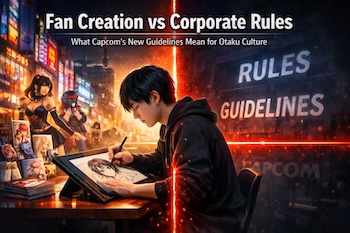
Otaku culture and fandom activity are now thriving everywhere, and in that environment, the distance between companies and fans becomes a surprisingly sensitive topic.
Until now, Capcom often felt like a company that quietly tolerated fan activity through an unspoken understanding. It was the kind of arrangement fans were grateful for. But this new announcement makes one thing clear: Capcom has now decided to state its position openly. In other words, it has moved from vague tolerance to written rules.
Behind that shift, you can also sense broader corporate concerns such as global expansion, brand consistency, and long-term image control. That does not mean Capcom is suddenly trying to clamp down on everything. Rather, it feels more like the company has drawn a visible line and said, this side is acceptable, that side is not.
From the author’s perspective, this is a major development.
Why? Because fandom spaces have long been built on a culture of free creation. Doujin works, cosplay, garage kits, fan-made figures, illustration circles, and small-scale creative scenes all grew inside an atmosphere where people pushed their own ideas forward first and worried about boundaries later. When a company makes its rules explicit in that environment, the safe zone becomes more visible, but so do the risks.
That is why this article asks a very specific question.
How will Capcom’s fan creation guidelines affect creators working inside Japan’s broader creative fandom culture?
To answer that, this article will cover what the guidelines actually say, how fans and creators should interpret them, what people making fan works need to watch out for, and what this means for Akihabara culture as a whole.
Rather than making this needlessly difficult, the goal here is simple. After reading, you should be able to think, all right, so this is how I should move from here. If you want to keep creating inside Akihabara’s culture sphere, read to the end.
Capcom Has Finally Made It Official
What Is Actually in the Fan Creation Guidelines?
From here, let us break down the contents of Capcom’s fan creation guidelines, officially announced on November 4, 2025, in a way that is easier to understand.
At first glance, it can look dense. But if you are someone who actually creates things, this is highly practical material, so it is worth understanding properly.
What counts as fan creation?
Capcom’s starting point is fairly straightforward.
If a fan creates a work based on a Capcom-owned copyrighted property, meaning characters, stories, music, visual assets, and similar elements, and adds their own creative expression to it, Capcom treats that as fan creation.
That includes things such as illustrations, manga, novels, three-dimensional works like figures or garage kits, music arrangements, cosplay costumes, photographs, and videos.
Video works, however, are handled separately under Capcom’s video guidelines, so that is a different set of rules you still need to check.
On the other hand, certain things fall outside the permitted scope. These include crossovers with other companies’ works, use of real people’s likenesses, reuse of Capcom logos or title logos, and direct cutting and pasting of game assets.
In other words, the core issue is whether your own creativity is actually present in the work.
Credit and attribution
This is one of those points that people often overlook.
Capcom asks creators, where possible, to clearly state that the work is fan-created and that it uses a Capcom property. That is framed more as a request than a harsh enforcement point. Capcom also says that failing to include such wording does not automatically result in removal, so it is not treated like an instant violation.
Even so, including that clarification is obviously the safer move.
What you should not do is place a formal-looking copyright notice such as a direct Capcom copyright mark on your own fan work. That creates too much risk of confusion with official material.
Can you charge money?
This is the question almost everyone jumps to.
The guidelines say that commercial use is prohibited in principle.
However, Capcom also says that small-scale paid distribution within the scope of a hobby is tolerated. In practice, that clearly points toward settings like doujin events and fan conventions, where creators sell limited runs of self-made work.
The problem is that Capcom does not define exactly where that hobby line ends. There is no hard number for copies, price ranges, or total profit. Instead, the company reserves the right to make that judgment itself.
So the practical takeaway is not a neat formula. It is more like this: if your activity starts looking obviously commercial, you are entering dangerous territory.
For three-dimensional works such as figures and garage kits, paid distribution remains limited to events where proper rights procedures have already been completed, such as Wonder Festival under its existing licensing framework. That part follows the traditional structure many creators already know.
Who is covered?
These guidelines apply to individuals and non-corporate groups, which in practice means private creators and doujin circles.
If a company or legally incorporated entity wants to create derivative merchandise or other secondary works, that falls outside this guideline and into Capcom’s formal licensing process.
So if a corporation wants to print and sell Capcom-based T-shirts or goods, that is no longer something to treat casually. It requires direct licensing contact. Trying to slide under the radar there is a bad idea.
What is clearly prohibited?
This is the part creators need to read without trying to soften it.
Capcom says no to activity that exceeds hobby-level commercial use. It also prohibits discriminatory, hateful, obscene, antisocial, defamatory, or otherwise harmful content. Political, religious, and ideological propaganda use is not allowed. Works that infringe third-party rights are also prohibited, as are creations that rely on direct copying or asset reuse rather than original expression.
Anything that damages the image of the work or its characters is also treated as a problem. So is anything made to look official, anything that could confuse people into thinking it is an authorized Capcom product, and anything that could interfere with business or function as counterfeit-like activity. Use of logos in that way also falls into the danger zone.
Finally, Capcom leaves itself a broad final clause. If the company decides something is unacceptable, it can reject it.
That means the spirit of the guideline is fairly clear. Freedom of expression is not being denied in the abstract, but the zone where a creator is obviously pushing too far is being defined much more openly than before.
The final rule is still Capcom’s judgment
Even if your work appears to follow the written guidelines, Capcom states that it may still request that you stop. If that happens, the company does not accept responsibility for losses suffered by the creator.
Capcom also states that the guidelines themselves may be changed without prior notice.
So there is an important reality here: what is acceptable today might not be acceptable next year.
There is another point worth noting as well. Capcom says it will not answer individual questions of the can I use this specific thing variety. That means creators are expected to judge for themselves and take responsibility for that judgment.
That is not unusual in fan culture, but now it is written down.
What Was Capcom Trying to Do?
From here, let us move beyond summary and into interpretation.
The key lens is twofold. One is the perspective of creators and fans. The other is the on-the-ground feeling of fandom spaces centered around Akihabara and related otaku culture zones.
This is not a declaration of exclusion
The first thing worth emphasizing is that Capcom explicitly says creators do not need to contact the company individually before making fan works.
As far as the author can tell, relatively few game companies have gone that far in writing. In many cases, the industry standard has been a gray, unofficial tolerance model where everything continues through silence.
By contrast, Capcom has now created a written framework and, within that framework, acknowledged hobby-scale activity such as doujin event distribution in a broadly positive way.
That does not read like rejection.
It reads like an attempt at coexistence.
For creators and fans alike, knowing what is likely to trigger trouble is often more reassuring than being left in a permanent gray fog. In that sense, the guidelines function not only as restrictions, but also as a safety map.
The commercial line is still blurry
At the same time, one point remains especially delicate for active creators: the line between hobby and commerce is still vague.
Capcom says that small-scale, low-volume paid distribution may be acceptable, but gives no hard numbers. No copy counts. No fixed price thresholds. No revenue ceiling. And the company explicitly says that it will make that judgment itself.
So imagine a common situation. A creator prints a doujin book, it sells better than expected, and they decide to reprint. Or production costs rise, so the sale price goes up a bit. Those decisions may feel normal from a fan creator’s perspective, but under a guideline like this, there is always a risk that the activity begins to look more commercial than hobbyist.
From the creator side, that means a larger burden of self-judgment remains in place.
Still, it is also only fair to recognize the other side of it. Capcom probably cannot give a perfect rule for every individual case. And very few companies have provided even this much structure in the first place.
That matters.
Adult content and the limits of brand image
Another major point is the treatment of adult content.
Because the prohibited section explicitly includes obscene content and material against public order and morals, creators working in R18 territory now have even more reason to be cautious.
This is especially interesting because Capcom’s own catalog includes titles with horror, gore, violence, and intense imagery. But Capcom’s position here makes something very clear: the intensity of an official work does not automatically extend to unlimited freedom in derivative works.
Those are separate questions.
So creators working on adult doujin, sexualized goods, or explicit reinterpretations of Capcom characters will need to evaluate their ideas through a brand-image lens from the earliest concept stage.
The real question becomes not only is this fan work technically mine, but also does this damage the image of Capcom’s world and characters?
That is a much more practical test than abstract arguments about freedom.
Not being mistaken for official is the key to preserving freedom
The guideline discourages formal-looking copyright marks and recommends making it clear that a work is fan-made.
At the same time, Capcom also says that failure to include those notices does not automatically trigger takedown.
That flexibility is worth noticing.
What that suggests is that the real concern is not paperwork for its own sake. The deeper issue is whether the fan work could be mistaken for official content.
If it cannot be mistaken for official, there seems to be more room to move.
That means creators who clearly identify their work as their own and avoid official-looking presentation may actually protect their freedom better by being more transparent, not less.
Seen that way, the guideline is not only restrictive. It also hints at how creators can preserve space for themselves.
What Changes in the Actual Creative Scene?
So how does this land inside Akihabara’s working creative environment?
Here are several situations where the guidelines are likely to have real-world effects.
Illustration, manga, and doujin events
Because hobby-scale activity is now written as broadly acceptable, there is a meaningful psychological effect. Small runs, face-to-face distribution, and modest event participation now feel less like unspoken risk and more like activity inside a known zone.
That is not the same as explicit permission, but it is still a big difference.
Garage kits and figures
For physical sculpted works, paid distribution remains tied to officially managed event frameworks. That means that even in Akihabara-area fan events, if there is no formal one-day rights system like the ones used at major licensed events, selling those items is not safe.
This is a point that creators need to understand, but event organizers should also take seriously.
Adult fan events and explicit works
Because obscene content and violations of public morals are directly prohibited, adult works carry real risk. Creators in more underground or erotic fan spaces will need to re-check tone, concept, and presentation from the planning stage onward.
This is not a minor issue.
Cosplay costumes, photos, and videos
Because logo use, official asset reuse, and problematic inclusion of third-party elements are all sensitive areas, even social media cosplay posts are not entirely carefree. The guidelines do not only touch the costume itself. They can affect the total presentation, including props, edited overlays, background use, and the overall way the post is framed.
That means creators need a wider awareness than before.
Akihabara retail, POP displays, and commercial sales
If a person is not acting as an individual fan creator but as a business, shop, or organized seller using Capcom imagery for displays or promotion, that likely falls outside the fan guideline and into formal licensing territory.
For Akihabara street shops, pop-up booths, and event businesses, that is a serious distinction.
Seen from all these angles, the guideline does not look like a simple system for controlling fandom.
The author reads it more as an attempt to organize coexistence between a major company and a creative fan culture that is already too large to ignore.
And the practical conclusion is actually quite clear.
Creators should continue making their own work in ways that cannot be mistaken for official releases. They should avoid unauthorized reposting and direct asset reuse. They should take responsibility for the fact that the work is theirs. And they should avoid expressions that clearly damage the image of the property.
If those basics are respected, there is still every reason to believe that fan culture will continue to breathe.

Summary
For people creating inside Akihabara culture, this is one of those moments where the mood quietly changes.
Not because creativity is dying. Not because companies suddenly hate fan work. But because the rules of coexistence have become more visible.
That changes how serious creators move.
The old atmosphere was built on instinct. You looked around, felt the tone of the scene, copied the habits of older creators, and stayed inside an unwritten line. That worked for a long time.
But a written guideline creates a different kind of pressure. It asks for self-checking. It asks creators to think a step earlier. It makes the border feel more real.
At the same time, that is not automatically a bad thing.
Akihabara has always been full of people who take fandom seriously. People who draw, sculpt, sew, print, edit, perform, and build because they genuinely love the source. For those people, having a clearer sense of the danger zones may actually make long-term activity more stable.
The point is not to get scared and stop.
The point is to create in a way that can survive.
That means keeping your work recognizably yours. It means not leaning on copied assets. It means understanding that being unofficial is not a weakness. In many cases, it is exactly what protects the space in which fan culture can continue.
So yes, this guideline matters.
It matters to doujin creators. It matters to cosplay circles. It matters to people making goods, figures, and manga. And it matters to Akihabara itself, because Akihabara is one of the places where these questions stop being abstract and become part of daily creative life.
The line is more visible now.
For serious creators, that does not only mean caution.
It also means a clearer way forward.
Quotation and reference
I quoted and referred to the information from this article.
We deeply consider and experience Japanese otaku culture!
akihabara.site:Capcom releases guidelines for derivative works: Examining the scope of permitted fan creations and points to note.
CAPCOM official:Capcom Fan Fiction Guidelines
All Write: Kumao