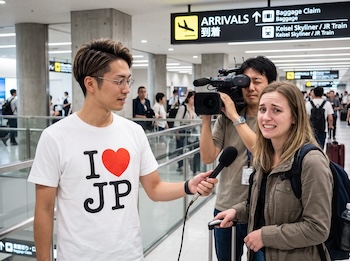
Have you ever landed at Narita or Haneda Airport, taken a seat in a taxi or turned on the hotel TV, and immediately noticed a pattern?
There is an entire genre of Japanese television dedicated to ambush-interviewing Western tourists the moment they step off a flight. A bubbly reporter thrusts a high-grade microphone into someone’s face and asks: Why did you come to Japan?
If the traveler answers with anything resembling high praise—I love your vending machines!, Your convenience store egg salad sandwiches changed my worldview!, Trains arrive down to the exact second!—the studio screen erupts into a cacophony of sound effects, pastel graphics, and tiny boxes framing Japanese celebrities nodding in absolute, theatrical ecstasy.
To an overseas visitor, it looks like extreme hospitality or innocent national pride. But if you live here, speak the language, and understand the cultural anxieties beneath the surface, you realize something far weirder is going on.
Japan is running a massive, self-soothing media echo chamber.
For the past decade, Japanese broadcast networks, tabloid magazines, and algorithmically boosted morning programs have been caught in a relentless cycle of telling their domestic audience that the entire globe is deeply envious of Japan. While you are just enjoying a bowl of cheap ramen or browsing retro games in Akihabara, your presence is being quietly packaged, edited, and sold back to Japanese households as proof that their nation is still the shining cultural pinnacle of planet Earth.
Here is a look behind the curtain at Japan’s most absurd modern media obsession, why domestic audiences are so addicted to foreign praise, and what overseas travelers actually think when they step outside the studio-crafted fantasy.
- The Anatomy of an Echo Chamber: Welcome to the “Nihon Sugoi” Industry
- Why Japanese Media Craves Western Approval
- The Grand Delusion: Inbound Booms vs. Bargain-Basement Tourism
- The Selective Filter: What Japanese TV Cuts from the Broadcast
- The Irony of Overtourism: From “Praise Us” to “Please Go Home”
- Real Respect vs. Media Narcissism
- A Healthier Way Forward
The Anatomy of an Echo Chamber: Welcome to the “Nihon Sugoi” Industry
In Japan, this cultural phenomenon has its own term: Nihon Sugoi (日本すごい, roughly translating to Japan is Amazing!).
It is not merely a passing trend; it is a multi-billion-yen content machine that spans terrestrial television, bestselling paperbacks, YouTube commentary channels, and daytime news infotainment.
The Formula Behind the Screen
The blueprint for a standard Nihon Sugoi TV segment is so rigid that you can practically predict every frame:
- The Stalker Camera at the Arrivals Gate: A camera crew lingers near international terminal exits, scanning crowds for foreign faces—preferably Western tourists who look enthusiastic, colorful, or easily overwhelmed.
- The Leading Question: The interviewer asks what inspired their journey. The ideal answer mentions Japanese culture, artisanal craftsmanship, cleanliness, safe streets, or otaku media.
- The Studio Reaction Window (Wipe): As the tourist praises the country, the camera cuts to a row of domestic TV personalities (tarento). Their expressions range from exaggerated astonishment to humble, teary-eyed gratitude.
- The Validation Climax: The voiceover narration steps in with dramatic orchestral backing: Yes! Even to foreign travelers from great superpowers, our everyday lifestyle looks like magic!
If an overseas visitor says they came to study an ancient carpentry technique, television crews will follow them into rural mountains for three days just to document a Westerner marveling at Japanese hand planes. If a backpacker admits they find municipal trash separation fascinating, an entire 40-minute special will be produced on how Japanese environmental discipline is bewildering the Western mind.
The Paperbacks in Train Stations
This spectacle does not end with television. Walk into any major bookstore near a commuter hub—whether inside Tokyo Station, Shinjuku, or Ikebukuro—and look at the non-fiction display tables.
You will routinely find rows of books boasting bombastic titles:
- Why the World Cannot Match the Genius of Japanese Politeness
- The West Is Astonished! The Hidden Power of the Japanese Soul
- Global Elite Thinkers Reveal Why Japan Will Save the 21st Century
For an English speaker glancing at these covers, it is easy to assume these are specialized nationalistic manifestos. In reality, they are mainstream paperbacks bought by ordinary suburban commuters on their way home to Chiba or Saitama. They function as emotional vitamins—a quick dose of reassurance that, despite daily stresses, their country remains an internationally adored paradise.
Why Japanese Media Craves Western Approval
To understand why this bizarre genre exists, you have to look at what has been happening inside Japan over the last thirty years.
Countries that are booming, expanding, and brimming with geopolitical confidence rarely spend all day asking foreigners if their convenience store snacks taste good. The United States does not produce prime-time television specials where producers cry tears of joy because a German tourist liked a hot dog in Chicago.
The rise of the Nihon Sugoi narrative is directly proportional to Japan’s domestic economic anxiety.
The Long Shadow of Stagnation
Between the 1960s and the late 1980s, Japan did not need domestic television programs to tell citizens they were doing well. Japanese electronics, semiconductors, automobiles, and real estate were aggressively buying out global markets. The country was universally recognized as an industrial titan.
Then came the asset bubble collapse, followed by what economists famously call the Lost Decades. Wages flatlined. Technological dominance in televisions, smartphones, and consumer electronics steadily migrated to South Korea, Taiwan, and Silicon Valley. Population numbers began their steep decline, leaving regional towns hollowed out and rural railway lines struggling to survive.
When real-world indicators—salaries, birth rates, currency strength, and global corporate market caps—started pointing downward, domestic media subtly shifted focus. If Japan could no longer dominate through raw economic muscle, it could reassure itself through moral and aesthetic superiority.
The Psychology of Third-Party Validation
Psychologically, it is far more comforting to hear praise from an outsider than from yourself.
If a domestic politician stands on a podium and shouts, Our country is wonderful!, the average salaryman rolls his eyes and thinks about his stagnant pension. But if a blonde backpacker from London or an engineer from California stares into a television camera and declares that Japanese toilets are a triumph of modern civilization, it triggers an instant dopamine rush.
The foreign tourist becomes an unpaid, unwitting therapist for an entire aging society. Their excitement acts as a mirror, allowing domestic viewers to temporarily forget domestic wage stagnation, corporate burnout, and demographic shrinkage.
The Grand Delusion: Inbound Booms vs. Bargain-Basement Tourism
In recent years, the Nihon Sugoi narrative has found fresh fuel in the staggering surge of international tourism. Tokyo, Kyoto, and Osaka have seen record numbers of foreign travelers packing train stations, hotels, and historic districts.
Japanese television loves to frame this influx as definitive evidence that the world is hypnotized by the sublime depths of Japanese culture. Pundits sit in broadcast studios, look at footage of packed streets in Asakusa or Shibuya, and nod smugly: Everyone on Earth dreams of being here.
Except there is an elephant in the room that domestic broadcasts prefer to whisper around: the historic collapse of the Japanese Yen.
The Reality Tourists Talk About
Foreign visitors do love Japanese cuisine, subcultures, safety, and scenery. But if you speak honestly to tourists in the back alleys of Akihabara or over drinks in Shinjuku, the primary topic of conversation is not ancient Zen philosophy.
It is the fact that Japan has become insanely, unbelievably affordable.
For travelers holding US Dollars, Euros, or British Pounds, Japan transformed into a luxury bargain wonderland. High-end wagyu beef dinners cost a fraction of a mediocre pub meal in London or New York. Impeccably clean business hotels rent for prices that would not buy a hostel bunk in Amsterdam. Authentic anime figures, vintage guitars, luxury watches, and retro video games sit on store shelves priced at what feels like a permanent 40% clearance sale.
When Western tourists arrive in massive numbers, they are not necessarily on a sacred pilgrimage to bask in Japanese perfection. A huge percentage of them are simply enjoying a world-class country at bargain-basement rates.
Yet, watch the evening news in Tokyo, and this financial reality is treated as a minor footnote. Instead, commentators frame the influx as a moral victory: Look how desperately they desire our traditional spirit!
The gap between why people are actually arriving and how the media explains their presence is comedy of the highest order.
The Selective Filter: What Japanese TV Cuts from the Broadcast
If you have ever had a microphone shoved in your face by Japanese media, you probably noticed how carefully directed the conversation was. Japanese television production does not want genuine, nuanced commentary on the complexities of Japanese life. They want short, sparkling soundbites that match an existing script.
To keep the fantasy alive, the Nihon Sugoi machine utilizes an aggressive editorial filter. Anything that threatens the image of an idyllic, flawless theme park is left on the cutting room floor.
| What Tourists Actually Experience | What Makes It to Japanese TV |
| Puzzling train seating rules and unwritten commuter etiquette traps | Japan’s rail system is the most punctual and clean miracle on Earth |
| Aggressive touts and fake monk scams in Ueno and Asakusa streets | Tokyo is so safe you can drop a wallet and it will walk back home |
| Rigid bureaucracy, cash-only cafes, and endless paperwork hurdles | Convenience stores offer unmatched hospitality and culinary genius |
| Cramped hotel rooms and rising hidden costs in tourist centers | Foreigners are deeply moved by the rich minimalism of our spaces |
The Unspoken Everyday Realities
When travelers arrive in Tokyo expecting the magical wonderland portrayed in media campaigns, they frequently hit small, confusing friction points that never appear on TV:
- The Invisible Rules of Public Transit: Navigating express trains often involves bizarre local quirks. Many travelers accidentally sit in reserved cars or get scolded on platforms because the complex ticketing layer is never clearly explained to outsiders.
- Urban Grift in Famous Districts: Tourists wandering through Ueno or Asakusa regularly run into bogus monks handing out fake golden amulets, or aggressive night-district barkers pulling unsuspecting foreigners into exorbitant drinking traps.
- The Paper and Cash Labyrinth: In an era where global travelers rely entirely on contactless phone payments, sudden encounters with rigid cash-only establishments or incomprehensible municipal recycling bins leave them bewildered rather than enchanted.
None of these real, everyday human experiences ever make it past the broadcast censors. If a foreign visitor tells an interviewer, I love the food, but trying to buy a local subway ticket was an absolute bureaucratic headache, that clip is quietly deleted. The editor keeps only the five seconds where the traveler bites into a melon pan and says it tastes delicious.
The Irony of Overtourism: From “Praise Us” to “Please Go Home”
The most hypocritical twist in this entire spectacle is the rapid domestic backlash that occurs whenever tourists actually show up in the numbers the media bragged about.
For years, programs preached that global admiration was the ultimate goal. But when international tourism surged to unprecedented levels, the narrative fractured into two contradictory messages running side by side on the very same television networks:
- At 6:00 PM: A glowing feature highlighting how European travelers worship Japanese onsen etiquette and traditional wooden architecture.
- At 6:30 PM: An alarmist special warning about the scourge of kanko kogai (tourism pollution), featuring hidden cameras recording confused backpackers standing in the wrong line at Kyoto bus stops or taking photos too close to historic gates.
Domestic audiences want the emotional validation of being loved by the world, but they want that love to remain decorative, quiet, and preferably confined to a television monitor. The moment international enthusiasm manifests as real human bodies crowding local trains, spilling luggage onto narrow sidewalks, or speaking loudly in neighborhood coffee shops, the mood in studio panels pivots from gentle paternal pride to quiet panic.
The media wants foreign visitors to exist as flat, cheerful extras in a domestic self-esteem production, rather than real people with varying habits, cultural differences, and travel fatigue.
Real Respect vs. Media Narcissism
Pointing out the absurdity of Japan’s media machine does not mean dismissing what makes Japan truly extraordinary.
There are countless reasons why people around the globe fall in love with this country. The meticulous attention to detail in food preparation, the preservation of ancient woodwork alongside futuristic urban skylines, the incredible wealth of manga, anime, and video game artistry, and the quiet safety of suburban residential neighborhoods are all undeniably real. Millions of travelers leave Japan with authentic, deep-seated appreciation for the people who build and maintain this society.
The tragedy of the Nihon Sugoi industry is that it cheapens authentic cultural admiration into cheap nationalistic vanity.
When a television program spends thirty minutes crying tears of self-congratulation because an American tourist likes an egg sandwich, it does not honor Japanese culture. It reduces centuries of history, complex craftsmanship, and deep social realities into shallow, consumable reassurance for a domestic audience afraid of its own economic shadow.
How to Navigate Japan Beyond the Media Script
If you are planning a trip to Japan, or if you are already walking the streets of Akihabara, Shinjuku, or Kyoto, the best thing you can do is ignore the media circus entirely:
- Be Honest, Not Performative: If a TV crew approaches you on the street, remember that you do not owe them a scripted performance. Speak candidly about what you enjoy, but do not feel pressured to act like you are visiting an alien utopia.
- Look for Real Cultural Depth: The true brilliance of Japanese culture is not found in superficial convenience store praise or gimmicky tourist spots. It is found in independent neighborhood workshops, quiet local kissaten coffee shops, complex subcultural communities, and honest, unscripted conversations with residents who see you as a person, not a studio prop.
- Understand the Economic Context: Recognize that your purchasing power is tied to complex currency shifts. Showing genuine consideration for local workers, balancing your spending across independent businesses, and respecting neighborhood residential spaces goes infinitely further than loudly proclaiming your love for local snacks.

A Healthier Way Forward
Japan does not need to manufacture artificial foreign compliments to prove its worth to itself. The nation’s art, literature, mechanical craft, and everyday civil consideration stand perfectly well on their own merits without being propped up by edited daytime television segments.
The next time you see a camera crew stalking the airport arrival halls, or catch a glimpse of a studio panel weeping because someone from abroad enjoyed a bowl of noodles, smile at the comedy of it all. It is not an accurate reflection of what the world thinks of Japan, nor is it a reflection of how confident Japan truly feels. It is simply the sound of a country talking to itself in the mirror, hoping against hope that the reflection smiles back.