Let’s be honest—Japan is a total paradise for train lovers. Bullet trains are lightning-fast, mountain views are stunning, and everything runs exactly on the second. But here is the thing: thousands of well-meaning tourists fall into a super stressful, invisible trap every single day. And no, I’m not talking about the standard Shinkansen lines. I’m talking about the regular express trains heading out to the countryside or airports.
If you’re from a Western country, you’re probably used to a pretty relaxed “hop-on and figure it out later” vibe. If you miss your train, you just jump on the next one, find an empty seat, and either move if someone shows up or pay the conductor on board. Right!?
Well, if you try that in Japan, you are in for a world of awkward silence, high-stress confrontations, and some serious public embarrassment.

Here is exactly why Japan’s express trains work differently, and how you can save yourself from a total vacation disaster.
The Big Culture Clash: “Just Sit Anywhere” Doesn’t Exist Here!
The root of the problem isn’t that tourists have bad manners. It’s just that the train system here is built on a totally different logic.
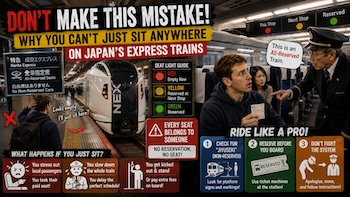
On a ton of popular modern express trains—like the Narita Express, the Azusa (heading to Yamanashi/Nagano), or the Hitachi (heading to Ibaraki)—railway companies use a strict system called “Zen-seki Shitei” (All-Reserved Seats).
Unlike older trains that had a few “free-for-all” unreserved cars, these modern trains have zero open seats. Every single square inch of those cushions already belongs to someone who paid for a specific seat, for a specific part of the trip.
To make things crazier, it’s all automated with little LED lights above your head:
- 🔴 Red: The seat is currently empty.
- 🟡 Yellow: Someone is boarding at the next few stations to claim this seat!
- 🟢 Green: This seat is fully booked and paid for.
For a tourist, a red light looks like a green light to sit down. You think, “Oh, it’s empty, I’ll just sit here!” But in Japan’s hyper-efficient system, boarding without a seat number completely throws a wrench into the machine.
The Awkward Domino Effect (How it ruins the vibe)
When you jump onto an all-reserved train thinking, “Eh, I’ll just pay the conductor later,” you unknowingly start a chaotic chain reaction for everyone around you.
- The Poor Local Passenger: Imagine boarding at your station, walking to your paid seat, and finding a tourist fast asleep in it. Japanese culture absolutely hates public drama and confrontation. So instead of just telling you to move, the local passenger is forced to deal with a massive wave of anxiety. You basically just ruined the quiet, peaceful ride they paid extra to enjoy.
- The Stressed Conductor: Conductors in Japan aren’t just checking tickets; they are managing a hyper-strict, minute-by-minute schedule. When they have to stop, explain the whole “All-Reserved” system to a confused tourist, handle a manual credit card payment, and translate the upgrade fees on a packed train, the whole schedule gets messed up. You’re basically turning a high-tech automated system back into a slow, frustrating customer service desk.

- Yourself (The Standing Traveler): If you get caught without a seat reservation, the staff won’t just let you slide. You’ll be kicked out of the seat and forced to stand in the narrow, swaying corridors between cars for hours—even if the train looks half-empty!? Plus, buying a ticket on board can sometimes cost you a penalty fee compared to buying it beforehand at the station. It’s just not worth it.
How to Ride Like a Pro: 3 Simple Rules
Want to keep your journey smooth, respectful, and completely stress-free!? Just build these three easy habits:
- Look for the “Jiyuseki” (自由席) Sign: If you are running late and absolutely must catch a train at the last second, make sure it actually has unreserved cars. Look for the platform markings that say “Non-Reserved” or “自由席”. If the train is labeled “All-Reserved” (全車指定席), do not step through those doors without a seat number in your hand!
- Use the Ticket Machines Before the Gate: Don’t assume the conductor will just fix everything on board. The digital kiosks at Japanese stations have excellent English menus. Taking literally two minutes to book a seat at the station will save you two hours of standing in a cramped train vestibule.
- Don’t Fight the System: If you accidentally end up on the wrong train or in the wrong seat, don’t try to argue your way out of it or play the “confused tourist” card. Just apologize, move to the open space between the train cars immediately, and follow the conductor’s instructions.

The Bottom Line
Japan’s trains are a beautiful masterpiece of modern engineering, but they only work because everyone trusts each other to sit in their exact, assigned spot. By changing your mindset from “just hop on” to “plan ahead,” you’re not just saving yourself from a super awkward situation—you’re showing some serious respect to the country you’re exploring.
I lost count of how many times I have seen people fighting over train seats. If you are traveling with family, it is a nightmare because the kids get absolutely frightened.
Typically, Japanese people get deeply confused when they see a stranger in the seat they paid for. They will approach you and explain the situation very gently. But here is the catch: if you snap back or show a bad attitude, they will likely blow their top. Being defensive will only backfire, so just apologize and move.
Stay smart out there, and happy travels!
Disclaimer: This is an independent travel guide based on personal observations of the Japanese rail system. Keep in mind that specific rules can vary depending on the region and the railway company, so always check the local station signs before you board!
Written by Kumao