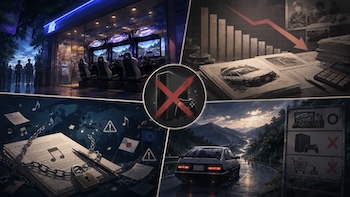
While the publisher has never officially announced the cancellation of a home console adaptation, a closer look at market data and development realities reveals three critical reasons why a new console or PC release remains out of reach for now.
Three points
A Severe Shift in Market Viability
The commercial trajectory of past console releases painted a grim picture for the development team. Sales plummeted heavily from the PS2 era (approx. 450,000 units) to the PS3 era (approx. 130,000 units), signaling a shrinking market for traditional console racing games.
Given the massive development budgets required for modern AAA-tier titles, factoring in heavy licensing fees for vehicles, the original manga property, and the soundtrack makes it incredibly difficult to reach a sustainable break-even point.
Protecting the Absolute Pillar of Arcades
Within the current amusement center ecosystem, the latest arcade iteration stands as one of the very few high-traffic, system-selling titles. It is a vital asset for arcade operators.
If a full-featured port were released on Steam or PS5, players would lose their primary incentive to visit physical arcades. This would deal a catastrophic blow to arcade foot traffic and operator revenues.
The Complex Web of Eurobeat Music Rights
The iconic Eurobeat tracks are an inseparable part of the franchise’s identity. However, securing the global distribution rights required for platforms like Steam presents an incredibly high legal and financial hurdle.
Between the risks of forced digital delisting and recurring contract renewal fees, staying within the more controllable bounds of physical arcades is a far safer business model than a one-time-purchase console release.
Historical Data of Major Franchise Releases
| Title & Platform | Release Year | Sales Volume / Scale | Market Reception & Review Trends | Featured Vehicles | Major Courses Included |
|---|---|---|---|---|---|
| Initial D (PS1) | 1999 | Moderate / Unspecified | Low to Mid: Noted for highly unusual physics and basic mechanics. Viewed primarily as a casual fan item. | ~10 models | Akina, Akagi, Myogi, Usui |
| Special Stage (PS2) | 2003 | ~450,000 units | Excellent: Built on the Arcade Stage Ver.2 engine. Highly praised for its deep story mode and superb musical direction. | 31 models | 11 courses (introducing Shiona, Happogahara, etc.) |
| Street Stage (PSP) | 2006 | ~250,000 units | High: Based on Ver.3. Delivering solid handheld controls and an engaging card-collection system. | 35 models | Full roster including Tsuchisaka and Shomaru |
| EXTREME STAGE (PS3) | 2008 | ~130,000 units | Mixed: Offered beautiful high-definition visuals for its time, but criticized for polarizing handling physics and sparse content. | 23 models | Akina, Myogi, Akagi, Happogahara, Tsukuba |
| Arcade Stage Zero (AC) | 2017 | Nationwide Arcades | High: Revamped control scheme with a 6-speed shifter. Features visual styles inspired by the trilogy films. | ~50 models | Hakone, Usui, Sadamine, Tsukuba, and more |
| THE ARCADE (AC) | 2021 | Currently Active | Excellent: Powered by Unreal Engine 4. Supports multi-passenger battles and drew heavy attention via cross-franchise collaborations. | 60+ models | Tsubaki Line, Akina, Nagao, and comprehensive legacy tracks |
Official Publisher Directions and Developer Insights
Analyzing official documentation and past statements from developers reveals telling perspectives on how the franchise is being managed.
- A Strict Commitment to the “Arcade Experience” In interviews surrounding the launch of the latest arcade version, the development leads heavily emphasized features unique to physical venues, such as 4-player local multiplayer and specialized steering wheel force-feedback. This highlights a deliberate corporate strategy: keeping the core experience exclusive to arcades rather than easily replicating it at home.
- The International Licensing Dilemma While the franchise enjoys massive, enduring popularity across Asia, expanding into North American and European markets is complicated by regional music and brand licensing. When publishing on global storefronts like Steam, these localized restrictions become a major bottleneck.
Critical Observations and Technical Realities
- The Importance of Community The production team has frequently noted that the arcade environment is fundamentally about fostering a physical community. Unlike home consoles, which favor isolated play, the publisher prioritizes the shared social experience of rivals meeting face-to-face at a venue.
- Physics Engines and Hardware Scaling The latest arcade version utilizes Unreal Engine 4. Translating this specific high-end performance to home setups demands robust PC hardware or a PS5. Attempting to downscale the experience for massive-install-base hardware like the Nintendo Switch risks compromising the brand’s premium image due to performance limitations.
- The Definitive Factor: Declining Retail Trends The consecutive drop in sales across generations—from 450k down to 130k—remains the primary financial hurdle. This clear downward trend makes securing an executive greenlight for an expensive home console project exceptionally difficult.
From the Author’s Desk: Looking closely at the data, the sharp decline in sales between the PS2 and PS3 eras seems to be the definitive turning point. It was the catalyst that pushed the publisher away from the traditional premium console model and fully into an arcade revenue-focused strategy.
The Verdict: Will We See a Console Release?
Estimated Probability Breakdown by the Author
- A New Home Console / Steam Release (PS5, Xbox Series, PC) 25% — 40% Chance
- A Dedicated Nintendo Switch Family Release 10% — 25% Chance
- A Remaster / Port of a Legacy Title (Rather than a brand-new game) 20% — 35% Chance
The reality is straightforward: the arcade version is currently thriving and actively receiving major updates. Releasing a console alternative right now would inevitably cannibalize the active player base’s time and money. Because the publisher is actively investing in the arcade infrastructure, console development remains on the back burner.
Triggers That Could Greenlight a Console Project
If the following industry shifts begin to align, the probability of a console release rises significantly.
Trigger A: The Arcade Version Transitions into a Maintenance Phase
Currently, the arcade version is receiving consistent large-scale content expansions (such as new versions introducing tracks and features). Once these major updates slow down and shift purely toward minor bug fixes and balance adjustments, development resources may free up for a home project.
- Probability Impact if Met: Overall chance rises from 25–40% → 45% — 60%
Trigger B: Breakthroughs in Unified Licensing Agreements
A console release—particularly on digital platforms like Steam—demands incredibly broad international permissions regarding automotive brands, tuning parts, and music, alongside risks involving user-generated mods. If the publisher establishes a unified, streamlined framework to clear these multinational rights efficiently, it will serve as a massive greenlight.
- Probability Impact if Met: Overall chance rises from 25–40% → 50% — 65%
Trigger C: Identifying a Viable Console Product Format
The most practical approaches for a home market release fall into three potential formats:
- A single-player-focused remaster of a classic title with reduced emphasis on competitive online play.
- A completely separate spin-off title built strictly around narrative and mountain-pass exploration.
- A home edition of the current arcade title featuring highly structured, strictly managed online environments.
Settling on a model that avoids the severe anti-cheat and connectivity hurdles of an open competitive PC/console environment will make a release much more feasible.
- Probability Impact if Met: Overall chance rises from 25–40% → 55% — 70%
Market Signs to Watch For
Positive Indicators (Release Becoming Closer)
- A noticeable slowdown in major content updates for the arcade version (Trigger A).
- Revisions or restructuring in current copyright and brand licensing text (Trigger B).
- Internal studio restructuring, such as arcade development veterans moving over to console-focused divisions (Trigger C).
Negative Indicators (Release Remaining Distant)
- Continued, aggressive updates delivering brand-new tracks, music, and mechanics to the arcade version. (Note: This is exactly what the market is experiencing right now.)

Final Outlook by the Author
When looking at the hard data, the immediate likelihood remains conservative. The current arcade ecosystem is simply too successful to disrupt.
- Probability of a Release within the Next Year: 5% — 15%
- Probability of a Release within the Next 2–3 Years: 20% — 35%
- Target Platforms: Highly likely to lead with Steam and PS5, with any potential Switch-tier version being delayed or heavily redesigned.
Ultimately, as long as the arcade business continues to grow and perform well, home console adaptations will naturally be treated as a secondary priority.
The roar isn’t gone. It’s simply waiting for the right road to exist.
Written by:Kumao
Frequently Asked Questions (FAQ)
Q: Is porting the current arcade version to home consoles technically impossible? A: Technically, it is entirely possible. However, when you factor in the need to preserve the unique arcade machine experience, manage complex global online infrastructure, and handle heavy licensing risks, the corporate costs and liabilities multiply dramatically.
Q: Are the music rights the absolute biggest obstacle? A: They represent a major bottleneck. The financial burden of long-term contract renewals for a global digital distribution model does not align well with the traditional one-time-purchase console structure.
Q: Wouldn’t the Nintendo Switch be the most logical choice due to its massive install base? A: While the user base is highly attractive, delivering the visual fidelity and brand experience of the modern arcade engine would require extensive, separate optimization. Consequently, it is rarely treated as the top development priority.
Q: What about a simple remaster of an older legacy title? A: This remains a distinct possibility. A single-player-centric package that minimizes complex multiplayer infrastructure is historically the easiest format to approve.
Q: What are the key early indicators that a console announcement is approaching? A: Watch for a prolonged plateau in arcade feature updates, changes in corporate licensing fine print, or the reassignment of core studio personnel.