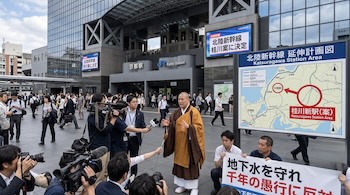
Hello, fellow travel enthusiasts and observers of Japanese pop culture. Today, let us dissect a freshly minted piece of infrastructure drama that perfectly illustrates how Japan manages to turn a technical transit dispute into a highly watchable, nation-wide theatrical production.
On July 15, 2026, the ruling government committee announced a major update regarding the long-discussed Hokuriku Shinkansen extension to Osaka. They officially dropped the original plan to build a massive underground platform directly beneath the historic central Kyoto Station. Instead, they approved the Katsuragawa Route, which shifts the future underground station about 5 kilometers west to the area of JR Katsuragawa Station.
For international observers, the immediate media coverage of this announcement reads like an epic showdown. Headlines flash with dramatic warnings from local Buddhist monks calling the project a “Thousand Years of Folly”(Sennen no Guko), claiming that bullet train tunnels will dry up the ancient underground water veins of Kyoto.
But if we look past the flashing cameras and the somber press conferences, the reality is far more calculated, highly political, and ultimately has almost zero impact on the actual day-to-day life of travelers. Let us peel back the layers of this hyper-dramatized transit circus and look at what is really going on.
The Anatomy of the Katsuragawa Compromise
To understand how we arrived at the Katsuragawa decision, we have to look at the political chess board rather than spiritual prophecy. The original 2016 plan aimed to tunnel straight under central Kyoto to link up with the existing Shinkansen hub. However, deep tunneling through the central Kyoto basin presented undeniable geological challenges and engineering risks regarding the city’s complex underground water table.
This is where local politics took center stage. The reformist political party, Nippon Ishin no Kai (Japan Innovation Party), capitalized on these local anxieties. During the recent Senate elections in the Kyoto district, Ishin candidates campaigned heavily on a platform of re-evaluating the central Kyoto route. Their massive electoral victory forced the ruling Liberal Democratic Party (LDP) to rethink their strategy.
The Central Kyoto Deadlock
– Massive engineering risks under the historic core
– Political pressure from the rising Ishin party
▼
The Bi-Partisan Solution
– Self-Defense: LDP needs to keep local voters happy
– Realism: Ishin offers “Katsuragawa” as a workable alternative
▼
The Result: Katsuragawa Route Approved
When the committee met, both the LDP and Ishin brought their best alternative ideas to the table. While Ishin initially favored an entirely different track running through neighboring Shiga Prefecture (the Maibara Route), they realistically joined forces with the LDP to present the Katsuragawa option as the ultimate compromise. By shifting the tunnel line 5 kilometers to the west, the government effectively bypassed the highest-risk geological zones of the central city while keeping the overall “Obama-Kyoto” framework alive.
The Media Circus: Elevating Local Complaints into National Theater
Now, let let us address the elephant in the room: the intense, almost apocalyptic media coverage surrounding the local Buddhist temples.
If you watch Japanese daily wide-shows (afternoon talk shows), you would think that the construction of a train line is about to trigger a spiritual curse on the ancient capital. The media absolutely loves framing this as a cinematic battle between cold, hyper-modern state machinery and the robe-clad guardians of 1,200-year-old traditional wells.
The Masterful PR Catchphrase
The Kyoto Buddhist Association pulled off a public relations masterstroke when they branded the project a “Thousand Years of Folly.” It is an incredibly sticky, dramatic phrase that TV producers simply cannot resist. It instantly elevates a mundane local environmental assessment dispute into an existential crisis about saving the soul of Japan.
The Reality Check
Let let us be perfectly frank here: the actual practical impact on the city’s water and day-to-day operations is incredibly overblown. Modern shield-tunneling technology is exceptionally sophisticated. Subterranean train lines run beneath major historic cities all over Europe and Asia without draining the local rivers or drying up historical landmarks. The idea that a single transit tunnel will permanently turn Kyoto into a barren desert is great for television ratings, but it holds very little water in the realm of modern civil engineering.
The media circus exists because it provides fantastic daily entertainment for viewers at home. It allows politicians to debate fiercely on screen, gives religious organizations a grand platform to display their protective heritage, and gives the public a compelling narrative to discuss over tea. Meanwhile, the actual, practical work of running the country moves along completely undisturbed.
Shifting the Underground Blueprint
Let let us compare the two plans side-by-side to see exactly what this political maneuver accomplished.
| Feature | The Abandoned “Central Kyoto” Plan | The Approved “Katsuragawa” Plan |
|---|---|---|
| Station Placement | Subterranean platform under Kyoto Station | Subterranean platform near JR Katsuragawa Station |
| Geological Risk Zone | High-density aquifer zone beneath the historic center | Lower-density suburban western water basin |
| Political Alignment | Heavily criticized by local reformist factions | Jointly backed by both LDP and Ishin factions |
| Real-World Impact | High risk of prolonged construction delays | More predictable engineering timeline |
| Public Narrative | Framed as a destruction of ancient heritage | Framed as a responsible, modern relocation |
As the data shows, the transition to the Katsuragawa route is a classic administrative pivot. By moving the project away from the immediate vicinity of the central temple districts, the government successfully neutralized the most vocal geographic opposition while maintaining the core logistics of the Shinkansen expansion.
The Tourist Perspective: Why You Don’t Need to Worry
For global travelers who view Kyoto as a must-see destination on their Japanese vacation itineraries, this news might initially sound alarming or confusing. Will you be dropped off in the middle of nowhere? Will you miss out on the iconic central Kyoto Station experience?
Let us bring this back down to earth with a healthy dose of realistic, traveler-focused logic. Your upcoming trips to Japan are absolutely unaffected.
A Timeline Across Decades
First and foremost, let let us look at the timeline. The estimated construction period for this massive deep-underground expansion is roughly 26 years, with an optimistic completion target set sometime in the late 2050s. Given the astronomical estimated costs of 3.9 to 5.5 trillion yen (which will likely fluctuate over the coming years), this project is a long-term future investment. Unless you are planning a trip for your future grandchildren, you will continue to use the current, perfectly optimized Tokaido Shinkansen system that drops you straight into central Kyoto today.
The Magic of Japanese Train Transfers
Even when Katsuragawa Station eventually opens decades from now, the idea that it is inconvenient is completely false. JR Katsuragawa Station is already a smoothly operating station on the main JR Kyoto Line.
- It sits a mere two stops away from central Kyoto Station.
- The ride takes roughly 5 to 6 minutes on a standard local train.
- The station area is modern, highly accessible, and directly connected to major commercial developments.
Future Hokuriku Shinkansen
Arrives at Katsuragawa Underground Station
(5-Minute Transfer via JR Local Line)
▼
Central Kyoto Station
Instant access to the historic heart of the city
In short, the entire “inconvenience” debate boils down to a minor 5-minute local train transfer. In the grand scheme of international travel, this is an incredibly trivial adjustment that does absolutely nothing to diminish the stellar quality of the Japanese transit experience.

Conclusion: Enjoy the Show, Enjoy the Journey
The ongoing saga of the Hokuriku Shinkansen’s Katsuragawa route is a prime example of Japan’s unique cultural landscape. It is a place where futuristic bullet trains must constantly navigate the loud, performative demands of local politics, media sensationalism, and traditional cultural institutions.
While the wide-shows will undoubtedly continue to broadcast tense debates and dramatic soundbites about the fate of Kyoto’s water for years to come, you can sit back, smile, and appreciate the entertainment value of it all. The temples will keep playing their part as the ancient defenders, the politicians will keep adjusting their blueprints to win votes, and the media will keep making a mountain out of a molehill.
And through it all, the trains will keep running flawlessly on time.
What are your thoughts on this transit drama? Do you find the intense media coverage of Japan’s infrastructure projects amusing, or do you think the 5-minute transfer to Katsuragawa is a smart move to keep the project moving forward? Let us know your thoughts in the comments section below, and make sure to subscribe for more realistic, hype-free insights into Japanese travel and culture!
All Write: Kumao