Japan is globally celebrated as one of the safest, most polite, and family-friendly destinations on earth. You picture a dream vacation where your children marvel at the neon lights of Tokyo, the historic streets of Kyoto, and the gentle hospitality of the locals.
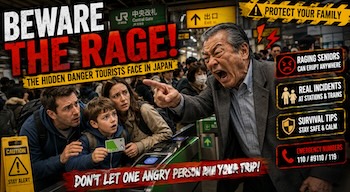
But as an experienced observer of Japan’s urban underbelly, I must give you a stark reality check. There is a specific, invisible hazard lurking in train stations, crowded walkways, and ticket gates that no tourism brochure will ever warn you about: The Volatile Senior Citizen (affectionately known by locals as the “Gekiko-Jisan” or Raging Old Man).
While rare, these sudden outbursts of irrational rage from a small segment of Japan’s elderly population can instantly turn a happy family walk into a terrifying core memory for your kids. Here is what you are actually seeing, real-world examples, and exactly how to shield your family from the rage.
The Horror at the Gate: Real-World Manifestations of the Rage
To the untrained foreign eye, Japanese society is a monolith of quiet compliance. However, under the immense pressure of dense crowds and changing social norms, certain elderly men undergo a total psychological short-circuit. They weaponize their age and seniority, venting their frustration on anyone they perceive as “disruptive”—especially tourists who don’t know the invisible rules.
Here are actual scenarios witnessed on the streets of Tokyo and Osaka:
- The Ticket Gate Ambush: A foreign family slows down at a JR ticket gate because their IC card (Suica/Pasmo) glitches or they aren’t sure which slot to put their paper ticket in. Within seconds, an elderly man behind them begins aggressively shouting in Japanese, chest-thumping, or violently sighing to induce panic.
- The Train Compartment Enforcer: Your children are excited, talking in normal conversational volumes on a local subway line. Suddenly, a senior citizen across the aisle snaps, shouting “Urusai!” (Noisy!) or slamming his umbrella against the floor to terrify the passengers into silence.
- The Sidewalk Bulldozer: In crowded areas like Shibuya or Takeshita Street, certain older men will refuse to alter their walking path by even a millimeter. If a tourist family accidentally steps into their trajectory, instead of a polite “sumimasen,” they are met with a hostile shove or a verbal tirade.
The Psychology of the Rage: Why Are They So Angry?
For an international traveler, this behavior is baffling. Isn’t Japan a culture of respect?
The harsh truth is that Japan is a rapidly aging society with severe economic stagnation. A portion of the older generation feels completely alienated by modern technology, the influx of international tourists, and a perceived loss of the “traditional respect” they believe they are owed.
When they see a foreign family occupying space, slowing down infrastructure, or violating unspoken micro-etiquette (like talking on trains), they don’t see guests—they see an opportunity to reassert their dominance under the guise of “correcting bad manners.”
The “Zero Engagement” Protocol: How to Protect Your Family
If your family is targeted by a raging senior, your instinct might be to argue back, explain yourself, or demand an apology. Do not do this. In Japan, arguing with a volatile person in public escalates the situation and can legally complicate things for you. Instead, follow this survival protocol:
- Evacuate Instantly: Do not make eye contact. Do not say “sorry.” Grab your children, turn around, and walk away into a crowded, well-lit area or toward a station staff member.
- The Language Barrier Shield: If they continue to follow or shout at you, completely ignore the Japanese language. Maintain a blank expression. These aggressors look for compliance or fear; a total lack of reaction usually diffuses their momentum.
- Seek the “Midori no Madoguchi” or Station Booth: If this happens inside a train station, immediately head to the nearest ticket window or look for station staff wearing uniforms. The mere presence of an official authority figure will cause the aggressor to instantly vanish into the crowd.
“If you are navigating Tokyo’s massive transit hubs during these stressful encounters, make sure you also check out our guide on [Never Get Lost in Shinjuku Station] to find safe zones and toilets instantly.”
Emergency Lifelines: Who to Call When Things Get Dangerous
If an encounter escalates from verbal shouting to physical intimidation, blocking your path, or touching your family members, the “polite illusion” is over. You are now dealing with a crime. Immediately utilize these Japanese emergency contacts:
- 110 (The Police – Emergency): Dial this immediately if you feel physically threatened. Japan has an incredibly dense network of mini-police stations called Koban (交番) near almost every major street corner and train station. Run toward a Koban.
- #9110 (Police Consultation – Non-Emergency): If an incident occurred, the aggressor left, but you want to report the behavior or seek advice on what to do without triggering a full siren-blazing emergency response.
- 119 (Ambulance / Fire): In the highly unfortunate event that someone is injured or suffering from severe shock/panic attacks due to an altercation.
- Japan Helpline (0570-000-911): A 24/7 toll-free, English-language support line for international tourists dealing with any crisis, from medical emergencies to local disputes.
Japan is still an incredibly safe country, and 99% of the elderly people you meet will be kind, gentle, and happy to see your family enjoying their homeland. But by preparing for that unpredictable 1%, you ensure that a single bitter individual cannot steal the magic of your Japanese adventure.
Disclaimer / Editorial Note
This article is an independent safety advisory intended to assist international travelers in identifying and de-escalating rare public altercations in urban Japan. The behaviors described do not represent the vast majority of Japanese citizens or elderly populations. Emergency numbers and protocols are provided based on official public safety guidelines in Japan.
Written by Kumao
“This station rage is just one of the hidden friction points for tourists. To ensure your itinerary is completely bulletproof, read our specific breakdown on [Tokyo Station ver. Japan Travel Mistakes] and [Osaka Japan Travel Mistakes] to avoid other common regrets.”