The Graphics Refusal: Why Japanese Gamers Choose 6-Inch Screens Over 4K Monitors!?
The Graphics Refusal: Why Japanese Gamers Choose 6-Inch Screens Over 4K Monitors!?
Games & Gear
2026.05.22
Step into any western gaming community, and the conversation is always about reaching the absolute peak of hardware performance. We are talking about liquid-cooled rigs, Nvidia RTX 90-series cards, and monstrous 4K OLED displays. To the Western mindset, immersion is a physical space—a dedicated shrine where you sit, isolate yourself, and dive into a virtual world.
But cross the ocean to Japan, and you’ll witness a bizarre paradox.
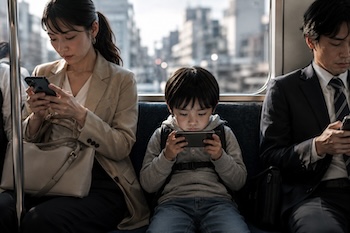
This is the country that birthed the global gaming industry. Yet today, even self-proclaimed hardcore Japanese gamers are actively rejecting the heavy-spec lifestyle. They aren’t buying the giant monitors. Instead, they are hunched over 6-inch smartphones or curling up with handheld screens.
To the outside world, it looks like a flat-out refusal of progress. Why would a nation with blazing-fast internet and tech-focused infrastructure choose to squint at a tiny rectangle!?
The answer goes way deeper than “small apartments.” It is a complex pipeline of childhood conditioning, social conformity, and a desperate survival strategy for managing limited personal time.
The Kindergarten Pipeline: The “Anpanman” Elite Education
To understand why an adult Japanese gamer will happily spend $1,000 on mobile gacha pulls but refuse to buy a $300 gaming monitor, you have to look at their literal infancy. This isn’t a trend that magically appeared with Genshin Impact—it is a behavior that is systematically engineered from the stroller.
The Smartphone as the Ultimate Digital Babysitter
Walk into any family restaurant in Tokyo, or ride the Yamanote train line, and you will see a frantic mother handing an iPhone or iPad to a crying toddler. For hours, these children sit in a state of absolute hypnosis, watching Anpanman or kids’ YouTube channels on a loop.
This is Japan’s silent “Mobile Elite Education.” Before these kids can even form full sentences, their brains are hardwired to associate dopamine, safety, and ultimate comfort with a vertical, handheld glowing rectangle.
The Death of the Living Room TV
By the time these children reach elementary school, the concept of a “home console connected to a shared family television” feels clunky and restrictive. The 6-inch screen is their native home. They didn’t grow up fighting their siblings for the living room couch; they grew up retreating into their own private world tucked away in their palms. By the time they become adults, sitting in front of a giant static monitor feels like an exhausting chore compared to the absolute intimacy of a mobile display.
The Monolithic Monster: Peer Pressure and the Fear of “Doing Your Own Thing”
There is a famous Japanese proverb: “The nail that sticks out gets hammered down.” This cultural obsession with uniformity and group harmony controls everything in Japan, and the gaming hardware market is absolutely no exception.
The “Everyone Else Has It” Purchasing Panic
In the West, PC gaming thrived because gamers loved the identity of being custom builders. They want to show off their unique rigs. In Japan, the absolute primary motivation for a teenager to buy a gaming device is peer-to-peer survival: “If I don’t play what everyone else is playing, I will be socially isolated at school.”
This is why the Nintendo Switch achieved a near-total monopoly in the domestic market. It wasn’t just because the hardware was great; it became a mandatory social passport.
Why Monitors are Viewed as “Boring Office Junk”
Because of this rigid cultural conformity, buying a dedicated, high-refresh-rate gaming monitor is quietly looked down upon by casual consumers. If a teenager asks their parents for a BenQ or ASUS gaming display, the response is almost always a confused: “Why do you need that? Your friends don’t use one. Just play on your phone or the tiny TV we already have.”
Investing money into personal hardware optimization is seen as an unnecessary, eccentric hobby. If a gaming setup doesn’t fit into the collective social circle’s lowest common denominator, it simply gets rejected.
Futon Ergonomics: The Crushing Reality of “Boot-Up Cost”
Let’s get real about the physical and mental state of a Japanese salaryman or university student. They are living in a society with some of the highest burnout rates in the world. When you are running on empty, the physical design of your gaming setup dictates whether you play at all.
The Psychological Barrier of the Desk
Think about a grueling 12-hour day of packed train commutes and navigating rigid corporate hierarchy. When that worker finally gets back to their tiny 6-tatami mat apartment, the absolute last thing their brain can handle is sitting upright at another desk, staring at another monitor, and waiting for a massive 100GB AAA game to patch on Steam.
This is the hidden killer of core gaming in Japan: The Boot-Up Cost. The mental friction of switching from “work mode” to “desk-gaming mode” is a luxury that exhausted people cannot afford.
The Futon Always Wins
Instead, they collapse into their true sanctuary: the Futon.
The Path of Least Resistance:
⭕ The Futon Routine: Collapse ➔ Hit 1 button on your Switch/Phone ➔ Instant Dopamine.
❌ PC / Desk Setup:High Mental Friction ➔ Instant rejection.
The handheld form factor requires zero behavioral transition. You slip under the heavy blanket, hit a single power button, and you are instantly in the game. It is the absolute peak of “lazy efficiency.” If a Western developer creates a gorgeous masterpiece that forces a player to sit upright in an ergonomic chair to appreciate its 4K textures, it is fighting a losing battle against the sheer gravity of the Japanese futon.
The Author’s Grief: The Death of Japanese Innovation in the Gacha Hell
Now, as someone who has watched the Japanese gaming scene evolve for decades, I’m not just going to praise this lifestyle for being “efficient.” We need to talk about the devastating, heartbreaking impact this has had on game development itself.
The Tragic Pivot to Predatory Gambling Mechanics
Because the domestic audience completely turned their backs on high-spec hardware, major Japanese publishers pulled their budgets away from ambitious, boundary-pushing console and PC projects. Why spend $100 million and five years developing a revolutionary open-world game when you can throw together a mobile title with flat anime PNGs and make billions in a single month through predatory “Gacha” microtransactions!?
The domestic market has trapped itself in a toxic loop. Japanese gamers demand ultra-convenient, bite-sized mobile loops they can play with one hand on a crowded train, and publishers are all too happy to feed that addiction with gambling mechanics disguised as RPGs.
Surrendering the Global Stage to Western Developers
It is incredibly painful to witness the creative decline of studios that once defined the entire medium. The legendary, risk-taking artistry that gave us the foundational eras of the NES, SNES, and PlayStation has drastically withered.
Apart from a few titan IPs like FromSoftware titles or flagship Nintendo releases, the cutting edge of game design, graphical innovation, and narrative scale has been almost entirely surrendered to Western and other Asian developers. Japan traded its crown as the pioneer of interactive art just so its population could roll for virtual waifus under their bedsheets.
The Verdict: Two Opposite Philosophies of Space and Time
Ultimately, the fierce divide between a 4K monitor and a 6-inch smartphone isn’t about which hardware is objectively superior. It is a fundamental disagreement on the value of space and time.
The West views gaming as an event—an escape into a dedicated environment built for maximum sensory input. Japan views gaming as a lubricant—a compact, frictionless tool to fill the exhausting cracks of a highly structured, over-worked life.
Enjoy your beautiful ray-traced graphics and immersive setups over there. Just don’t expect Japan to pull itself out of the comfort of the futon anytime soon!?
The critiques regarding corporate gacha models and domestic industry stagnation represent the personal observations of the author. While mobile and handheld ecosystems dominate mainstream Japanese culture, a dedicated, highly competitive e-sports and custom PC community continues to grow rapidly in the underground urban scene.