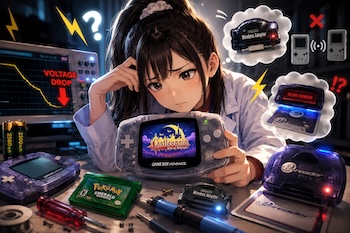
Hey retro fans! If you’re into the Game Boy Advance scene, you already know that IPS screen mods are an absolute game-changer. Playing Castlevania or Pokémon Emerald on a crisp, backlit display makes it feel like a whole new console.
But as everyone rushes to tear down their old hardware and solder in those gorgeous modern panels, we need to talk about a glaring issue that’s being swept under the rug.
Yeah, I’m talking about voltage and battery drain.
While a modded GBA works perfectly fine for solo gaming, things get weird—and frustrating—the moment you start plugging in vintage hardware. Especially those rare, region-exclusive Japanese peripherals that Western collectors are spending big bucks on right now.
Let’s dive into why your high-tech IPS mod might actually be breaking your retro setup!?
⚠️ A Quick Side Note / Disclaimer: Just a reminder that every GBA console is a bit different depending on its age and how it was modded. The issues I mentioned above can vary based on your specific IPS kit, battery health, and whether your console’s capacitors are getting old. Modding is always a “at your own risk” hobby, so treat your vintage hardware with care!
The Voltage Trap: Why Modern Screens and Old Tech Fight for Power
Here’s the quick science behind the issue. Original GBA systems were engineered to be incredibly efficient, sipping power from two standard AA batteries. The stock reflective screen barely used any juice.
Modern IPS mods? They are absolute power hogs.
Even if you’re using high-capacity rechargeable batteries, an IPS panel draws significantly more current to keep those pixels bright. When you are just playing a game, the system manages. But the second you plug a peripheral into the extension port, that device also demands power from the GBA’s internal regulator.
The result? A massive voltage drop. The system tries to feed both the hungry screen and the external gear, leading to random sync loss, data corruption, or straight-up hardware freezes.
The Japanese Wireless Adapter (AGB-015) Mystery
Let’s look at a prime example: the Japanese GBA Wireless Adapter (AGB-015).
With multiplayer retro gaming seeing a massive resurgence, Western collectors have been buying tons of these from Japanese marketplace sites. They look incredibly cool, and hey, who doesn’t want to play Pokémon wireless multiplayer across the room!?
But try plugging an AGB-015 into an IPS-modded GBA and starting a multiplayer lobby.
During my testing, the connection became a total gamble. Sometimes the units would pair up, only to drop the signal mid-trade. Other times, the adapter’s status LED would just blink weakly before the game threw a communication error.
Why? Because the wireless adapter requires a stable, sustained current to broadcast its signal. When the IPS screen hogs the power, the wireless chip simply starved. Interestingly, switching the IPS screen to its lowest brightness setting sometimes stabilized the connection—proving that power draw is 100% the culprit here.
The Nintendo e-Reader: Region Differences and Scan Failures
Another massive target for collectors is the Nintendo e-Reader (specifically the Japanese Card-e Reader+).
If you’ve ever tried scanning classic Super Mario Advance 4 cards on a modded setup, you might have noticed a strangely high rate of “Scan Error” messages. At first, you might blame the old paper cards or a dirty lens.
But there’s a catch. The Japanese and Western versions of the e-Reader have slight hardware and firmware differences, and the power draw required during the physical scanning process is surprisingly heavy. When the GBA’s internal voltage dips due to the IPS screen, the e-Reader’s read-head fails to process the data fast enough.
It’s incredibly annoying to finally track down rare Japanese e-Cards, only for your premium modded console to choke on them!?

The Verdict: How to Balance Modern Visuals and Vintage Gear
So, does this mean you should rip out your beautiful IPS display? Absolutely not. But if you’re a hardcore collector who loves utilizing the GBA’s original ecosystem, you need a strategy.
Here are a few quick tips to survive the voltage trap:
- Upgrade to a Clean Juice Mod: If you’re running an IPS screen, stop relying on standard AA batteries. Look into dedicated LiPo rechargeable battery mods that include upgraded power regulators. These handle the extra power draw much better.
- Keep a “Purist” Console: Seriously, every serious GBA collector should keep at least one unmodded, stock console in their kit. Whether it’s a stock AGB-001 or a front-lit AGS-001, you want a native 3V environment when doing link-cable multiplayer or running heavy peripherals.
- Turn Down the Brightness: If you must use peripherals on your IPS handheld, crank the screen brightness down to the minimum setting before powering on the external device. Your batteries (and your link connection) will thank you.
IPS mods are amazing for playing solo in the dark, but when it comes to the complex world of 20-year-old multiplayer tech, original is still king.
Have you guys noticed any weird glitches with your modded systems and link cables? Drop a comment below and let me know what gear is giving you trouble!
Written by Kumao
⚠️ A Quick Side Note / Disclaimer: Just a reminder that every GBA console is a bit different depending on its age and how it was modded. The issues I mentioned above can vary based on your specific IPS kit, battery health, and whether your console’s capacitors are getting old. Modding is always a “at your own risk” hobby, so treat your vintage hardware with care!