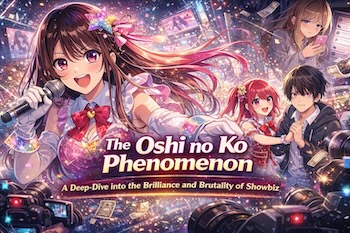
- The Oshi no Ko Phenomenon: A Deep-Dive into the Brilliance and Brutality of Showbiz
- 1. A Mirror to Reality: The Industry’s Truth and the “Lies of Love”
- 2. The Commercial Juggernaut: Analyzing Sales and Global Dominance
- 3. Structural Storytelling: Foreshadowing and the “Second Watch” Trap
- 4. Honest Review: Cast Evaluations and the “Scriptwriter Logic” Problem
- 5. The Holy Land Pilgrimage: Real-World Locations in Tokyo
- 6. Why it Became a Social Phenomenon: The Essence of “Stanning”
- The author’s Perspective
The Oshi no Ko Phenomenon: A Deep-Dive into the Brilliance and Brutality of Showbiz
Is there any other anime in history that has peeled back the layers of the Japanese entertainment industry with such visceral, unflinching honesty? Oshi no Ko is far more than a typical idol-themed show. It is an unprecedented masterpiece that confronts the blinding radiance of the spotlight and the pitch-black shadows lurking behind it—cyberbullying, produce-first mentalities, and the agonizing struggle of youths caught between commercialization and personal identity. As the impressive line goes, “Idols tell lies because fans don’t actually want to know the truth.” This sentiment serves as a sharp surgical strike to the heart of modern fandom. This article explores the core of this unique work, keeping pace with the anime’s progression while maintaining maximum sensitivity to spoilers, delivering an analysis built on the perspective of an original manga reader.
1. A Mirror to Reality: The Industry’s Truth and the “Lies of Love”
The reason Oshi no Ko doesn’t end as mere fiction is that the mechanisms and emotions depicted are frighteningly linked to the real world. Industry insiders—the “people on the inside” of idol management—have taken to SNS to express how much the dialogue hurts to hear because it is so accurate. Aka Akasaka (Original Story) and Mengo Yokoyari (Art) have utilized their proximity to the media world to create a depiction rooted in “observation and experience,” not just speculation. For instance, the arc involving “cyberbullying and attempted suicide” mirrors the real-life tragedy of a Terrace House cast member. The series also touches on the reality of “underground idol contact business (cheki)” and “dark business scandals,” portraying them as the agony of human beings trapped within a system. It asks a profound question: What is the nature of the “lie” in showbiz? The act of “stanning” (oshi) may fundamentally be about choosing to believe in a lie that is so well-crafted it feels like the truth.
2. The Commercial Juggernaut: Analyzing Sales and Global Dominance
Oshi no Ko is a top-tier business success. Looking at the numbers, the impact is undeniable. Despite the general decline in physical media, the first Blu-ray volume (Limited Edition) released in June 2023 sold over 15,000 units in its first week, a top-class figure for late-night anime that kept it high on the Oricon rankings. The theme song “Idol” by YOASOBI has achieved over 500 million views on YouTube (as of May 2025), topped the Billboard Japan charts for 15 consecutive weeks, and generated over 3 million uses on TikTok globally. It served as a cultural bridge between subculture and pop culture. Furthermore, the series achieved a “clean sweep” across streaming platforms like Netflix, ABEMA, and d-Anime Store, holding a top 3 spot on Netflix Japan for three consecutive months. The live-action version also employed a hybrid model of theatrical release and Amazon Prime distribution, earning 850 million yen at the domestic box office and ranking #1 in weekly views on Prime Video, proving the success of a cross-promotion strategy that funneled anime fans into the live-action and manga ecosystems.
3. Structural Storytelling: Foreshadowing and the “Second Watch” Trap
The narrative is built on a structure of meticulous foreshadowing. The 90-minute Episode 1 acts as a mystery thriller, introducing the provincial gynecologist Goro and his ultimate idol, Ai Hoshino—an intro that drops viewers into a dark abyss. Episodes 2–5 focus on the “Reconstruction of Showbiz,” highlighting the 2020s media environment through the lens of teen magazines, MV production, and particularly the reality dating show arc, where the violence of self-unaware viewers and the calculations of producers are laid bare. Episodes 6–11 shift to the re-launch of B-Komachi, emphasizing that stage success is strictly business success, where even facial expressions are managed as “acting.” From the perspective of a manga reader, the series demands a second watch. An action by Aqua in the beginning that seems “genius” at first glance transforms into an expression of “distorted obsession” upon a second viewing. The anime’s superior direction—the use of BGM, voice acting, and timing—turns the manga’s clues into intense emotional triggers, embedding hints of the future “turning point” within the first season’s fabric.
4. Honest Review: Cast Evaluations and the “Scriptwriter Logic” Problem
Even a masterpiece faces critiques. Regarding the live-action adaptation, it is a “double-edged sword.” While the visuals were high-fidelity, particularly the casting for Ai Hoshino, some fans felt that the leads playing Aqua and Ruby lacked emotional depth, appearing as “just handsome faces” without the layered internal turmoil of the original. There is a concern that the story’s composition is “too perfect.” The way foreshadowing is collected can feel so intentional that it exposes the author’s hand, making Aqua’s motivations seem to rely too much on “genius settings” rather than human emotion. Characters occasionally become “devices” to speak the author’s ideology, with Aqua and Kana Arima delivering lines that feel more like a scriptwriter’s perspective than that of actual teenagers. Furthermore, the contrast between “The Stage (Light)” and “Backstage (Hell)” is so extreme that it ignores the nuanced “grey zones” of the industry. The live-action version also suffered from being “too safe,” following the anime so faithfully that it avoided the bold reinterpretation that the medium allows, perhaps out of a fear of “flaming” (enjo) on social media.
5. The Holy Land Pilgrimage: Real-World Locations in Tokyo
Fans can walk the real world of Oshi no Ko through these specific locations:
- Shibuya Crossing & 109: The heartbeat of the industry; specifically the angle looking up at 109 from Center-gai where Ruby stands in the OP.
- Takao-san Area (Hachioji): The mountainous residential area mirroring the “mountain clinic” where Ai gave birth in secrecy.
- Akihabara (Radio Kaikan & UDX): The symbol of otaku culture and underground idols. Locations like TwinBox AKIHABARA and the rental spaces behind UDX serve as models for the cramped backstage and live houses where the new B-Komachi began.
- Zepp DiverCity Tokyo: Rumored model for B-Komachi’s major stage, with identical layouts and lighting.
- Ichikawa City (Chiba): The quiet residential area where Aqua and Ruby’s talent dormitory is located.
- Roppongi Hills & TV Asahi: The backdrop for major production agencies and variety show studios, capturing the authentic atmosphere of Akasaka and Roppongi.
- Hibiya/Yurakucho: The specific office buildings and cafes used for meetings between producers and managers, recreated with startling realism by the art staff.
6. Why it Became a Social Phenomenon: The Essence of “Stanning”
Oshi no Ko resonated because it addressed the universal human need for “approval and empathy.” In the 2020s, it asked, “What does it mean to support someone?” and “What does it mean to be supported?” It isn’t just a story about cute idols; it is a story of family, revenge, and the structural violence of the media. By depicting the act of “Oshi” as the act of “believing in someone’s incompleteness,” it reached far beyond anime fans to social critics, industry pros, and media theorists. It is a story for everyone because it touches on the universal feeling of being saved by someone’s radiance or supported by their words. That is why it became a legend in just one season.
The author’s Perspective
But wait, we aren’t finished! Akihabara.site will continue to dive to the bottom of this swamp, exploring the real-life incidents that inspired the plot, a list of 10 “Oshi no Ko-like” anime, and the truth behind the fictional unit “B-Komachi.” We are also planning a Complete Akihabara Pilgrimage Map covering collab cafes, merch shops, and panel displays. Please bookmark and stay tuned! Until next time—😃
by: Kumao
↓Click here for anime-related articles↓
・Detective Conan OVA Complete List (2026): All Episodes Explained, Timeline & Canon Status
・Detective Conan Movies: What TV Episodes to Watch Before Each Film
・MyAnimeList Top 50 Anime: A 2026 , I tried to consider it from the perspective of a Japanese geek
・Every Anime Set in Akihabara: The Complete Guide to Japan’s Otaku District in Anime
・The Haruhi Suzumiya TV Anime 20th Anniversary Project ExplainedHaruhi’s SOS Brigade
・Joins Sanrio Virtual Festival 2026: What’s Official, What’s Likely, and How to Watch
・Akiba Maid War Review With No Spoilers|Japanese anime
・Pokémon Lovers, Don’t Miss This! The Ultimate Guide to Japan’s Local Pokémon Across 47 Prefectures
・The 7 Biggest Mysteries About Satoru Gojo That Have Jujutsu Kaisen Fans Buzzing
・Jujutsu Kaisen Hidden References Explained Episodes 1–9, With a Japanese Fan Lens
・Jujutsu Kaisen Hidden References Explained Episodes 10–19, With a Japanese Fan Lens
・Sushiro x JoJo Collaboration Starts in Japan(akihahabara,sendai,koube,OSAKA,TOKYO)
・Demon Slayer Finale Begins! Infinity Castle Arc Hits Japan Amid TV Hype—When Will America and Europe See It?