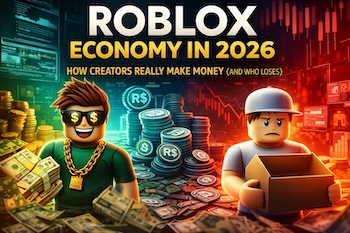
In 2026, Roblox is no longer defined by the phrase kids game platform.
According to market projections, Roblox’s annual revenue is expected to reach approximately 7.4 billion USD, which translates to well over one trillion yen in Japanese currency. What once looked like a colorful sandbox for children has evolved into a fully functioning global digital economy.
From the outside, the numbers suggest a success story.
On the inside, the reality is far harsher.
Behind the growth lies a platform where income disparity among creators is widening, platform dependency is deepening, and power over monetization is increasingly concentrated. In 2026, Roblox is a place where winners and losers are clearly separated—and that separation is structural, not accidental.
This article examines the actual state of the Roblox creator economy in 2026, focusing on revenue systems, participation requirements, and the mechanisms that generate inequality. Understanding the realities that rarely surface in public discussions is essential to understanding Roblox itself.
- How DevEx Changed, and Why Roblox Creators Are Becoming Professionals
- Facial Verification and the Economic Shock It Created
- From Sponsorships to Joint Management: How Corporate Tie-Ins Evolved
- The Three Metrics That Decide Creator Survival in 2026
- From User-Generated Content to the AI Generation Era
- The author’s Perspective
How DevEx Changed, and Why Roblox Creators Are Becoming Professionals
The Developer Exchange program (DevEx)—which allows creators to convert Robux into real-world currency—has moved far beyond the idea of side income or hobby-level rewards.
In 2026, creators who generate consistent income on Roblox are no longer operating as individuals experimenting in their spare time. Many have transitioned into business-oriented development, complete with corporate structures, tax planning, and contractual management.
In some cases, developers have formally incorporated, treating Roblox not as a platform but as a core business channel. Because DevEx exchange rates have stabilized relative to earlier years, financial institutions now view Roblox income as credible enough to support bank loans for studio expansion.
At the same time, the cost of compliance has risen sharply.
Safety standards, moderation requirements, identity verification, and platform-level governance all impose ongoing operational expenses. For small-scale solo developers, this has made entry and long-term survival significantly more difficult.
The current DevEx environment rewards only those who can balance high production quality with professional operational systems. This shift signals that Roblox’s creator economy has entered a new phase—one where professionalism is no longer optional.
Facial Verification and the Economic Shock It Created
The full rollout of facial verification systems in early 2026 fundamentally split the Roblox economy into two distinct layers.
Users who fail to complete identity and age verification face restrictions on chat features and access to advanced experiences. While this change was framed as a safety measure, it also reshaped monetization patterns for creators.
The most significant growth occurred in content designed explicitly for verified users.
With access to a trusted, age-confirmed audience, developers gained the freedom to design higher-priced, adult-oriented experiences. As a result, premium content aimed at older users expanded rapidly.
Notable examples include:
- Horror titles targeted at players aged 17 and above
- Casino-inspired game mechanics designed without child-focused constraints
These genres benefit from fewer design limitations, allowing more aggressive monetization flows and deeper gameplay systems.
By 2026, the choice of target age group alone can determine revenue outcomes, even for projects with similar development costs. Whether a game is built around verified-user assumptions has become one of the most critical business decisions a creator can make.
From Sponsorships to Joint Management: How Corporate Tie-Ins Evolved
The model that dominated Roblox until 2025—brands simply purchasing ad placements—has almost completely disappeared.
In its place, revenue-sharing partnerships between companies and creators have become the standard. Today’s corporate presence on Roblox is built on long-term collaboration rather than one-off promotions.
Global brands now prefer to integrate directly into existing popular games, rather than commissioning standalone experiences from scratch. Fashion and lifestyle brands, including high-profile names like Nike and Gucci, have adopted this approach.
Instead of temporary pop-ups, many collaborations now feature permanent in-game stores designed to fit seamlessly into the host game’s world.
Under this structure, creators are no longer contractors. They function as business partners, balancing gameplay design with brand identity. This three-way relationship—company, creator, and user—forms a clear B2B2C model.
For top-tier development teams, this shift has made monthly revenues in the tens of millions of yen a realistic outcome. Roblox has effectively transformed from an advertising venue into a platform for joint digital enterprises.
The Three Metrics That Decide Creator Survival in 2026
Professional Roblox creators no longer rely on intuition or luck. They track specific metrics daily, treating them as survival indicators rather than abstract analytics.
These numbers determine whether a project can sustain itself as a business.
Creators who succeed are those who read behavior patterns and monetization data precisely. Roblox in 2026 does not reward passive publishing. It rewards continuous optimization.
The most critical indicators include:
- 30-Day Retention Rate (D30)
Measures how many users return after one month.
A rate above 15 percent marks the threshold of a breakout title. - ARPPU (Average Revenue Per Paying User)
Indicates how much each paying user contributes.
For verified-user content, surpassing 2,000 yen per user is a key benchmark. - Engagement-Based Revenue Share
Income generated from non-paying users through time spent in-game.
Ideally, this should account for around 30 percent of total revenue.
Without controlling these metrics, long-term survival on Roblox is extremely difficult.

From User-Generated Content to the AI Generation Era
Roblox has now integrated generative AI tools directly into item creation workflows. As a result, traditional 3D modeling skills alone are no longer a strong differentiator.
The new advantage lies in prompt design—the ability to instruct AI systems effectively to produce usable, high-quality assets quickly.
At the same time, lowered production costs have triggered an explosion of content volume. Items are mass-produced, flooding the marketplace.
In this environment, individual asset quality matters less than IP strength.
Creators who develop recognizable characters, worlds, or ongoing series are far less likely to be buried under imitation. Those who chase short-lived trends without building identity struggle to maintain revenue over time.
Generative AI has equalized production capability. In doing so, it has raised the importance of planning, branding, and operational judgment. Roblox creators in 2026 are expected to think like executives, not just artists.

The author’s Perspective
Roblox in 2026 is no longer a space reserved for talented kids experimenting with games.
It has become a competitive economic zone, where capital, strategy, and execution collide head-on. Calling it a paradise would be dishonest. Entry barriers are high, and survival by luck alone is no longer possible.
Yet this harshness is precisely what connected the metaverse to the real economy.
What was once play became labor.
What was once labor became industry.
There is no going back.
All Write: Kumao