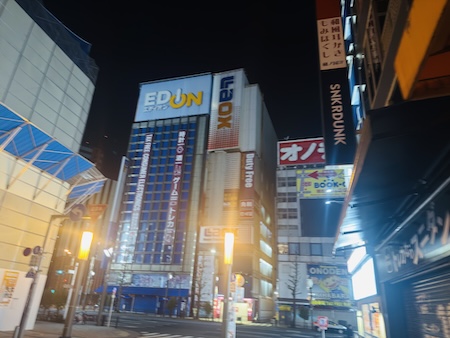
Long before neon facades, multi-story anime emporiums, and maid cafes redefined the urban geography of Tokyo, Akihabara was built on an invisible foundation of electromagnetic static. Modern tourists stepping out of the JR Electric Town Exit see a sprawling carnival of pop culture and consumer technology. Yet beneath the luminous consumer displays lies an older, far more clandestine legacy forged in the fires of World War II psychological warfare, military radio interception, and the desperate resourcefulness of post-war black markets.
At the center of this historical transmission sits the spectral figure of Tokyo Rose. Her disembodied voice floated across the Pacific on shortwave frequencies, serenading homesick American soldiers with sweet jazz records while delivering calculated psychological poison. The clandestine technology that broadcast her broadcasts, and the vacuum tubes that captured her voice, did not vanish when the guns fell silent in 1945. Instead, that military hardware migrated directly into the scorched ruins of Kanda and Akihabara, sparking an underground tinkering culture that eventually birthed modern otaku identity.
To understand why a district famous for digital idols and video games still honors the solder-stained workbenches of surplus electronics vendors, one must trace the circuit back to zero hour: the intersection of wartime deception, pirate shortwave receivers, and the phantom frequencies that still echo beneath the Sobu Line tracks.
- The Phantom Voice of the Pacific: Who Was the Real Tokyo Rose?
- Post-War Black Markets and the Vacuum Tube Boom: The Genesis of Akihabara
- Underground Frequencies: The Clandestine Radio Culture That Shaped Otaku Tech
- When WWII Lore Leaks into 4chan’s /b/: The Modern Myth of Tokyo Rose
- Epilogue: The Signal Never Stopped—Why We Still Chase Ghost Frequencies in Tokyo
The Phantom Voice of the Pacific: Who Was the Real Tokyo Rose?
In the humid foxholes of Guadalcanal and the pitching decks of aircraft carriers across the South Pacific, Allied servicemen gathered around shortwave field receivers every evening at zero hour. From the static hissed a sultry, impeccably American voice: So you are still out there, boys? Poor suckers. While you are rotting in the jungle mud, your sweethearts back home are dancing with shipyard workers who make real money. Let us listen to some sweet swing music before you meet your maker tomorrow.
This was The Zero Hour, an English-language propaganda broadcast produced by Radio Tokyo under the direction of the Imperial Japanese Army. Designed by psychological warfare specialists, the program aimed to hollow out American morale through nostalgia, survivor guilt, and existential dread. Yet contrary to popular Allied belief, there was never a single woman officially registered as Tokyo Rose. The name itself was coined entirely by American soldiers, who synthesized multiple female announcers into one unified, seductive phantom of the Pacific.
Among the several women forced or coerced into broadcasting behind the microphone, Iva Toguri D’Aquino became the historic lightning rod. An American-born UCLA graduate stranded in wartime Japan while visiting an ailing aunt, Toguri refused to renounce her United States citizenship despite extreme pressure from the Kempeitai (military police). Assigned to read lighthearted scripts on The Zero Hour under the moniker Orphan Ann, she deliberately adopted a self-mocking, comedic tone, often smuggling tongue-in-cheek warnings into her monologues to blunt the psychological sting of the Japanese High Command.
Here lay the supreme paradox of wartime psychological operations: the targeted troops loved her. The Imperial military had assembled one of the finest collections of American big-band shellac records in East Asia, looted from occupied territories across Manila and Singapore. While Japanese citizens endured strict wartime rationing and patriotic martial music, Allied soldiers were treated to cutting-edge Glenn Miller, Tommy Dorsey, and Benny Goodman recordings broadcast over high-wattage transmitters. Instead of inducing despair, the phantom voice became an indispensable nightly companion, fostering an enduring, bizarre nostalgia that persisted long after the armistice.
Post-War Black Markets and the Vacuum Tube Boom: The Genesis of Akihabara
When Japan surrendered in August 1945, the Allied Occupation under General Douglas MacArthur (GHQ) imposed total demilitarization across the Japanese archipelago. Hundreds of thousands of Imperial Army and Navy telecommunication rigs, field radios, radar components, and aircraft avionics were ordered dismantled, confiscated, or scrapped. At the same time, returning veterans and demobilized electrical engineers converged upon the scorched ruins of central Tokyo, seeking any means to survive amid hyperinflation and systemic food shortages.
The geographic genesis of what we now call Electric Town took root around Kanda-Sudacho and the railway viaducts of Akihabara. Street vendors pitched simple wooden stalls along the bomb-damaged earth, trading stolen military wiring, salvaged copper transformers, and surplus vacuum tubes. Students from nearby technical academies, including Tokyo Denki University, scavenged these open-air black markets, hunting for components to assemble primitive radio kits capable of tuning into civilian broadcasts and NHK’s newly sanitized educational programming.
For a detailed breakdown of how this post-war scrap trading evolved across subsequent decades into a multi-billion-dollar pop culture sanctuary, explore our foundational architectural study on Akihabara: From Radio Parts to Otaku Sanctuary—A Journey Through Japan’s Electric Town.
In November 1949, GHQ issued the Black Market Stall Liquidation Edict, attempting to clean up Tokyo’s street corners ahead of reconstruction. Rather than dispersing, the radio merchants successfully negotiated with the municipal government and the national railway bureau to relocate their operations under the concrete arches of the elevated Sobu and Yamanote railway tracks. This consolidated sanctuary became Tokyo Radio Center and Radio Department—multi-level, claustrophobic labyrinths of electronic specialization that remain active to this day.
To trace the lineage that transformed wartime hardware into consumer civilian tools, examine the functional migration between military-spec surplus and the early Akihabara electronics trade:
| Military Hardware Origin | Black Market Salvage Context | Civilian Repurposing in Akihabara | Long-Term Cultural Impact |
|---|---|---|---|
| Imperial Army Transmitter Tubes | Looted depot stores and scrapped base stations | Hand-wound shortwave receivers and DIY home radios | Established Akihabara as the world capital for audiophile tube amplifiers. |
| Naval Radar Oscillators & Cathodes | Confiscated coastal surveillance batteries | Experimental oscilloscopes and diagnostic test benches | Trained the generation of engineers who launched Japan’s 1960s television boom. |
| GHQ Field Communications Wire | Surplus motor pools and maintenance scrap barrels | Sub-harnesses, transformer rewinds, and speaker cables | Sparked specialized wire merchants like Oyaide Electric, still trading in the district. |
| Quartz Crystals & Frequency Resonators | Aviation headsets and encrypted communication units | Precision tuning rigs for illicit shortwave scanning | Created the foundation for underground amateur radio clubs across Tokyo. |
To see how this rugged post-war marketplace compares with the current tourist terrain, consult our companion chronicle on Old Akihabara vs Today, detailing the structural transformation from solder smoke to software displays.
Underground Frequencies: The Clandestine Radio Culture That Shaped Otaku Tech
During the Allied Occupation, the Japanese public was strictly prohibited from owning shortwave radio equipment capable of receiving foreign signals. GHQ feared Soviet ideological infiltration from the north, underground imperial loyalist organizing from within, and uncontrolled communication loops outside their monitored censorship bureau. Commercial radios sold to Japanese civilians had their tuning capacitors physically locked or modified to restrict reception strictly to domestic medium-wave bands.
For technical hobbyists, this restriction acted like gasoline thrown on an intellectual fire. In hidden upstairs rooms above Akihabara’s rail viaducts, amateur technicians bypassed factory oscillator limiters, rewound induction coils with scavenged enamel copper, and fabricated illicit shortwave converters. By soldering together dirt-cheap scrap tubes with surplus American components, anyone with steady hands could listen in on forbidden signals: Voice of America broadcasts, Soviet telemetry, ships negotiating the Pacific, and the lingering static of cold war numbers stations.
This clandestine tinkering marks the authentic cultural birth of the Japanese otaku. Decades before the term was applied to anime viewers or manga collectors, otaku behavior was defined by an obsessive, anti-authoritarian dedication to information retrieval via complex hardware manipulation. The early amateur radio (HAM) operators who frequented Akihabara established dedicated communication networks long before consumer internet protocols existed.
These HAM enthusiasts operated on distinct social terms:
1. Radical Anonymity: Identity was decoupled from birth, social status, or corporate rank, masked entirely by an alphanumeric callsign.
2. Decentralized Knowledge Exchange: Schematic diagrams, antenna tuning tips, and component availability were shared freely across airwaves without centralized gatekeepers.
3. Meritocracy of the Soldering Iron: Respect within the subculture was dictated not by wealth, but by the technical ingenuity required to pull a clear signal out of cosmic noise.
This early radio subculture served as the direct behavioral prototype for textboard communities like 2channel (now 5channel) and its Western offshoot 4chan. The habit of gathering anonymously in unregulated spaces to dissect esoteric signals was not invented by web browsers; it was soldered together in 1950s Akihabara backalleys, across counters that evolved into legendary retail hubs like Akizuki Denshi and Sengoku Densho.
When WWII Lore Leaks into 4chan’s /b/: The Modern Myth of Tokyo Rose
In modern digital folklore, historical wartime propaganda frequently cross-pollinates with creepypasta and internet urban legends. Across Western anonymous forums like 4chan’s /b/ (Random) and paranormal boards (/x/), the spectral myth of Tokyo Rose periodically re-emerges, stripped of its geopolitical reality and recast as an eerie analog ghost in the global telecommunications machine.
Threads frequently crop up featuring late-night shortwave listeners operating software-defined radio (SDR) platforms. They post grainy audio captures pulled from the 6 MHz and 9 MHz bands—static-drenched recordings where fragments of 1930s swing music drift beneath cold numeric readouts, occasionally interrupted by a woman speaking softly in vintage mid-Atlantic English. Enthusiasts assign elaborate occult histories to these transmissions, arguing that remnants of The Zero Hour were somehow absorbed into ionospheric bounce loops, forever circling the upper atmosphere like acoustic phantoms.
This digital haunting illustrates how human psychology treats shortwave radio as a liminal space. Much like the fascination with real Cold War numbers stations—such as the notorious Lincolnshire Poacher or UVB-76 (The Buzzer)—audiences feel an instinctive thrill when encountering voices that seem to originate from nowhere, addressing an audience that has long ceased to exist.
Walk through Akihabara at three in the morning, when the screaming arcade jingles are silenced and the train platforms go dark. The low mechanical hum vibrating through the steel pillars of Radio Kaikan and the Sobu Line viaducts feels less like modern urban transit and more like the respiration of an ancient relay station. The physical architecture of Electric Town has spent eight decades capturing, processing, and broadcasting human longing across invisible spectrums. The ghost voices circulating on internet boards are simply the latest layer in that persistent transmission.
Epilogue: The Signal Never Stopped—Why We Still Chase Ghost Frequencies in Tokyo
Today, the vacuum tubes that pulled Tokyo Rose from Pacific skies are mostly collector items, glowing softly inside high-end boutique headphone amplifiers tucked away on the third floor of Radio Center. The shortwave radio craze has given way to gigabit optical fiber networks, algorithmic content feeds, and the multi-billion-dollar virtual talent industry.
Yet if you look closely at contemporary Japanese subculture, the lineage remains unbroken. The massive global phenomenon of VTubers—synthetic female avatars delivering intimate, daily livestreamed companionship to millions of isolated viewers across the world—is the ultimate digital descendant of the phantom radio voice. As explored in our sociological inquiry into The Soul Beyond the Shell: Inside the Dark Sociology of Japan’s Virtual Talent Industry!?, modern audiences continue to project their deepest emotional attachments onto disembodied performers operating behind digital masks.
From the Allied soldiers seeking comfort in the midnight transmissions of The Zero Hour, to the post-war engineers hunting for surplus triodes under the railway bridges, to modern net travelers refreshing anonymous discussion boards for secret lore, the fundamental human impulse has never shifted. We are all searchers standing in the dark, tuning our receivers through the surrounding static, desperately waiting for an elusive, familiar voice to emerge from the void.
Tokyo Rose was never an individual woman; she was a frequency. And in the narrow alleys of Akihabara, that circuit is still live.
Written by Kumao
References / Sources