Tokyo is often introduced to visitors as a city of pop culture, nightlife, and cutting-edge architecture.
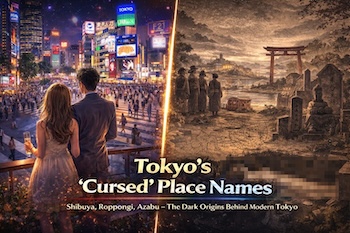
But many of its most famous districts carry names rooted in death, punishment, disaster, and spiritual fear.
These are not horror stories invented for tourists.
They are place-name memories—echoes of how people once understood land, danger, and the unseen.
This article explores several well-known Tokyo districts often described as “imi-na chimei”—names associated with ominous meanings—using documented history and surviving folklore.
Shibuya (渋谷) — The Valley of Bitter Water
Shibuya today is synonymous with youth culture and neon crowds.
Its name, however, points to a far less glamorous past.
Origin theories (historical & linguistic)
- 渋 (shibu) means “bitter,” “astringent,” or “unpleasant.”
- 谷 (ya) means “valley.”
One widely cited explanation is that the area was once a low-lying valley with poor-quality water, unsuitable for drinking or agriculture. Another theory connects the name to iron-rich soil that produced bitter-tasting runoff.
Folklore layer
In premodern Japan, valleys were often associated with:
- Flooding
- Disease
- Spirits believed to linger in damp, sunless land
This does not mean Shibuya was “cursed,” but it was not considered a desirable place to live in early eras.
Why it matters today
Modern Shibuya is built on top of massive flood-control infrastructure.
The name itself quietly records the land’s original risk.
Roppongi (六本木) — The “Six Trees” of Death and Execution
Roppongi is famous for nightlife and international culture, but its name has long invited speculation.
Name origin (multiple documented theories)
There is no single confirmed explanation, but several historically recorded theories exist:
- Six large trees once stood as landmarks in the area.
- The name refers to six samurai families whose crests featured tree motifs.
- The area functioned as a boundary zone, where executions or punitive acts may have occurred during the Edo period.
Cultural context
In Edo-era urban planning, edges and boundaries were where:
- Punishment took place
- Criminals were displayed
- Social order was reinforced
Even without proof of mass executions, the association of Roppongi with authority and discipline was strong.
Why it matters today
Roppongi remains a liminal space—neither fully traditional nor fully foreign.
Its historical identity as a border zone persists in function, if not form.
Azabu (麻布) — Hemp Cloth and Burial Ground Associations
Azabu appears elegant today, but its name points to practical—and darker—origins.
Literal meaning
- 麻 (asa) = hemp
- 布 (fu) = cloth
Hemp was used for:
- Clothing
- Rope
- Burial shrouds
Historical use of the area
Records and local histories describe parts of Azabu as:
- Sites of textile production
- Land used near temples and burial grounds
- Areas associated with funerary practices
Folklore layer
Because hemp cloth was commonly used in death-related rituals, Azabu became associated with:
- Mourning
- Transition
- Spiritual boundaries between life and death
Why it matters today
Azabu’s calm, upscale atmosphere contrasts sharply with its origins—making it a prime example of Tokyo’s ability to absorb and overwrite memory without erasing it.
Why Tokyo Has “Ominous” Place Names at All
Unlike many Western cities, Japanese place names often preserve environmental warnings:
- Flood zones
- Execution grounds
- Burial sites
- Disease-prone land
Rather than renaming them, people learned to live with the meaning.
These names functioned as:
- Oral hazard maps
- Cultural memory
- Spiritual caution signs

Visiting Tokyo With This Knowledge
This is not about superstition.
Understanding these names means:
- Reading Tokyo as a layered city
- Recognizing that modern districts were once feared or avoided
- Seeing nightlife and shopping areas as places that overcame risk, not places without history
When you walk through Shibuya, Roppongi, or Azabu, you’re standing on land shaped by centuries of human fear, adaptation, and belief.
Final Note for Overseas Visitors
These stories are drawn from:
- Historical records
- Linguistic analysis
- Surviving Japanese folklore
They are not meant to frighten—but to add depth to your experience of Tokyo.
Tokyo is not just modern.
It is built on memory.

All Write: Kumao