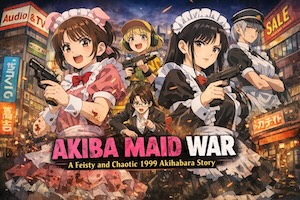
A maid cafe yakuza comedy that turns 1999 Akihabara into a battlefield
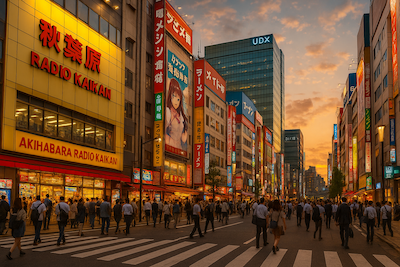
The story opens on a single scene set in 1985. Then the clock jumps forward, and Tokyo is suddenly wearing late-90s colors. Neon. chunky signage. bargain electronics energy. The kind of Akihabara that used to scream words like video, audio, calculators, locks, TV, and sale from giant rooftop boards.
That choice matters, because Akiba Maid War does not use Akihabara as a vague anime backdrop. It uses a very specific Akihabara, and it uses it with intention. The streets feel like an era. The storefront typography feels like an era. Even the quiet absence of later landmarks becomes part of the atmosphere.
Then the show hits you with its core concept.
A maid cafe story.
A gangster story.
Both at once.
In 1999 Akihabara.
The result is a dark comedy with a strange kind of sincerity. It is violent. It is ridiculous. It is unexpectedly affectionate toward maid work. And it is one of those rare anime that can feel like a parody and a tribute in the same scene without collapsing.
The author recommends it without hesitation.
- Why this setup works so well
- The central stage: Maid Cafe Ton Tokoton
- The menu is funny because it feels like real maid cafe marketing
- The 1999 Akihabara recreation is a hidden selling point
- The tone: dark comedy that still respects the craft
- The fights are not one-note
- Characters: a crew built for contrast, not realism
- References and collage humor, done the right way
- Who this anime is for
- A final note from the author’s Akihabara perspective
Why this setup works so well
The hook is not just maid plus yakuza. It is maid plus yakuza inside the social rules of Akihabara.
The series treats maid cafes like competing families. Protection money becomes a twisted version of business pressure. Friendly greetings become intimidation. Customer service becomes a weapon. And the city around them, that late-90s Akihabara, makes it feel oddly believable even when everything is clearly insane.
The show understands two truths at the same time.
One, maid work is performance.
Two, the city is performance.
When you set a power struggle inside a place built on performance, the comedy becomes sharper and the violence becomes more shocking.
The central stage: Maid Cafe Ton Tokoton
The main story follows a small, struggling maid cafe called Maid Cafe Ton Tokoton, a place whose concept leans hard into its pig theme. It is not a glamorous flagship. It feels like a shop barely holding itself together, which makes it the perfect setting for a story about pressure from above.
Inside, there is a compact stage for songs and dances, the kind of stage that instantly reminds long-time Akihabara visitors of how early maid spaces often tried to do everything in a small footprint. There is also a practical, slightly old-school service layout where food is passed through a small opening connected to the kitchen. Nothing about it screams luxury. It screams hustle.
Outside, recruiting customers happens through old-fashioned street flyer distribution, the kind of aggressive footwork that defined certain eras of Akihabara business. The show frames this as routine labor, not as a cute side gag. That detail matters because it makes the workplace feel real even when the plot is not.
Ton Tokoton is also placed inside a building that feels like a classic Akihabara stack. One floor can be an unrelated food shop. Another floor can be the workplace. Another floor can be staff housing. In late-90s and early-2000s Akihabara, that kind of building mix was common enough to feel familiar.
The cafe is part of a larger maid cafe group called <strong>Kedamono Land</strong>. Within that hierarchy, Ton Tokoton is treated like a weak link. That dynamic fuels the early story tension without requiring complicated exposition. You understand instantly: this is a small shop being squeezed by a bigger machine.
The menu is funny because it feels like real maid cafe marketing
Part of the charm is how the series builds a menu that feels like something a late-90s themed maid shop would actually write, with cute names designed to sound like rituals.
Ton Tokoton has signature items like a TonTon drink, a TonTon water with a silly myth attached to it, and beginner sets that include a two-shot cheki style photo, because the show knows that the photo is not just a bonus, it is a business pillar.
There are also items that sound like classic maid cafe staging, including an omelet dish that implies an illustration service, the kind of performative add-on that makes customers feel like they bought a moment rather than food.
Even if you never care about maid cafes, these details help the show feel grounded. The violence is more absurd when the workplace details feel correct.
The 1999 Akihabara recreation is a hidden selling point
If you lived through Akihabara’s transitions, the background work can hit harder than the jokes.
The series shows a version of Akihabara where certain later symbols simply do not exist yet. North of the Electric Town Exit, you do not see the modern Akihabara Daibiru skyline presence. You do not see the later era of themed landmarks like the now-closed Gundam Cafe. Instead, you notice open space and pedestrian structures that feel strangely fresh precisely because they look less commercialized.
That contrast creates a quiet time-travel effect. The show does not pause to explain it. It just lets you notice it.
It also sprinkles in signage and shop references that look very close to reality. You can catch names that clearly point toward familiar Akihabara staples such as Tsukumo, Laox, and AkibaO, along with a bookstore reference that points toward Melonbooks. The series uses these as background texture rather than fan-service spot-the-reference puzzles, which is why it works. The city feels inhabited rather than staged.
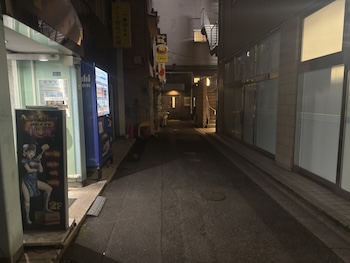
There is even a kind of messy street realism in small touches, like how garbage placement and utility poles are framed in the background. It is not glamorous. It is urban. That is exactly what the late-90s Akihabara vibe was, a place in transition, half electronics bazaar and half chaotic street ecosystem.
If you only want story, you can ignore this layer.
If you care about Akihabara as a place, this layer becomes a reward.
The tone: dark comedy that still respects the craft
A lot of violent comedies become lazy. They use shock as a substitute for writing.
Akiba Maid War does something more difficult. It keeps returning to the idea that maid work is still work. There are routines. There are customer expectations. There are small humiliations and small victories. There are nights where you do not want to smile, but you have to.
That respect is why the comedy lands. When a character performs a sweet greeting while the scene is clearly wired with danger, it is funny because the social rule is real. The show understands the mask. It understands the exhaustion behind the mask.
This is also why the violence hits harder. It violates a space that is built on controlled cuteness. The clash is the point.
The fights are not one-note
The action is not just random brawling. Different episodes lean into different kinds of conflict and staging. Sometimes the fights play like direct genre homage. Sometimes they shift into training arcs that feel like parody. Sometimes they turn into gambles and tests that feel like a brutal corporate game disguised as comedy.
The important part is that it does not feel repetitive. The series does not rely on one trick. It keeps changing the shape of the conflict, which keeps the audience alert even when the premise is already outrageous.
Characters: a crew built for contrast, not realism
The main cast works because each character is designed to collide with the others.
The author avoids plot spoilers here and focuses on what makes them effective on-screen.
Nagomi Wahei
Nagomi arrives in Akihabara with a simple dream. She wants to be a cute maid. That innocence becomes the perfect lens for the audience, because she reacts the way a normal person would react when the city turns out to be something else entirely. Her strength is not toughness at first. It is persistence. She keeps trying to stay positive even when reality keeps refusing her fantasy.
Ranko Mannen
Ranko is the hard edge. She has scars, discipline, and a soldier-like presence that instantly changes the temperature of a scene. She can switch from polite maid posture to lethal seriousness without warning, and that contrast becomes one of the show’s most memorable rhythms. She also carries the sense of someone returning to Akihabara with history behind her, which connects the character layer to the city layer.
Yumemi
Yumemi operates like a professional. On the surface she can perform cute, but there is calculation behind the smile. She reads situations fast and adapts. That makes her valuable in a story where charm can be both a tool and a trap. She also represents the kind of maid who understands the customer-facing game deeply and can weaponize it.
Shiipon
Shiipon brings a bold energy that feels very tied to the era. A sharper mouth, casual speech, and a kind of toughness that is not military, but personal. She feels like someone who survives by refusing to be intimidated. In a show full of forced politeness and ritual greetings, that attitude becomes a spark.
Zoya
Zoya adds a different flavor. She is a newcomer with an outsider rhythm, and her language style creates comedy without turning her into a disposable joke. Her presence also allows the show to play with communication, loyalty, and respect in a way that feels surprisingly human beneath the madness.
The Manager
The manager character is the type of person who talks like she is delivering life lessons, even when she is obviously a chaos engine. That is not just comic relief. It is a device. In a story about power structures, having a manager who keeps trying to frame survival as motivation talk creates a constant tension between what people say and what they do.
The cast works because each one holds a different relationship to the maid identity. Some characters believe in it. Some treat it like a job. Some use it like camouflage. When the plot escalates, those differences become emotional leverage.
References and collage humor, done the right way
Akiba Maid War is packed with nods to other famous anime and manga styles. The key is that the show does not stop and point at them. It uses them as a vocabulary. It shifts visual language and scene rhythm in a way that feels like the creators are having fun, but the story continues moving.
That is the right way to do homage. It becomes flavor, not distraction.
Who this anime is for
This series is not a gentle comfort watch. It is dark. It is loud. It is sometimes brutal.
But if you like any of the following, it will probably click.
You like Akihabara as a real place, and you want an anime that actually cares about the city texture.
You enjoy genre collisions, especially when comedy and violence are forced to coexist.
You like workplace stories, but you want one that does not pretend the workplace is safe.
You enjoy anime that commits to a ridiculous premise without apologizing.
If you hate violence entirely, it will not be for you.
If you enjoy hard-edged comedy that still understands human routine, it is worth trying.

A final note from the author’s Akihabara perspective
The most satisfying part is not only the jokes or even the shock. It is the feeling that someone on the production side actually looked at Akihabara as a layered place, not as a generic otaku theme park.
The late-90s signboards. The almost-recognizable shop references. The sense of streets that existed before certain modern landmarks reshaped the area. These details create a strange nostalgia even for people who did not personally live that era, because the city feels like it had a real past.
The author hopes this kind of Akihabara depiction continues, because every time anime treats the city with specificity, it becomes more than a backdrop. It becomes part of the story’s identity.
Quotation and reference
I quoted and referred to the information from this article.
We deeply consider and experience Japanese otaku culture!
[No spoilers] Review of the anime “Akiba Underworld War” Surprised by the blown setting!|akihabara.site Official
TV anime official HP:Akiba Maid War
All Write: Kumao
↓Click here for anime-related articles↓
・Detective Conan OVA Complete List (2026): All Episodes Explained, Timeline & Canon Status
・Detective Conan Movies: What TV Episodes to Watch Before Each Film
・MyAnimeList Top 50 Anime: A 2026 , I tried to consider it from the perspective of a Japanese geek
・Every Anime Set in Akihabara: The Complete Guide to Japan’s Otaku District in Anime
・The Haruhi Suzumiya TV Anime 20th Anniversary Project ExplainedHaruhi’s SOS Brigade
・Joins Sanrio Virtual Festival 2026: What’s Official, What’s Likely, and How to Watch
・Akiba Maid War Review With No Spoilers|Japanese anime
・Pokémon Lovers, Don’t Miss This! The Ultimate Guide to Japan’s Local Pokémon Across 47 Prefectures
・The 7 Biggest Mysteries About Satoru Gojo That Have Jujutsu Kaisen Fans Buzzing
・Jujutsu Kaisen Hidden References Explained Episodes 1–9, With a Japanese Fan Lens
・Jujutsu Kaisen Hidden References Explained Episodes 10–19, With a Japanese Fan Lens
・Sushiro x JoJo Collaboration Starts in Japan(akihahabara,sendai,koube,OSAKA,TOKYO)
・Demon Slayer Finale Begins! Infinity Castle Arc Hits Japan Amid TV Hype—When Will America and Europe See It?