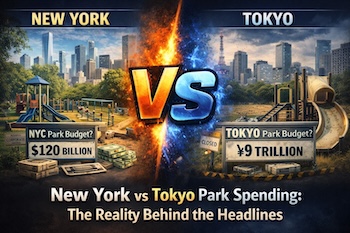
Urban comparison loves clean punchlines:
“New York spends like a nation.”
“Tokyo removes playground equipment.”
But the real story isn’t emotional. It’s structural.
This is a comparison of fiscal design, liability culture, and maintenance economics—not civic pride.
- Budget Scale: Are We Even Comparing the Same Thing?
- Why NYC Parks Get Upgraded So Often
- Why Tokyo Removes Equipment: A Rational Outcome Under a Different Constraint Set
- Revenue vs Silence: A Cultural Constraint With Fiscal Consequences
- Demographics: Infrastructure Follows Who Actually Lives There
- The Real Divergence: Risk Governance
- Long-Term Urban Implication
- FAQ
- Conclusion
Budget Scale: Are We Even Comparing the Same Thing?
New York City’s budget is routinely described as “state-sized,” and the numbers support that. Recent adopted budgets sit in the $110–$120B range.
Tokyo Metropolitan Government is also enormous, but “Tokyo’s budget” is often misread as one pot. Tokyo’s governance is split across the metropolitan government plus 23 special wards, each with its own budget responsibilities.
Recent reporting shows Tokyo’s budget totals can be around 9–10 trillion yen depending on fiscal year and accounting scope.
So yes—there’s a gap.
But the bigger difference is how the city is structured:
Revenue and transfers work differently: U.S. cities lean heavily on property-tax-driven models, while Japan relies more on intergovernmental transfers and shared frameworks (in practice, the structure matters as much as the headline total). So the gap is real — but governance models differ.
NYC operates as a unified municipal government with a massive central budget.
Tokyo’s “city core” is administratively distributed across 23 wards, with the metropolitan level handling some shared functions.
Why NYC Parks Get Upgraded So Often
New York’s park system is not funded as “pure public cost.” It’s frequently supported through hybrid funding:
- capital budget spending
- philanthropy
- corporate sponsorship
- conservancy models (the famous example is Central Park Conservancy)
- event revenue and naming-style arrangements
This produces a system where parks can be maintained not only by taxes, but by money streams attached to visibility and activation.
The other big factor is risk handling. In the U.S., litigation exists, but it is often treated as a managed cost: the system expects risk and tries to price it, insure it, and redesign around it, not erase it.
Why Tokyo Removes Equipment: A Rational Outcome Under a Different Constraint Set
Tokyo’s local park decisions are often shaped by:
- higher sensitivity to accident and complaint costs
- lower tolerance for injury claims (politically and administratively)
- demographic pressure (aging residents and changing child density patterns)
- limited “park monetization” expectations—parks are culturally expected to be quiet, free, and non-commercial
When the perceived equation becomes:
accident risk + complaint/response cost > perceived benefit
removal becomes the rational administrative choice.
This is not “laziness.” It’s risk minimization under budget and political constraints.
This is not laziness.
It is risk minimization under fiscal constraint.
Revenue vs Silence: A Cultural Constraint With Fiscal Consequences
In many U.S. contexts, parks can be “activated”:
- vendors
- events
- ticketed activities
- sponsorship signage
In Japan, parks are often expected to remain:
- quiet
- free
- neutral
- non-commercial
That expectation limits revenue options.
So maintenance becomes pure cost, not a cost offset by activation.
Demographics: Infrastructure Follows Who Actually Lives There
Central Tokyo wards often see:
- high single-occupancy ratios
- lower child density in premium areas
- aging residents
NYC has stronger family retention in certain boroughs and a different population inflow profile, which affects demand patterns for playground infrastructure.
Playground investment tends to follow population structure, not nostalgia.Playground investment follows population structure.
The Real Divergence: Risk Governance
The core split isn’t “rich vs poor.”
It’s risk management philosophy.
NYC logic: invest, insure, redesign.
Tokyo-ward logic: reduce exposure, simplify, remove.
One expands liability capacity.
One compresses it.
Long-Term Urban Implication
If playground removal continues alongside demographic decline:
- child-visible infrastructure decreases
- public play culture weakens
- urban family retention may drop further
But if activation increases without liability reform:
- budget strain rises
- political backlash increases
The question isn’t “who is better.”
It’s which governance model sustains vitality longer.
Which governance model sustains vitality longer?

FAQ
Q1. Why does Tokyo remove playground equipment?
Because risk exposure and complaint/response costs can outweigh perceived benefits under local constraints.
Q2. Why do NYC parks get upgraded more often?
Because hybrid funding (public + private support) and risk-bearing systems allow reinvestment and redesign.
Q3. Is this just “NYC is richer than Tokyo”?
No. The core difference is governance structure and risk management philosophy.
Q4. Do Tokyo’s 23 wards change the budget comparison?
Yes. Responsibilities and budget allocations are split across the metropolitan level and ward level.
Q5. Why does monetization matter for parks?
If parks can host revenue-generating activity, maintenance is offset; if not, it remains pure cost.
Conclusion
New York spends aggressively to maintain urban function and spectacle, backed by hybrid funding and risk-bearing systems.
Tokyo preserves stability by minimizing risk and cost under different cultural and administrative constraints.
Both are rational inside their systems.
And the emotional response people feel when they see empty playgrounds isn’t irrational either.
It’s a signal: a visible shift in what the city chooses to prioritize.

Quotation and reference
I quoted and referred to the information from this article.
We deeply consider and experience Japanese otaku culture!
|akihabara.site Official
Official Website of New York City (NYC.gov)
Official Website of the Tokyo Metropolitan Government (TMG)
All Write: Kumao