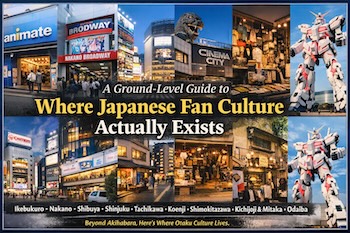
Akihabara is no longer the single answer to Tokyo’s pop-culture map. Today, it operates as one specialized gear inside a massive, citywide engine.
Tokyo’s otaku ecosystem has decentralized. Rather than forcing every fan into the same narrow alleys of Electric Town, the metropolis has naturally divided itself by subculture function, medium format, audience demographic, and event tempo. Where you should spend your morning, afternoon, and evening depends entirely on what you intend to hunt, experience, or carry back in your suitcase.
This is the definitive ground-level atlas of Tokyo’s physical fandom geography: a practical breakdown of how each district actually functions, what distinct rulebooks govern its sidewalks, and how to navigate the transit arteries connecting them all without losing half your shopping day to train transfers.
- Tokyo Otaku Hubs at a Glance: The Strategic Matrix
- 1. Akihabara: The Multi-Floor Vertical Dungeon
- 2. Ikebukuro: The Engineered Pedestrian Circuit
- 3. Nakano: The Indoor Archival Citadel
- 4. Shibuya: High-End Fashion and Fleeting Pop-Up Velocity
- 5. Shinjuku: Urban Scale and Cinema-Driven Encounters
- 6. Asakusabashi & Ueno: Production Crafting and Hybrid Showcases
- 7. Tachikawa: The Audiophile Cinema Pilgrimage
- How to Connect the Dots: The One-Day Subculture Loop
Tokyo Otaku Hubs at a Glance: The Strategic Matrix
| District | Core Specialization | Signature Landmarks | Best Matched For |
|---|---|---|---|
| Akihabara | Hardware, scale figures, retro gaming, card games | Radio Kaikan, Mandarake Complex, Surugaya | Deep solo hunting, bishojo, technical hardware |
| Ikebukuro | Josei-muke fandom, 2.5D stage plays, blind-box trading | Animate Flagship, K-BOOKS specialty wings, Otome Road | Character badge trading, collaboration cafes, group visits |
| Nakano | Archival toys, vintage animation cels, retro manga | Nakano Broadway, Mandarake thematic sub-stores | Nostalgic rarities, deep-cut oddities, vinyl collectors |
| Shinjuku | Event-driven pop-ups, premiere screenings, cinema | Shinjuku Wald 9, Piccadilly, Animate Shinjuku | Film premieres, late-night screenings, urban lifestyle mix |
| Shibuya | Trend crossovers, high-fashion collabs, fast pop-ups | Shibuya PARCO 6F (Nintendo TOKYO, Pokemon Center) | Mainstream flagships, stylish streetwear anime merch |
| Asakusabashi | DIY crafting supplies, display hardware, ita-bag parts | Kiwa Seisakusho Flagship, Parts Club | Custom badge displays, doll modification, bag crafters |
| Tachikawa | Acoustic cinema pilgrimage, relaxed community walking | Cinema City (Gokuon Sound System) | Audiophile anime viewing, stress-free movie marathons |
1. Akihabara: The Multi-Floor Vertical Dungeon
Akihabara remains the undisputed capital for hardware density, garage kits, scale figures, and PC component culture. However, the modern district does not present its true depth on the ground floor. To navigate Akihabara successfully, you must master the vertical dungeon crawl.
Directly outside the Electric Town Exit sits Radio Kaikan, a ten-story monument condensing dozens of independent specialty vendors into stacked compartments. Further along Chuo Dori and deep into Junk Street, shops like Mandarake Complex, Kotobukiya, and AmiAmi house massive inventories that cater to collectors seeking precision craftsmanship and rare card singles.
- Navigation Rule: Do not judge a shop by its street front. The most specialized vintage doujinshi and rare figure cases hide on the 4th through 7th floors of narrow, elevator-only buildings.
- Transit Pulse: Direct connectivity via the JR Yamanote, Keihin-Tohoku, Sobu lines, and Tokyo Metro Hibiya Line.
2. Ikebukuro: The Engineered Pedestrian Circuit
If Akihabara is an open-world hunt, Ikebukuro is an expertly designed walking loop built around character adoration, stage productions, and social fan gatherings. Emerging from the station’s East Exit leads immediately into Sunshine 60 Dori, terminating at the Animate Ikebukuro Flagship Store, one of the largest physical anime retail installations on earth.
Along Otome Road and the surrounding side avenues, K-BOOKS operates separate, highly compartmentalized outposts specifically segmented by media type: stage-play actors, voice artists, idol franchises, and doujinshi. This setup eliminates friction, letting collectors target exactly what they need while finding designated spaces to inspect acrylic character stands and trading badges.
For a detailed breakdown of how to travel directly between these two mega-capitals in just 20 minutes, explore our in-depth Akihabara vs Ikebukuro transit guide and cultural matrix.
3. Nakano: The Indoor Archival Citadel
Nakano does not concern itself with seasonal broadcast calendars or fast-moving social media trends. Inside Nakano Broadway, a residential-commercial complex that feels preserved from the early 1970s, culture is stored with museum-like gravity.
Mandarake commands over two dozen standalone micro-outposts across the complex’s 2nd, 3rd, and 4th floors. Each shop is rigorously quarantined by sub-discipline: production animation cels in one corner, vintage Sofubi vinyl monsters in another, discontinued retro console cartridges down a dark corridor, and antiquarian manga anthologies behind glass.
- Transit Hack: Board the JR Chuo Rapid Line from Shinjuku Station for a single-stop journey (approx. 5 minutes) straight to Nakano Station’s North Exit.
- Collector Advisory: Many specialty counters in Nakano Broadway open strictly between 12:00 PM and 8:00 PM; arriving before noon guarantees facing closed iron shutters.
4. Shibuya: High-End Fashion and Fleeting Pop-Up Velocity
Shibuya represents the intersection of subculture and mainstream consumer lifestyle. Rather than hunting through cramped, dusty back-alleys, visitors encounter anime, gaming, and VTuber culture through gleaming flagship showcases and brand collaborations.
The epicentre is the 6th floor of Shibuya PARCO (CYBERSPACE SHIBUYA), housing the official Nintendo TOKYO store, the Pokemon Center Shibuya, the Capcom Store, and the Jump Shop. Surrounding apparel outlets along the Shibuya slope regularly partner with active anime franchises for high-concept, limited-run street fashion that looks natural inside trendy cafes.
5. Shinjuku: Urban Scale and Cinema-Driven Encounters
Shinjuku does not cluster its fan retail into a single isolated neighborhood; instead, fandom operations are embedded directly into the city’s broader entertainment network. It functions primarily as a staging ground for screenings, theatrical stage greetings, and midnight media events.
Theatrical complexes such as Shinjuku Wald 9 and Shinjuku Piccadilly serve as critical cultural arenas where advance screenings, cast appearances, and themed concessions bring together huge crowds on Friday nights. Paired with a massive underground retail presence including Animate Shinjuku, it forms a natural hub for fans balancing nightlife, gourmet dining, and limited-edition movie goods.
If you plan to navigate Shinjuku’s sprawling rail complex during your tour, be sure to review our survival walkthrough on the ultra-rational method to master Shinjuku Station.
6. Asakusabashi & Ueno: Production Crafting and Hybrid Showcases
While the rest of Tokyo focuses on buying pre-finished commercial goods, Asakusabashi is where fandom is engineered by hand. Positioned just one station east of Akihabara on the JR Sobu Line, this wholesale trade district supplies the structural backbone of Japanese fan crafting.
Flagship craft supply outlets like Kiwa Seisakusho and Parts Club provide fabrics, clear display vinyl, clasps, ribbons, and decorative metals required to construct custom ita-bags and fan-made jewelry. Just north along the railway in Ueno, historic multilevel stores like Yamashiroya offer pristine figure displays and imported collectables, blending traditional downtown foot traffic with hardcore hobby curation.
7. Tachikawa: The Audiophile Cinema Pilgrimage
Located in Tokyo’s western suburbs along the JR Chuo Line, Tachikawa proves that geography follows acoustic passion. Fans routinely bypass massive downtown IMAX screens to travel out to Tachikawa Cinema City, famous among anime enthusiasts for its custom Gokuon (Explosive Sound) systems tuned specifically for theatrical feature animations.
Films with demanding sound design—such as mecha battles, musical masterworks, and cinematic action franchises—frequently enjoy theatrical runs spanning months longer here than in central Tokyo. The spacious, walkable suburban parklands surrounding the station provide quiet spots to unpack collector program books and converse away from the dense Shibuya crowds.
How to Connect the Dots: The One-Day Subculture Loop
To avoid spending the majority of your day trapped on train platforms or walking circles around station exits, follow this highly rational subculture transit arc designed to keep walking fatigue to an absolute minimum:
- Morning (10:00 AM – 1:00 PM): IkebukuroStart at the Animate Ikebukuro Flagship and browse Otome Road while foot traffic is manageable and midday lines have not yet formed.
- Early Afternoon (1:15 PM – 3:30 PM): Nakano BroadwayTake the Marunouchi subway line or bus link across to Nakano. Explore the vintage galleries and Mandarake outposts during their peak opening hours.
- Late Afternoon to Evening (3:45 PM – 8:00 PM): AkihabaraHop on the JR Chuo-Sobu Line directly from Nakano to Akihabara Station with zero transfers. Spend your dusk hours diving into Radio Kaikan and the neon-lit back alleys of Electric Town.
For an expanded look across the greater metropolitan area, see our full companion study on the Tokyo Anime City Guide 2026.
Written by Kumao