If you don’t have time, please click on the table of contents!
First of all, please ensure safety.
- A Practical Guide for Visitors Who Want to Enjoy the City Without Trouble
- 1. Kabukicho (Shinjuku)
- 2. Roppongi
- 3. Shibuya
- 4. Kinshicho
- 5. Ueno
- 6. Ginza
- 7. Akihabara
- What to Do If You’re Caught in a Rip-Off Situation
- Emergency Numbers
- Red Flags That Mean “Do Not Enter”
- Final Perspective
- Summary: How to Enjoy Tokyo Nightlife Safely
A Practical Guide for Visitors Who Want to Enjoy the City Without Trouble
Tokyo is often described as one of the safest major cities in the world. That reputation is largely true. Violent crime is rare, and most nights pass without incident for both locals and visitors.
And yet, every year, foreign travelers report the same types of problems in the same districts: unexpected bills, missing wallets, aggressive street approaches, and situations that escalate faster than expected.
These incidents are not random.
They follow patterns tied to specific nightlife areas, business models, and moments when visitors are tired, distracted, or unfamiliar with how things work locally.
This guide does not exist to tell you where not to go.
It exists to explain why certain districts generate more trouble for visitors—and how a small amount of awareness lets you enjoy Tokyo’s nightlife safely and confidently.
1. Kabukicho (Shinjuku)
Kabukicho is the largest nightlife district in Japan and one of the most intense. Restaurants, bars, host clubs, themed attractions, and late-night venues are packed into a dense grid of streets and multi-story buildings.
That density is what makes Kabukicho exciting—and what makes it risky.
With crowds constantly moving, it becomes easy for pickpocketing to go unnoticed. With hundreds of venues stacked vertically, it becomes easy to hide pricing behind doors that close once you step inside. And with a constant flow of tourists, first-timers are always available.
Where problems concentrate
In the northern sections around Golden Gai and Omoide Yokocho, the danger comes from crowd pressure. Tiny bars fill beyond capacity, personal space disappears, and valuables are exposed. Theft here is quiet, fast, and often discovered only later.
Closer to the central streets near Ward Office Street, the problem changes. This area is known for establishments that rely on unclear pricing and pressure tactics. Street promoters promise simple deals, guide visitors into upper floors, and allow costs to accumulate through seat fees, service charges, and unspoken rules. When the bill arrives, it bears little resemblance to what was described outside.
Late at night, the environment shifts again. Main roads stay bright, but side alleys empty quickly. If trouble happens there, help is harder to find, and communication becomes more difficult.
Kabukicho is not dangerous by default.
But it is unforgiving toward people who follow strangers or assume everything works the same way as daytime Tokyo.


2. Roppongi
Roppongi is international, which makes it feel easy. That’s also why it attracts people who assume visitors won’t know what is normal in Tokyo nightlife pricing.
Two different risk styles in one district
Club streets: pickpocketing, occasional drink tampering reports, aggressive touting.
High-end lounges: price shock via table charges, service fees, minimum spend, and menu ambiguity.
What makes Roppongi distinct
The pressure can be more physical than elsewhere—blocking your path, grabbing an arm, insisting you follow. Some touts are foreign, which can lower a visitor’s guard.
Practical habits that actually work
Watch your drink like you would at a festival. Keep your phone out of back pockets. If someone is pushy, disengage immediately—politeness is not a survival strategy.
3. Shibuya
Shibuya isn’t built around rip-off bars as much as it is built around crowds. The risk is the crowd itself: dense flows, intoxication, chaotic movement, and a high percentage of people with phones in hand.
Where trouble starts
Center Gai at night: bag snatching and pickpocketing, plus drunk arguments that flare into fights.
Clubs/live venues: theft spikes when attention drops—phones left on tables, bags left loose.
Major events (Halloween, countdown nights): extreme crowd pressure where harassment and theft increase.
The Shibuya mistake tourists make
Assuming “it’s Japan, it’s safe” and letting their guard drop in the loudest crowd in the country. Shibuya isn’t evil—it’s just a perfect place to lose track of your stuff.
4. Kinshicho
Kinshicho is the sleeper entry on this list because it doesn’t have the global “danger” branding of Kabukicho or Roppongi. It looks like a normal Tokyo station area—until you drift into the wrong side at night.
Why Kinshicho surprises visitors
South of the station, the nightlife footprint expands quickly. The area blends hostess bars, small drinking spots, and venues that thrive on late-night traffic. Tourists often pass through from nearby attractions (including Skytree-area routes) without realizing they’ve stepped into a nightlife zone that runs on a very different social script.
What scams look like here
Kinshicho approaches can feel casual—more like a local guy chatting than a polished tout. That’s the trap. The pitch is often low-pressure at the start:
“Just one drink.” “Cheap.” “Come see.”
Once inside, the pattern becomes familiar: unclear pricing, layered charges, and the psychological pressure of being seated in a venue where staff expect you to comply. Even if the establishment isn’t a full rip-off operation, you can still get hit with costs you did not anticipate—especially at places that use time-based charges or ambiguous “set” systems.
Why the environment can get rougher
Kinshicho is near areas associated with heavy drinking culture. People start drinking early, and by evening the mood can be louder and less patient. That increases the chance of arguments, uncomfortable encounters, and situations you do not want as a visitor.
How to handle Kinshicho smartly
If you’re not intentionally going out in Kinshicho, treat it like a transit area at night.
Avoid wandering south late. Stick to main roads and well-lit routes. If someone invites you into a venue, decline and keep moving—no debate.
5. Ueno
Ueno’s risk profile is not about organized scams. It’s about alcohol density + narrow lanes + crowd friction.
Why Ueno becomes messy at night
The under-the-tracks izakaya lanes are famous for cheap drinks and fast turnover. That creates a lively atmosphere—but also a setting where intoxication is the default.
In a packed narrow alley, one drunk person losing balance can trigger a chain reaction: spilled drinks, shouted arguments, shoulder checks, and a confrontation you never wanted.
The main problems visitors report
1) Getting pulled into fights by proximity
You don’t have to do anything wrong. Being the nearest foreigner in a loud argument sometimes makes you a target for misplaced frustration or attention.
2) Theft in crowd compression
Ueno is textbook pickpocket territory: narrow lanes, constant bumping, loud distractions, and people setting phones on small counters in standing bars.
3) Pushy sales energy around Ameyoko
Most places are normal. But a few lean into pressure tactics: “special menu,” unclear totals, or fast ordering that makes it harder to track what you agreed to.
The Ueno survival rules
Keep your bag in front. Don’t leave your phone on a counter.
If a group is shouting, do not watch—move away. Curiosity escalates risk.
6. Ginza
Ginza is not “unsafe.” Ginza is expensive in a way visitors do not recognize until it’s too late.
The key misunderstanding
Many travelers think a “scam” requires illegal behavior. Ginza’s biggest danger is that the bill can be legitimate while still feeling unreal.
Ginza nightlife includes a world built around introductions, corporate entertainment, and status pricing. In that world, the menu is not the full story. Charges stack through systems that are normal to insiders and shocking to outsiders.
How the money actually disappears
Costs often accumulate through:
- seat/table charges that apply automatically
- bottle systems that assume group ordering
- hostess drinks and service fees
- time-based structure where staying longer multiplies totals
You can walk in thinking you’re paying for a drink and discover you’re paying for an entire framework.
How to enjoy Ginza safely
If you want “Ginza at night” without bill shock, you have excellent options:
- hotel bars with clear menus
- street-level restaurants with prices posted
- casual bar streets nearby where the pricing style is more transparent
If a place feels like it’s not designed for walk-ins, believe that feeling and leave.
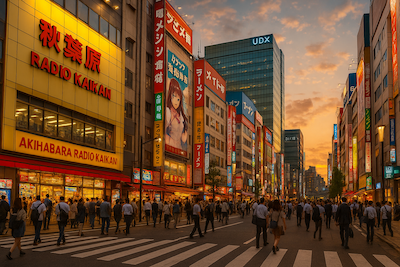
7. Akihabara
Akihabara’s danger is not street violence. It’s the nighttime monetization layer that looks cute from the outside and expensive from the inside.
What changes after dark
In the evening, street pitching for concept cafés becomes more visible. Staff in themed outfits can feel approachable and harmless—especially to first-time visitors who think they’re being invited to a normal café experience.
But many venues are not selling coffee. They are selling time, attention, and interaction.
How the pricing trap works in practice
The signboard pitch is designed to feel simple:
“Charge ¥500.” “All drinks ¥500.” “Cheap.”
Inside, the real system shows up through rules that were not clearly understood outside:
- the entry charge may cover only a short window (for example, the first 30 minutes)
- extensions are automatic if you don’t explicitly end the session
- there may be an expectation to buy staff drinks (often far above normal drink prices)
- paid extras like cheki photos can add several thousand yen per item
- “one more” becomes “one more 30 minutes”
None of this is always illegal. The problem is that visitors interpret it as a café, while the venue operates as a high-cost service model.
What to trust in Akihabara
Large, established chains and places with clear English explanations and posted rules are generally safer. The risk rises sharply when:
- a street staff member is pushy
- the venue is small, unknown, and upstairs
- pricing is spoken vaguely instead of shown clearly

The Akihabara rule
If you want a concept café experience, choose it intentionally—don’t let it choose you from the street.
What to Do If You’re Caught in a Rip-Off Situation
1) Do not escalate physically
Do not shove, swing, or try to push through people. That turns a money problem into a legal problem.
2) Do not agree to a huge payment under pressure
You can state that you dispute the amount. You can ask for a written breakdown. You can refuse to go to an ATM.
3) Use the sentence that changes the temperature
Say calmly: “I will call the police.”
Do not threaten. Do not yell. Just state it and begin acting on it.
4) Move toward public space
If you can get outside, do it. Once you are in a public area, your leverage improves dramatically.
5) Go to a koban
Police boxes are usually near major stations. Search koban on Google Maps. Officers deal with these situations regularly.
6) Contact your embassy for serious incidents
Especially for lost passports or situations involving injury or coercion.
Emergency Numbers
Police: 110
Japan Visitor Hotline: 050-3816-2787 (multilingual support)
Red Flags That Mean “Do Not Enter”
- Someone approaches you repeatedly after you say no
- Prices are not posted—only phrases like cheap, special, all-you-can-drink
- Upper-floor venue with no visible interior
- No credible Google Maps presence or reviews look artificial
- You are being guided by an unnamed “information center” that won’t clearly name the venue
Final Perspective
Tokyo nightlife is not dangerous by default.
It becomes risky when visitors enter systems they don’t understand—tired, distracted, and trying to be polite.
If you ignore street pitches, confirm prices before you sit, and keep your valuables secured in crowds, you avoid most problems. Then Tokyo becomes what it should be at night: energetic, unforgettable, and safe.
Summary: How to Enjoy Tokyo Nightlife Safely
Tokyo’s nightlife districts are not dangerous places to avoid.
They are places that require understanding.
Most problems faced by foreign visitors come from the same few patterns: following street touts, entering venues without clear pricing, losing awareness in crowded areas, or assuming that all districts operate the same way.
Each area has its own rhythm.
Kabukicho and Roppongi demand strict avoidance of touts.
Shibuya requires crowd awareness.
Ginza requires price awareness.
Akihabara requires understanding that some “cafés” are time-based service businesses, not casual coffee shops.
A small amount of knowledge changes everything.
Ignore unsolicited invitations.
Confirm prices before sitting down.
Stick to bright, busy streets late at night.
Do that, and Tokyo’s nightlife becomes what it should be: energetic, memorable, and safe.