A First-Hand Interview With a PC-98 Era Regular
“Was Akihabara really that different 20 years ago?”
If you’ve ever wondered what the district felt like before it became a global anime tourism hotspot, this article is for you.
The author, who has spent over a decade observing Akihabara firsthand, sat down with a hardcore regular who frequented the area around the year 2000. Online, he went by the name “98-shiki Mokélé” His handle references the NEC PC-98 computer series and a mythical cryptid—an appropriate metaphor for someone who “was everywhere in Akiba, yet never fully known.”
What follows is not nostalgia for its own sake.
It’s a comparison of two eras—and a discussion of what “Akihabara-ness” actually means.
Akihabara’s Identity: 2000 vs 2025
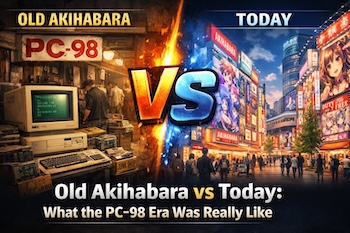
In 2025, Akihabara is globally recognizable. Anime billboards dominate Central Street. Concept cafés line side streets. Tourists stop for photos. Tax-free counters are standard.
But around 2000, according to our interviewee, the atmosphere was fundamentally different.
“It wasn’t a tourist destination. It was a place where otaku could just exist as themselves.”
Step out of the station, and you were surrounded by electronics parts shops and second-hand PC stores. The famous “Junk Street”—a cluster of narrow back alleys filled with used and broken hardware—was a rite of passage.
Cardboard boxes overflowed with components. The smell of dust and circuitry lingered. Nothing was curated. Nothing was sanitized. It was chaotic, unpredictable, and alive.
Today’s Akihabara feels outward-facing and media-conscious.
Back then, it felt like an inward-facing republic.
The Hardcore Routine: Hunting Junk Like Treasure
A typical day for a serious regular?
- Exit the station.
- Head straight to Junk Street.
- Dig through mountains of discarded PC parts.
“Junk” meant exactly that: broken, incomplete, or untested components. If it worked, you won. If it didn’t, you laughed and moved on.
You might find:
- A mysterious motherboard for 100 yen.
- A floppy disk drive with only the front panel intact.
- A discontinued graphics card buried in a cardboard bin.
Self-built PC culture was central. Shops like DOS/V Paradise and T-ZONE were pilgrimage sites. Lines formed early in the morning for new parts. Teenagers and middle-aged engineers stood shoulder to shoulder.
The rule was simple: self-responsibility.
If you bought something useless, that was part of the game.
In 2025, warranties and sealed packaging dominate.
In 2000, risk was the thrill.
Food in Akihabara: Survival and Status
Akiba food culture tells its own story.
As students, many regulars survived on convenience store bread and cheap cola—spending every possible yen on hardware or games.
For adults, however, one place symbolized arrival: Niku no Mansei.
The multi-floor meat restaurant near Manseibashi Bridge was half-jokingly described as a “class system.” The higher the floor, the more expensive the meal.
- Students ate gyudon at humble shops like “Sambo.”
- Working adults celebrated at Mansei.
- Event after-parties happened there.
Looking out over Akihabara at night from Mansei felt, in our interviewee’s words, like surveying “our kingdom.”
Food wasn’t just sustenance.
It reflected where you stood in life—and in fandom.
Legends and Chaos: Only in Old Akiba
Some stories sound unreal.
One day, a pile of unwanted PCs appeared in Junk Street with a sign: “Free—take them.” A spontaneous dismantling festival followed.
Another memory: closing sales where figure cases were emptied onto tables and divided among eager fans like war trophies.
And then there were the early internet meetups. Anonymous message board users would gather in person, recognizing each other through inside jokes and ASCII art references. It was one of the first moments when online and offline otaku culture fused seamlessly.
Akihabara was not just a marketplace.
It was a laboratory for emerging subculture.
The Unwritten Rules of Old Akiba
When asked whether there were “rules” back then, the answer was immediate.
Yes.
- Never mock someone’s niche hobby.
- Respect lines. No cutting.
- If someone behaved badly, veteran regulars would confront them directly.
- Differences in taste were normal. Depth of obsession was respected.
There was a strong sense of informal self-governance.
A feeling that “we protect this place.”
Even the so-called “paper bag culture”—walking proudly with character-branded shopping bags—symbolized that confidence.
Today’s Akihabara is more regulated, more global, and more observed.
But some of that old local cohesion has faded.
What Has Actually Changed?
The biggest visible shift is structural.
- Fewer parts shops.
- More anime retail and concept cafés.
- Tourism as a permanent layer.
- Safer, cleaner, more predictable.
But according to our interviewee, one thing has not disappeared:
“There’s always something you can only find here.”
That feeling—of discovery, of encounter, of shared obsession—is the core continuity.
What We Want to Pass On
In an era where almost everything can be purchased online, physical districts must offer something more than transactions.
Old Akihabara offered:
- Risk
- Community
- Serendipity
- A code of conduct
Modern Akihabara offers:
- Accessibility
- Global fandom
- Events and collaborations
- Visibility
The challenge is not choosing between past and present.
It is understanding what must remain.
Akihabara has always reflected its era—PC parts, visual novels, maid cafés, inbound tourism. Each layer builds on the previous one.
If the past was defined by “self-built culture,” perhaps the future depends on how consciously we preserve its spirit.
Akihabara is not just a district.
It is a place where personal mythologies are formed.
And that, more than junk parts or neon signs, may be its true identity.

Closing Note
This interview is only a fragment of a much longer conversation. More discussions will explore:
- Back-alley culture then and now
- New-generation Akiba spots
- What Akihabara might look like in ten years
If you have your own Akihabara memories—whether from 1999 or 2025—those stories are part of the district’s living archive.
Akihabara continues to evolve.
The question is not whether it has changed.

FAQ(Schema用)
Q1. What was Akihabara like before anime tourism?
It was centered around PC parts, junk hardware, and self-built computer culture rather than anime retail.
Q2. What is the PC-98 era in Akihabara?
It refers to the period when NEC’s PC-9800 series dominated Japanese computing and Akihabara thrived as a hardware hub.
Q3. Why was Junk Street important?
It symbolized the risk-and-reward culture of old Akihabara, where broken parts could become rare finds.
Q4. Is modern Akihabara completely different?
While tourism and anime retail dominate today, the spirit of niche discovery still remains.
Quotation and reference
I quoted and referred to the information from this article.
We deeply consider and experience Japanese otaku culture!
[Dialogue] Akihabara Otaku Chronicles! The identity of “Akihabara style” told by the people of 2000 x modern Akiba people|akihabara.site Official
All Write: Kumao
↓Please dig deep into Akihabara-related articles!↓
Akihabara Timeline (1990–2019): How Tokyo Became the World’s Top Otaku CityAkihabara People Watching: Strange Voices from a Quiet Cafe
Akihabara Travel Story: The Anime Umbrella Theft That Froze the Room
In 2022, when Akihabara was full of vacant tenant → Verify what happened nowAkihabara Travel Story: The Anime Umbrella Theft That Froze the Room
Akiba Maid War Review With No Spoilers|Japanese anime
Akihabara vs Ikebukuro |Two Otaku Capitals, Two Completely Different Rulebooks
Recommended Women’s Complete Guide | Ikebukuro and Akihabara Street Walking Saved Version
Introducing the trends and stores of Akihabara ramen shops.
Akihabara Lucky Bags 2026
Is Akihabara Past Its Prime? Inside the now Shift of Japan’s Otaku Capital
Akiba Shrines: Between Circuits and Silence — The Hidden Spiritual Layer of Tokyo’s Electric Town
Akihabara: From Radio Parts to Otaku Sanctuary—A Journey Through Japan’s Electric Town