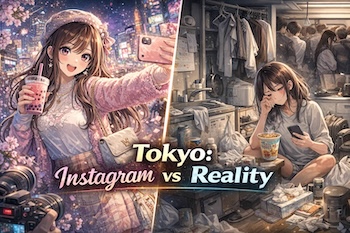
Tokyo is one of the most photographed cities in the world.
Shibuya crossings.
Roppongi rooftops.
Azabu cafés.
Odaiba sunsets.
Marunouchi office life.
On social media, it looks like everyone lives inside a luxury postcard.
But what does everyday life actually look like for young professionals in Tokyo?
This is not an attack.
It’s a structural look at how the city really works.
Imagine the otaku soul that is recommended in this environment.
The Tokyo You See Online
Scroll through Instagram or X and you’ll see:
- “Living my Shibuya life.”
- “Roppongi nights.”
- “Marunouchi office girl.”
- “Azabu coffee break.”
The background is always:
- Glass towers
- Designer cafés
- Polished urban aesthetics
Tokyo, framed as elite and effortless.
But social media shows where people visit, not necessarily where they live.
Where Many Young Workers Actually Live
Most early-career workers do not live in central luxury districts.
Common residential areas include:
- Koto Ward
- Kasai / Nishi-Kasai
- Nakano
- Kita Ward
- Musashino
- Edogawa side neighborhoods
Typical setup:
- 20–25㎡ studio apartment
- Rent: ¥90,000–¥110,000
- Unit bath
- Minimal storage
- Thin walls
- Compact kitchen
Stylish photos are taken carefully:
- IKEA mirror
- MUJI rug
- Ring light
- Clean angle
The rest of the room? Not always shown.
This isn’t deception—it’s curation.
The Commute Reality
“Working in Minato Ward” sounds glamorous.
But for many, it means:
- Tozai Line at 6:50 AM
- Chuo Line at 7:30 AM
- Keiyo Line crush hour
- Hibiya Line at peak compression
Tokyo’s economic structure concentrates jobs in the center,
while housing affordability pushes residents outward.
The result:
A daily migration of bodies into high-density office districts.
This isn’t a moral failure.
It’s urban design.
The Financial Breakdown
Let’s look at a realistic early-career monthly take-home:
Net income: approx. ¥230,000
Expenses:
- Rent: ¥110,000
- Transportation: ¥15,000
- Phone: ¥10,000
- WiFi: ¥5,000
- Food: ¥50,000
- Clothing / cosmetics: ¥20,000
- Socializing: ¥20,000
- Beauty / grooming: ¥10,000
Remaining balance: minimal.
This is not poverty.
But it is pressure.
Tokyo’s young workforce often trades:
- Time
- Space
- Savings
For proximity to opportunity.
Why the “Central Tokyo Persona” Exists
Here’s the key point.
Tokyo is status-coded by district.
Saying:
- “I work in Minato.”
- “I was in Roppongi last night.”
- “Lunch in Marunouchi.”
Carries symbolic weight.
Even if you don’t live there.
In hyper-dense cities, location becomes identity.
And social media amplifies that identity.
It’s not fake.
It’s aspirational branding.

The Structural Issue Beneath the Surface
This pattern connects to broader urban realities:
- Employment centralized in core wards
- Affordable housing pushed outward
- Long commutes normalized
- Limited disposable income
- Delayed family formation
Tokyo functions efficiently.
But efficiency has a human cost.
And that cost is often invisible behind skyline photos.

The Real Tokyo Is Not a Lie
Important clarification:
Most young Tokyo residents are not pretending.
They:
- Work hard
- Commute long hours
- Save what they can
- Enjoy the city when possible
The “illusion” is not fraud.
It’s compression.
Tokyo compresses:
- Space
- Time
- Identity
- Aspiration
And social media simply reflects that compression.

Final Thought for Overseas Visitors
If you visit Tokyo, understand this:
The neon districts you see are economic engines.
The people serving coffee, working in towers, or meeting you at events likely live somewhere quieter, smaller, and farther out.
Tokyo’s glamour rests on a vast commuter ecosystem.
That doesn’t make it broken.
But it makes it complex.
Understanding that complexity makes you see the city more clearly.