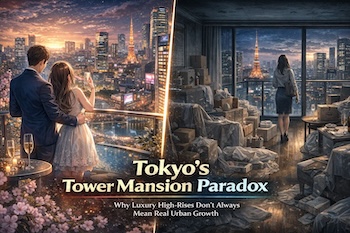
Tokyo’s skyline keeps rising.
Glass towers.
Premium residences.
Instant sell-outs.
From the outside, it looks like urban success.
But beneath the surface, Tokyo’s high-rise boom reveals a structural contradiction.
This isn’t conspiracy.
It’s urban economics.
Sold Out Doesn’t Mean Lived In
New tower mansions in central Tokyo often sell out quickly.
But buyers are frequently:
- Investment investors (domestic and overseas)
- Wealthy households using units for tax positioning
- Asset diversification buyers
- Occasional-use secondary home owners
In many cases, purchase does not equal primary residence.
This creates a phenomenon urban scholars describe globally as:
“Vertical vacancy.”
Apartments exist.
Ownership exists.
But daily life does not.
The High Floors Are Often Financial Instruments
In many luxury towers:
- Upper floors command the highest prices.
- Views are marketed as prestige.
- Units are traded before occupancy.
But long-term residents—especially ultra-high-net-worth individuals—often prefer:
- Lower floors (easier access)
- Low-rise properties
- Detached homes in quiet wards
Why?
Practical reasons:
- Elevator wait times
- Earthquake sway perception
- Evacuation concerns
- Maintenance fees
- Limited long-term family usability
High floors are frequently investment-grade containers, not homes.
The Illusion of Dense Urban Population
Policy logic suggests:
More high-rises → More residents → More tax base → More families.
Reality is more complicated.
Observed patterns in central Tokyo districts:
- High share of single-occupancy units
- Smaller average household sizes
- Lower child population ratios compared to suburban family zones
- Noticeable unit vacancy at premium tiers
This does not mean towers are empty.
It means density does not automatically equal demographic renewal.
Urban growth statistics can mask lifestyle fragility.
Who Actually Fills Tokyo’s Workforce?
Tokyo’s labor system relies heavily on:
- Young migrants from regional Japan
- Early-career workers in small rental units
- Long commuter corridors feeding the central wards
Affordable housing near business cores remains limited.
So the pattern becomes:
Work in Minato or Chiyoda.
Live in outer wards or satellite cities.
Commute daily.
This is not uniquely Japanese—
but Tokyo’s scale makes it extreme.
Housing, Family Formation, and Urban Pressure
Research consistently shows:
- Smaller living space correlates with delayed marriage
- High housing costs correlate with delayed childbirth
- Long commute times correlate with lower family satisfaction
Central Tokyo units are often:
- 20–30㎡ studios
- Not designed for multi-child households
- Expensive relative to income
Families frequently relocate outward once children are born.
Thus:
Urban core = economic engine
Suburbs = demographic base
The two do not align.
Is Tokyo Becoming a “Vertical Ghost Zone”?
Globally, cities like:
- New York
- Vancouver
- London
- Hong Kong
Have documented cases where luxury high-rises show low nighttime occupancy.
Tokyo has not reached extreme ghost-tower levels seen elsewhere.
However, the structural ingredients exist:
- Investment-driven purchases
- Wealth parking
- Limited primary residence use in premium units
The risk is not emptiness.
The risk is imbalance.

The Structural Tension
Here is the core paradox:
Central Tokyo is treated as a residential success story.
Yet it functions primarily as:
- Employment hub
- Financial storage zone
- Prestige geography
Not as a stable, family-oriented living ecosystem.
That distinction matters.

Final Thought
Tokyo is not collapsing.
It remains one of the world’s safest, most efficient megacities.
But prosperity and sustainability are not the same thing.
When housing becomes more financial instrument than home,
cities shift from living systems to capital systems.
And that shift changes everything.

All Write: Kumao