If you watch Japanese TV around New Year, you will probably see the same cheerful scene.
A crowded street. Smiling tourists. A narrator voice saying Japan is amazing. Inbound travel is booming. Everyone looks happy.
When the camera cuts to Kappabashi in Tokyo, the story usually becomes even sweeter. People are shopping for knives, bowls, chopsticks, and gifts that feel deeply Japanese.
But sometimes, instead of joy, you feel something else.
Not anger. Not hatred. Not even suspicion.
You feel sorry.
Because you can see the moment a tourist buys a beautiful dream in the wrong place, at the highest possible price, with the purest intentions.
And nobody tells them.
- The moment that made the whole thing hurt
- Kappabashi in one honest sentence
- The big misunderstanding that costs tourists money
- Why the shops look Japanese even when the products are not
- The hidden cost: you are buying a story without realizing it
- The knife exception: when Made in Japan truly matters
- So what should you buy in Kappabashi
- And what you should not buy there if your goal is tradition
- A smarter path: keep the magic, stop the regret
- Why Japanese TV coverage feels uncomfortable
- A small checklist for tourists before buying
- The honest ending
The moment that made the whole thing hurt
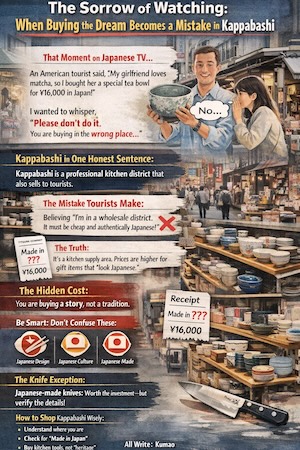
In one TV segment, an American tourist said something like this.
His girlfriend is into matcha. He wants to bring her a special tea cup from Japan.
He picks up a tea bowl with a traditional look. The price tag is 16,000 yen.
He smiles, proud of his choice, because to him it feels like Made in Japan culture, wrapped and ready to gift.
At that moment, I did not feel angry at the shop.
I felt embarrassed on behalf of Japan.
I wanted to whisper one thing.
Please do not do it. You are buying in the wrong place.
Not because Kappabashi is bad.
Because Kappabashi is not what you think it is.
Kappabashi in one honest sentence
<strong>Kappabashi is a professional kitchen supply district that also sells to tourists.</strong>
That is it.
It is not a museum of Japanese craftsmanship. It is not a sacred street of tradition. It is not a guaranteed Made in Japan zone.
It is a place built for restaurants, cafes, bars, and small businesses to buy equipment, tools, plates, packaging, and supplies.
Tourists are welcome, and many shops serve them politely. But the core logic of the district is still business supply.
If you shop there thinking you are walking through pure Japanese tradition, you are carrying the wrong map in your head.
The big misunderstanding that costs tourists money
Many travelers believe a simple rule.
Wholesale district equals cheap.
That rule can be true in the business world.
But tourists are not buying like businesses.
A wholesale district works best when you buy in quantity, with the right connections, or with a business account, or when you understand the supply chain.
Tourists usually do the opposite.
They buy one item at a time.
They buy the most giftable version.
They buy the one with English support.
They buy the one that looks most Japanese.
They buy the dream edition.
This is not a scam. This is normal pricing logic.
<strong>You are not being tricked. You are just paying the highest retail version of a business product.</strong>
Why the shops look Japanese even when the products are not
Here is another truth that feels uncomfortable until you accept how modern manufacturing works.
A lot of items sold in Japan are imported. Many are made in China, Vietnam, Thailand, or other countries. Even when the design is Japanese, the production can be overseas.
This is not unique to Japan. It is global.
The problem happens when tourists mix up three different ideas.
Japanese design
Japanese culture
Japanese manufacturing
A product can express Japanese culture and still be manufactured abroad. A product can be designed in Japan and still be produced in an overseas factory. A product can be sold in Japan and still not be Made in Japan.
In a tourist district, packaging and aesthetics become part of the product.
Brush-style labels. Minimalist boxes. Traditional patterns. The visual language of Japan.
This is not evil. It is marketing.
But if you want the meaning of Made in Japan, you have to look for it directly.
The hidden cost: you are buying a story without realizing it
This is the part that hurts the most, because the tourist is not greedy.
They are sincere.
They want to respect Japan. They want to bring something meaningful. They want the gift to carry memory and care.
So they buy narrative.
The problem is that the narrative looks like manufacturing.
Kappabashi is great at selling objects that feel Japanese. It is literally built for selling objects that look right in a restaurant.
But if you confuse Japanese atmosphere with Japanese tradition, you can end up paying premium prices for a story you did not mean to buy.
Again, not a scam.
Just the wrong dream.
The knife exception: when Made in Japan truly matters
Now the important nuance.
Not everything in Kappabashi is imported, and not every tourist purchase is a mistake.
And one category deserves special attention.
Knives.
High-quality Japanese kitchen knives are real, and certain manufacturing regions have long histories and specialized craft.
A good knife can be a perfect purchase.
But this is exactly why tourists should be careful. Because knives are where the gap between dream and reality can be the most expensive.
Some shops are deeply legitimate and knowledgeable. Some are more like retail counters selling what looks right. Some product lines are authentic. Some are mass-produced. Some brands are transparent. Some are vague.
The solution is simple, but most tourists do not do it.
Ask clear questions. Check origin labeling. Understand what you are buying.
A serious knife shop will explain steel type, maintenance, and sharpening. A shop selling you a fantasy will focus on the romance first.
Romance is fine. But with knives, facts matter.
So what should you buy in Kappabashi
Kappabashi is excellent for certain types of shopping, especially if you accept what the district is.
It is strong when you want practical Japanese lifestyle tools, restaurant-style presentation items, or fun kitchen culture.
Here are the kinds of purchases that usually make sense.
Everyday kitchen tools
Professional-grade utensils and gadgets
Plates and bowls that are meant for daily use, not ceremony
Packaging supplies, bento accessories, small storage items
Fun novelty items that you understand as souvenirs, not heritage
If you treat Kappabashi as a high-quality kitchen district with a huge selection, it becomes a paradise.
If you treat it as a spiritual temple of Made in Japan tradition, you will get confused and overpay.
And what you should not buy there if your goal is tradition
This is where the 16,000 yen matcha gift story belongs.
If your goal is Japanese tradition, not Japanese vibe, you should be cautious about buying these categories in Kappabashi as your first choice.
Tea ceremony items, unless you know what you are doing
Craft objects where provenance matters
Anything you are buying mainly because you believe it is Made in Japan without checking
Kappabashi can still have good options, but it should not be your default location for cultural heritage shopping.
It is a kitchen supply district.
Respect it for what it is.
A smarter path: keep the magic, stop the regret
Here is the best approach for American and European visitors who want gifts that are both meaningful and smart.
Step 1: Decide what you are actually trying to buy
Are you buying function, aesthetics, or provenance
A gift can be any of these, but you must pick honestly
Step 2: If provenance matters, verify it
Look for origin labeling
Ask the staff directly where it is made
If the answer is vague, treat it as not proven
Step 3: Match the product to the right district
Kappabashi is for kitchen tools and restaurant supply culture
Other districts are better for crafts, tea culture, and heritage objects
Step 4: Stop thinking cheap equals authentic
Authentic can be expensive
Cheap can be imported
High price can still be mostly narrative
Step 5: If you still love it, buy it anyway
But buy it consciously
That is the difference between regret and satisfaction
This is the key moral point.
<strong>Buying a story is not stupid. Buying a story by accident is what hurts.</strong>
Why Japanese TV coverage feels uncomfortable
Japanese media often treats crowd size as success.
More tourists equals good news.
But crowd size does not tell you whether visitors are learning, whether they are buying smart, or whether they are quietly being steered into the most expensive version of their own dream.
Everyone smiles.
Nobody asks whether the story makes sense.
That is why, when you see the New Year Kappabashi coverage, you can feel a strange shame.
Not because Japan is bad.
Because Japan is letting polite visitors misunderstand the country in the most predictable way.
A small checklist for tourists before buying
Before you buy anything that you believe is a cultural object, pause and ask yourself these quick questions.
Am I buying this because it is beautiful, or because I believe it is Made in Japan
Did I confirm origin, or did I assume based on aesthetics
Is this a kitchen supply product, or a traditional craft object
Would I still pay this price if it was not from Japan
Am I okay paying for the story
If you can answer these cleanly, your purchase is probably fine.
If you cannot, step away for five minutes. Walk. Compare shops. Re-check your intention.
That alone will save you money and regret.
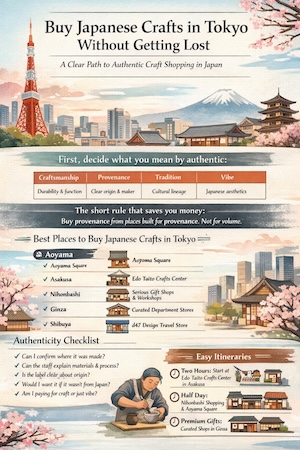
↓As a sequel, we released a Tokyo guide to buy Japanese crafts without hesitation. Please refer to it.↓
The honest ending
Kappabashi is not fake.
It is not a scam.
It is a real district with a real purpose.
But many tourists walk into it carrying a fantasy map of Japan, and the district sells them what their map expects.
The saddest part is that the tourists are not careless.
They are generous.
They want to give love in the form of Japanese culture.
And that is why it hurts to watch them pay 16,000 yen for a gift that might be more atmosphere than tradition, simply because nobody told them where they were standing.
So here is the truth, said with kindness.
Kappabashi is not the wrong place to buy things. It is the wrong place to buy a dream without checking what the dream is made of.
If you still want to buy that tea bowl after knowing all this, then it might truly be worth 16,000 yen to you.
Just do not confuse Japanese vibes with Japanese tradition.
And do not let a smiling TV segment convince you that a crowd means you are shopping smart.
All Write:Kumao

↓We also introduce the deep city of Tokyo!↓